The OpenAI Codex team is not merely building an AI coding agent. It is also using that agent to compress the way product work gets done: product managers submit pull requests, designers write production code, engineers explore requirements directly against the repository, and formal specifications are reserved for the coordination problems that genuinely need them.
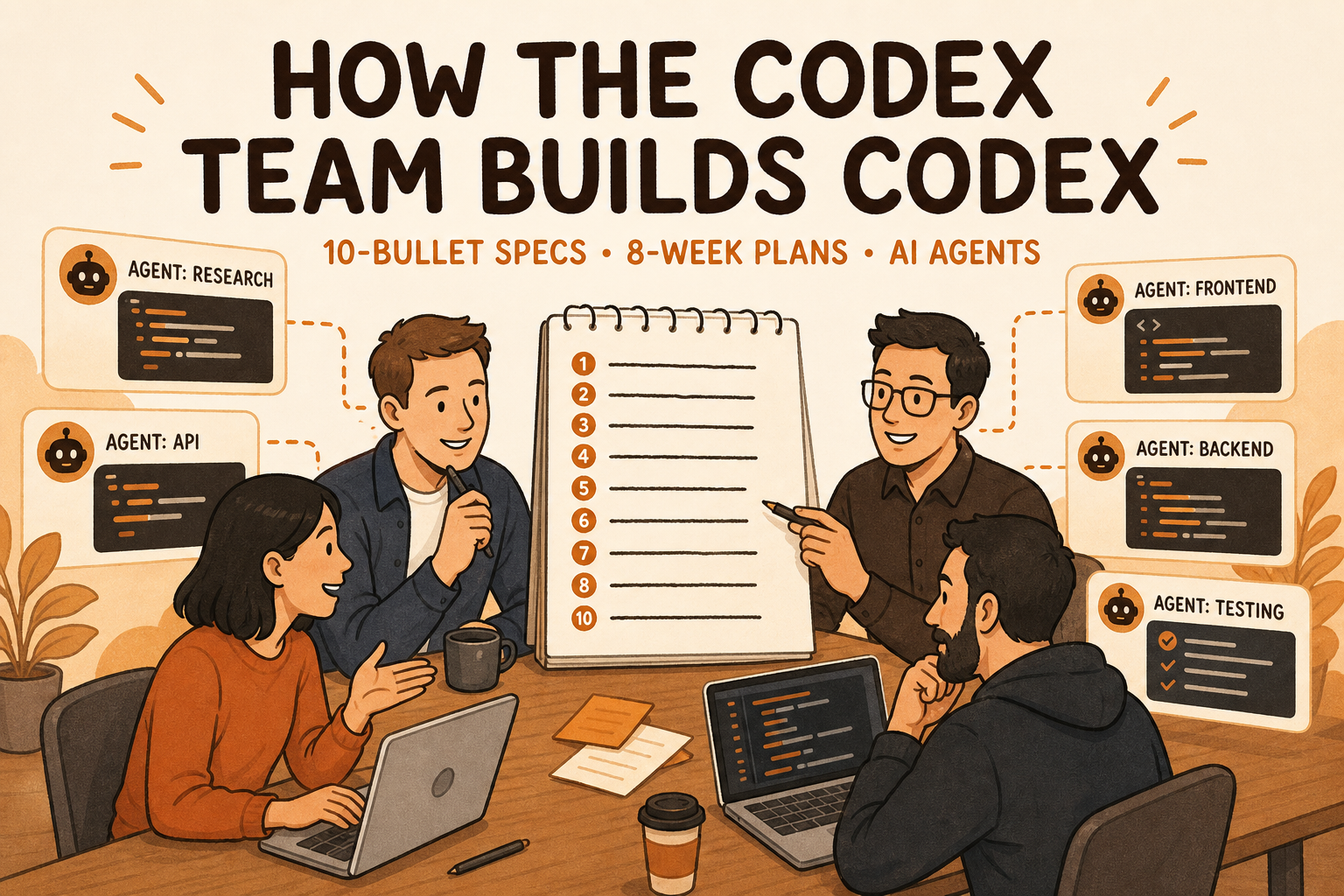
That is the central lesson from a 43-minute Behind the Craft interview with Codex product lead Alexander Embiricos and OpenAI developer-experience lead Romain Huet. The most repeated headline from the conversation—“the entire Codex product has a ten-bullet spec”—is too strong. What Embiricos actually said was that the team writes very few specs and, when one is needed, it may be only “like 10 bullets or something.”
The distinction matters. The Codex approach is not “never document.” It is to delay documentation until the work exceeds what one empowered owner, working with an agent, can understand and execute.

What the OpenAI Codex Team Revealed
The interview describes an operating model built around five linked ideas:
- Write a spec only when complexity or coordination requires one.
- Plan concrete work for no more than about eight weeks, while keeping a looser long-term direction.
- Let the people closest to the code make more decisions.
- Treat product management as missing-work coverage, not automatic command authority.
- Hire for agency and evidence of shipped work.
These are statements about one unusually technical, fast-growing team. Some details—such as the approximate team size or comparisons between designer and engineer output—are anecdotes from the speakers, not independently audited productivity metrics. The useful question is therefore not whether every company should copy Codex, but which conditions make this model viable.


Why Codex Uses 10-Bullet Product Specs
Traditional product development often separates discovery, requirements, design, implementation, and validation among several roles. Each handoff creates a need for more explicit documentation. Codex changes the economics of those handoffs because a single person can ask an agent to inspect the repository, trace dependencies, propose options, implement a small change, run tests, and prepare a pull request.
Embiricos said the team writes a spec when the problem becomes too large for one person to hold in their head or when several people need to coordinate. Even then, the document can be extremely short. The objective is not completeness for its own sake; it is enough shared context to unblock a decision.
Huet demonstrated the same principle through Codex Plan Mode. He pointed the agent at an iOS project and asked what the team should build next. Rather than starting from a blank planning template, the agent inspected the actual codebase and proposed directions grounded in the product’s current state.
This shifts product discovery closer to executable evidence. A plan can be challenged against code, tests, interfaces, and technical constraints before a large group commits to it.

How PMs and Designers Use Codex to Explore Ideas
Embiricos described three practical modes for a product manager:
- For a small change, submitting a good pull request may be faster than negotiating for engineering priority.
- For a medium-size change, Codex can produce an implementation plan for review.
- For a vague or complex idea, the agent can explore the repository and help the PM build a mental model—even if the generated implementation is never shipped.
That third mode is the most important. The output is not always code. It can be better questions, clearer trade-offs, or an explanation that helps an engineer understand why a direction matters.
The interview also claims that Codex designers now contribute more code than an engineer did six months earlier. That should be read as a qualitative observation from the product lead, not a benchmark. The broader point is credible: once generating a working change becomes easier, role boundaries move. The scarce work becomes selecting the right change, defining quality, reviewing behavior, and owning the result.
The team says most of its code is agent-generated, yet it does not present this as carefree “vibe coding.” Humans still provide system design, judgment, verification, and accountability. Teams adopting the same pattern need authority controls for AI coding agents so that faster execution does not silently expand risk.

Why OpenAI Plans for Eight Weeks—or the Distant Future
Embiricos relayed advice from an OpenAI researcher named Andre: plan near term or long term, but avoid the middle. He described near-term planning as a concrete goal with an absolute maximum horizon of roughly eight weeks. Long-term planning is more directional: assume models become more capable, more tasks can be delegated, and many agents can work in parallel.
The missing middle is a conventional feature roadmap. When model behavior changes rapidly, a detailed six-month sequence can encode assumptions that expire before the work begins.
This was presented as advice that shaped the Codex team—not as a formally published OpenAI policy. It also has limits. A regulated product, hardware program, enterprise migration, or multi-party launch may require commitments far beyond eight weeks. The transferable principle is to match planning detail to the stability of the underlying constraints.

How Parallel Agents Led to the Codex App
The Codex desktop app illustrates how product direction, model capability, and user behavior interacted.
OpenAI released GPT-5.2-Codex on December 18, 2025, describing it as optimized for long-horizon work, context compaction, large refactors, and reliable long-running tasks. Embiricos said this generation crossed an important practical threshold: users could delegate longer tasks and expect more one-shot completions.
Advanced users responded by running many terminal sessions in parallel. In the interview, Embiricos approximated one widely shared setup as “like 18 terminals” across three displays. The desktop app made that multi-agent pattern visible and manageable for people who would not build a tmux command center.
But model progress did not create the app idea from nothing. Embiricos also described discussing a delegation-oriented interface with Peter Steinberger in October, before GPT-5.2-Codex shipped. The more accurate causal story is that better models and observable power-user behavior validated and accelerated an existing direction.
OpenAI launched the Codex app for macOS on February 2, 2026, later adding Windows. The official launch post said Codex usage had doubled since the mid-December model release and that more than one million developers had used Codex in the preceding month. By March 19, OpenAI reported more than two million weekly active Codex users.

Why Power Users Shape the Product Roadmap
Codex is unusually exposed to its most advanced users because its core is open source. Users can inspect code, enable experimental behavior, fork the project, and develop workflows before the product team has simplified them for a broader audience.
That makes power users an early-warning system for product demand. It can also make the product inaccessible if every advanced control is promoted into the default interface.
The team’s answer is layered design: keep the core interaction minimal, provide sensible standard behavior, and let experts discover configuration, forks, and experimental features over time. The metaphor in the interview was a game that reveals deeper mechanics as the player progresses.
This is a stronger strategy than simply copying whatever power users do. The team watches the frontier, identifies repeated behavior, then decides which parts deserve a safer and simpler product surface.

Inside the Codex Team's “Pirate Ship” Operating Model
When Yang suggested the Codex group had roughly 50 to 100 people, Embiricos said that sounded about right. He also said the rapidly growing team had only recently added a second product manager and intentionally operated a little like a “pirate ship,” with limited cross-functional alignment and simple reporting lines.
He described switching between two modes. In execution mode, he uses Codex to understand feedback, inspect the repository, prepare changes, and help the team launch. In coordination mode, he spends more time forming direction and communicating trade-offs.
This structure works partly because the builders are also users. Engineers, designers, and PMs can evaluate the product through daily experience, while an active open-source community supplies constant external feedback. A team serving unfamiliar users, complex buyers, or multiple regulated stakeholders cannot assume the same degree of shared intuition.

Codex as a Developer-Platform Entry Point
Huet argued that Codex is becoming an entry point to the broader OpenAI developer platform. Instead of publishing only hand-written integration guides, developer-experience teams can package knowledge as Skills and teach builders to use Codex to work with image generation, Sora, speech-to-speech systems, APIs, and external tools such as Linear.
This idea expands Codex from a code generator into an orchestration surface: the agent can read documentation, modify an application, run commands, and connect the developer’s intent to several platform capabilities.
The architecture supports that direction. The open-source Codex repository is primarily Rust, and its documented core contains shared business logic. The app-server documentation says it powers rich interfaces such as the VS Code extension. In the interview, Huet said the desktop app, IDE extension, and CLI communicate with the same open-source harness.
For readers who want the command-line foundation, the Codex CLI guide explains the lower-level workflow. Teams coordinating several agents should also consider a file-first multi-agent collaboration protocol so that parallel work remains inspectable.

Is AI Eliminating the Product Manager Role?
Embiricos offered the interview’s most provocative position: he sees product management as a gap-filling role rather than inherently a leadership role. As agents let engineers, designers, and PMs perform more of one another’s work, the gaps change.
The useful interpretation is not “fire every PM.” Embiricos explicitly preserved a place for people who spend serious time with users, understand a market, and operate in a sufficiently large organization. Every problem still needs an owner; the owner does not always need the PM title.
Huet recalled that Stripe reached about 250 employees with no PMs before modern AI tools, because engineers were building an API they personally wanted to use. That is an interview recollection rather than a separately audited staffing record, but it highlights the dependency: the closer builders are to users and the product, the less translation work is required.
AI compresses the talent stack most effectively when people possess judgment outside their original role. A PM who can inspect code, a designer who can ship an implementation, and an engineer who can interview customers can make decisions with fewer handoffs. But eliminating coordination without distributing those skills merely hides the work.

What Other Product Teams Can—and Cannot—Copy
Most teams can copy the mechanics before copying the organization:
- Give one owner an agent and access to the real repository.
- Ask for a plan grounded in code before scheduling a large planning meeting.
- Let non-engineers prepare small, reviewable pull requests.
- Keep near-term goals concrete and revise medium-term assumptions frequently.
- Separate agent speed from human approval, testing, security, and ownership.
- Observe advanced user workflows, then productize only repeated and valuable patterns.
What they should not copy blindly is the staffing ratio or lack of formal coordination. Codex benefits from technical users, employees who use their own product, an open-source feedback loop, strong model expertise, and a platform changing quickly enough to punish rigid roadmaps. A healthcare workflow, enterprise procurement product, or consumer service for unfamiliar users has different constraints.
The right experiment is small and measurable: choose one bounded feature, let a cross-functional owner use Codex from discovery through pull request, and compare lead time, defects, review burden, and user outcome with the existing process.
A Practical AI-First Product Development Playbook
An AI-first workflow inspired by the OpenAI Codex team can be expressed as seven steps:
- Start from the repository. Let the agent inspect current behavior before proposing a feature.
- Name one accountable owner. The agent can execute tasks, but a person owns the decision and result.
- Use the lightest useful artifact. A short plan or ten bullets may be sufficient; add detail only when coordination requires it.
- Delegate exploration before implementation. Ask the agent for alternatives, dependencies, tests, and failure modes.
- Keep work bounded and verifiable. Use clear permissions, tests, review gates, and rollback paths.
- Share the mental model. Preserve the reasoning and trade-offs, not only the generated patch.
- Measure outcomes, not code volume. Faster code generation matters only if the team ships the right behavior at acceptable quality.
That approach also explains the team’s hiring preference. Embiricos emphasized links, ideas, agency, and visible work over credentials. Agent leverage rewards people who notice an important problem, learn what they need, and carry the work through verification.

Conclusion
The OpenAI Codex team offers a compelling preview of product development after code generation becomes cheap. Specifications shrink because exploration happens against the codebase. Roles blur because more people can make working changes. Planning becomes shorter because the model layer moves quickly. Product management shifts toward whichever gaps still require human judgment.
The model is powerful, but it is not universal. Its success depends on technically fluent builders, direct contact with users, strong verification, and clear ownership. The durable lesson is not “use exactly ten bullets.” It is to remove coordination that no longer creates value while making accountability more explicit wherever an agent increases execution speed.
This article is a substantially rewritten English analysis based on BaoyuAI's original WeChat article, “Interview: How the Codex Team Uses Its Own Product to Build Codex”, the original interview, and the primary sources below.
Primary Sources
- OpenAI: Introducing GPT-5.2-Codex
- OpenAI: Introducing the Codex app
- OpenAI: OpenAI to acquire Astral
- OpenAI Codex open-source repository
- Codex Rust core documentation
- Codex app-server documentation
Frequently Asked Questions
Does the entire Codex product have one 10-bullet spec?
No. Embiricos said the team writes very few specs and that a spec, when needed, may be roughly ten bullets. He did not say one ten-bullet document specifies the entire product.
Does the Codex team have no product managers?
No. The interview said the team had only recently added a second PM. The broader argument was that product ownership and leadership do not automatically have to belong to a PM.
Did GPT-5.2-Codex create the Codex app idea?
Not by itself. The team was already discussing a delegation-oriented interface before the model launched. Better long-horizon capability and visible parallel-terminal workflows helped validate and accelerate the app.
Can any company replace its roadmap with eight-week plans?
Not safely. The approach fits a rapidly changing software and model environment. Products with regulatory, hardware, contractual, or multi-company dependencies may require longer commitments and more formal documentation.
What is the most transferable lesson from the OpenAI Codex team?
Put planning and implementation closer together. Give a responsible owner access to the real codebase, use agents to explore and execute, and add documentation or coordination only when complexity justifies it.