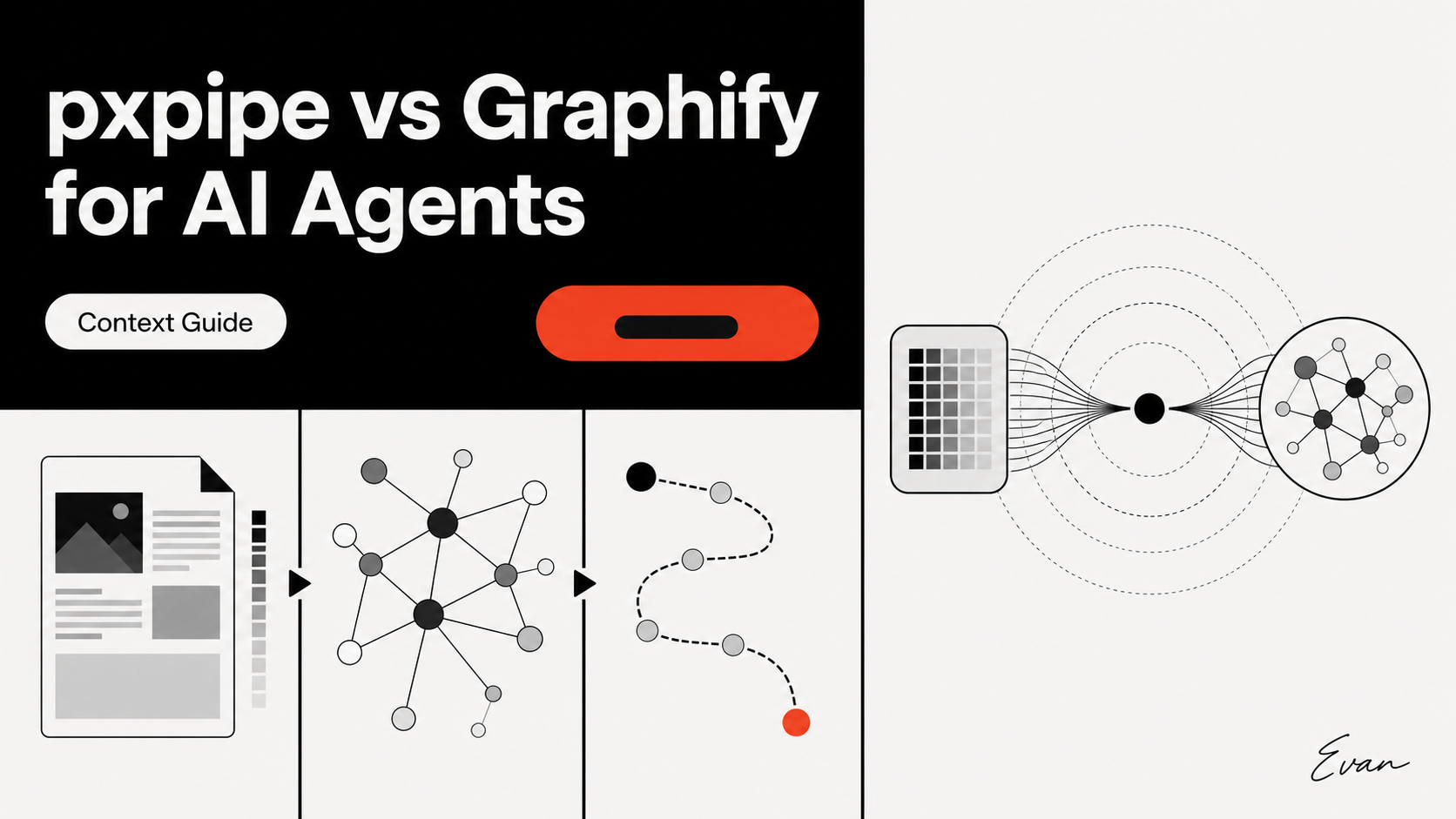
pxpipe and Graphify solve different parts of the AI coding context problem. pxpipe reduces the token footprint of bulky context already being sent to a model by rendering selected text as images. Graphify builds reusable structural knowledge about a repository. Choose by the bottleneck: request cost and repeated history favor pxpipe; dependency paths and project understanding favor Graphify; some teams can use both.
The comparison is not a contest between two interchangeable indexes. pxpipe is an independent proxy with a lossy representation. Graphify is a project knowledge layer. Neither removes the need to inspect source code, run tests, and review architecture-sensitive changes.
Quick Verdict
Use pxpipe when your agent repeatedly sends large, token-dense material and the older material can tolerate gist-level recall. Use Graphify when the agent needs to ask structural questions such as which modules depend on an interface, which tests cover a path, or how code and design documents connect.
| Decision factor | pxpipe | Graphify |
|---|---|---|
| Primary job | Reduce the request footprint of bulky context | Preserve reusable repository structure |
| Representation | Dense PNG pages plus selected text anchors | Entities, relationships, paths, communities, and provenance |
| Works on | Context the client already sends | Code, documentation, and project artifacts that are indexed |
| Exactness | Imaged text is lossy; exact values need text or re-reading | Graph results still require source verification |
| Strong fit | Old history, repeated tool output, dense logs | Navigation, impact analysis, dependency and ownership questions |
| Main risk | Silent visual misread, proxy compatibility, logging | Stale or incomplete relationships and overtrusted inference |
The safest design uses each layer for its actual job. A graph can help select relevant evidence. A compression proxy can reduce the cost of carrying bulky, gist-tolerant evidence through a long session. Exact edit targets, commands, identifiers, and acceptance criteria should remain connected to their original source.
What pxpipe Tries to Solve
The canonical teamchong/pxpipe repository describes pxpipe as a local proxy that transforms selected large input blocks into PNG images before forwarding a request. It can image system and tool documentation, large tool results, and older history while leaving recent turns and ineligible material as text. It compresses the request, not the model response.
Claude Code officially supports the ANTHROPIC_BASE_URL environment variable for routing requests through a proxy or gateway. pxpipe uses that transport path, but it is not an Anthropic product or official Claude Code integration.
The project defaults to Claude Fable 5 because its maintainers report better dense-image reading from Fable than from the other models they evaluated. Anthropic independently confirms that Fable 5 supports vision and is available in Claude Code. That establishes technical compatibility, not independent validation of pxpipe’s quality or savings.
The project reports substantial reductions on its own traffic and small paired tests. Its SWE-bench Lite pilot reports 10 of 10 tasks resolved in both compressed and uncompressed arms, with 65% smaller measured requests in the compressed arm. Its SWE-bench Pro expansion reports 14 of 19 tasks resolved with compression and 15 of 19 without it, with 18 of 19 verdicts agreeing. These are maintainer-run, workload-specific results. They do not prove universal savings, repository superiority, or statistical equivalence.
The important limitation is lossiness. pxpipe reports that broad gist survives more reliably than exact strings. Dense identifiers can be silently misread, so hashes, paths, version numbers, secrets, commands, code to be edited, and numerical constraints should stay as text or be re-read from the repository.
What Graphify Tries to Solve
Graphify addresses a different question: how can an agent reuse project knowledge instead of reconstructing the repository’s structure from scratch during every task?
A code knowledge graph represents entities such as files, symbols, modules, APIs, tests, documents, and concepts. Relationships can express imports, calls, ownership, containment, test coverage, or cross-document references. The graph becomes a query layer for finding a relevant neighborhood before the model opens the underlying source.
This matters because repository understanding is not proportional to the amount of text in a prompt. An agent may read ten files and still miss a dynamic consumer, a generated contract, or the design decision that explains an unusual boundary. Structured relationships help the agent form better navigation questions:
- What calls this service?
- Which tests exercise this interface?
- Which module owns the shared type?
- Which documents explain this dependency?
- What paths connect the requested feature to persistence or deployment?
Graphify does not make those answers infallible. Static extraction can miss reflection, runtime configuration, external consumers, and generated behavior. Inferred relationships can be wrong. A stale graph can point to an obsolete path. The graph should narrow and organize source inspection, not replace it.
For the underlying model, see Graphify’s guide to knowledge graphs for AI coding assistants. For Claude-specific use, the Graphify and Claude Code integration guide explains how the saved project report fits into an agent workflow.
Compression vs Structured Code Knowledge
Compression asks, “How can this material occupy fewer model tokens?” Structured code knowledge asks, “Which project facts and relationships should the agent retrieve?”
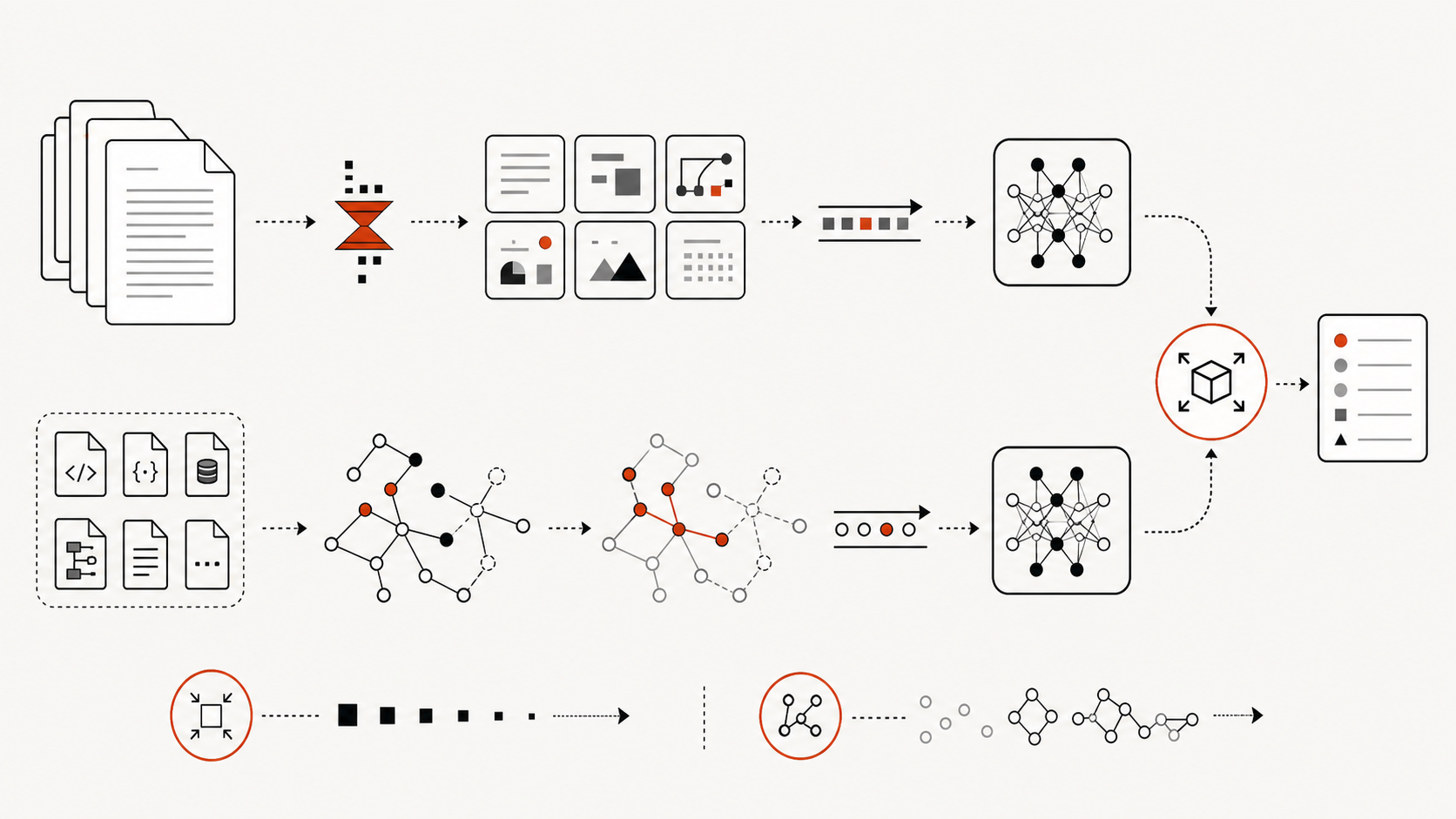
Those questions lead to different failure modes.
With compression, the relevant information may be present but visually misread. The model can recover the broad meaning of a tool log while corrupting a hash or variable name. The mitigation is to classify information by exactness: keep precision-critical fields as text and provide a source re-fetch path.
With a graph, the relationship may be missing, stale, or inferred incorrectly. The agent may receive a clean structural answer that omits a runtime edge. The mitigation is provenance, refresh rules, source links, and verification through search, tests, and runtime evidence.
They also operate at different times. Graphify can prepare reusable project context before a session and update it as the repository changes. pxpipe transforms eligible material on the live request path. A graph can reduce unnecessary file reading; pxpipe can reduce the footprint of the remaining bulky context.
This suggests a layered workflow:
- Query the graph for relevant entities and paths.
- Open the authoritative source files and current documentation.
- Keep exact edit targets and constraints as native text.
- Compress only older, dense material where gist is sufficient.
- Run tests and inspect the final diff against the original repository.
When Each Approach Fits
Choose pxpipe for a pilot when long Claude Code sessions repeatedly resend large logs, tool output, or old conversation history. The workload should have measurable input cost, a clear source of truth, and low dependence on exact recall from compressed material.
Choose Graphify when developers repeatedly spend time locating owners, dependencies, tests, and cross-file paths. It is especially relevant when multiple agents or models need the same repository map, because the structural layer can remain model-independent.
Use both when project discovery and context cost are separate bottlenecks. For example, Graphify can identify the modules, tests, and design notes involved in a migration. The agent can read those sources directly. pxpipe can then compress older tool output or historical discussion as the session grows.
Avoid either tool as a default without a controlled trial. For pxpipe, record exact package and model versions, request logs, safeguard refusals, incorrect identifiers, re-read calls, cost, and task outcomes. For Graphify, record graph freshness, missing or incorrect edges, retrieval usefulness, source-opening behavior, review time, and regressions.
Lifecycle also matters. pxpipe’s package and code were changing in mid-July 2026, but its maintainer stated that issue and pull-request response capacity was limited. A graph layer introduces its own maintenance work: refresh triggers, extraction coverage, provenance, and ownership. The easier system is the one whose failure mode your team can observe and correct.
FAQ
Can compression and graphs be used together?
Yes. Use the graph to select relevant project knowledge, then use compression only for bulky material that does not require byte-exact recall. Keep code, paths, IDs, commands, secrets, version strings, and acceptance criteria in native text or retrieve them again before acting.
What evidence should teams collect before switching?
Freeze the repository commit, task, client, model, permissions, and tests. Compare repeated runs with and without the new layer. Record request tokens, cost, latency, task success, incorrect facts, source re-reads, review effort, graph misses, proxy failures, and recovery time. A lower bill is not useful if review or rework rises.
Which approach is easier to maintain over time?
It depends on the operating risk. pxpipe requires version, model, proxy, privacy, and visual-fidelity checks. Graphify requires graph refresh, extraction coverage, provenance, and stale-edge controls. A small team with mostly dense session history may prefer the narrower proxy. A team with recurring repository-navigation problems may gain more from maintained structural knowledge.
Conclusion
The useful answer to pxpipe vs Graphify is not a winner. pxpipe is a request-path optimization for carrying bulky context more cheaply, with an explicit lossiness trade-off. Graphify is a reusable structural layer for asking better repository questions, with freshness and coverage trade-offs.
Start from the bottleneck. If the agent already has the right evidence but resends too much of it, test pxpipe. If the agent repeatedly reads files without building a dependable map of dependencies and intent, test Graphify. If both problems exist, combine selective retrieval, cautious compression, source verification, and tests rather than asking one tool to solve every context problem.
Leave a Reply