No authoritative single product, repository, or standard named “Skill Zoo” was verified for this article. Here, the phrase describes the growing ecosystem of Agent Skills libraries: reusable SKILL.md packages for Claude Code and other coding assistants. That ecosystem improves capability reuse, but it does not automatically give an agent current knowledge of a complex repository.
What Skill Zoo Changes for Coding Assistants
The skill-library phenomenon changes how teams package instructions for coding agents.
Anthropic's official Claude Code documentation defines a skill as a folder with a SKILL.md entry point. A skill can include instructions, scripts, references, templates, and examples. Claude discovers the skill through its name and description, then loads its full instructions only when the task calls for them. This progressive-disclosure model avoids placing every procedure in permanent context.
That is a meaningful improvement over repeatedly pasting the same checklist into chat. A team can encode:
- how to prepare a release;
- how to review an API change;
- how to run a repository's application;
- how to validate migrations;
- how to follow an internal writing or security workflow.
Claude Code supports skills at personal, project, enterprise, and plugin scopes. Anthropic also publishes a public skills repository with examples. Its README includes an important limitation: the examples are educational and demonstrative, and the behavior available in Claude may differ. Some materials use different licenses, so “public repository” must not be read as “every file is open source and production-approved.”
OpenCode implements the same broad SKILL.md pattern and discovers skills from OpenCode, Claude-compatible, and Agent Skills-compatible directories. The Agent Skills standard describes this portability as a lightweight open format. Portability, however, does not guarantee identical behavior. Clients can interpret permissions, extra frontmatter, tools, and execution differently.
So the useful meaning of “Skill Zoo” is not one verified marketplace. It is a large and expanding collection of reusable agent procedures that teams must still evaluate, version, and govern.
Skills vs Project Understanding
A skill and a project model answer different questions.
| Layer | Main question | Typical contents |
|---|---|---|
| Skill | How should the agent perform this type of work? | Steps, quality gates, tools, templates, examples |
| Project rules | What stable constraints apply here? | Commands, conventions, generated-file rules, approvals |
| Repository knowledge | What entities and relationships exist now? | Symbols, imports, dependencies, tests, schemas, docs |
| Task evidence | What changed in this run? | Current diff, logs, failing tests, tool output |
A code-review skill can tell Claude to check authentication boundaries and run focused tests. It does not know which module owns authentication in the current repository unless that knowledge is supplied or discovered. A release skill can define the workflow but cannot know the current dependency graph from a static instruction file.
This is why “more skills” should not be confused with “better repo understanding.” Skills improve procedural consistency. Repository understanding requires current, source-backed evidence.
The boundary also protects skill quality. If a team copies a fast-changing directory inventory, symbol list, or dependency map into SKILL.md, the package becomes stale quickly. A better skill instructs the agent how to retrieve current facts: inspect the source, consult generated architecture artifacts, query a graph, and record the commit it used.
Why Complex Repos Need Code Knowledge Skills
Complex repositories need skills that connect procedure to live project structure.
A generic debugging skill might say: reproduce the failure, narrow the scope, inspect recent changes, form a hypothesis, and run the smallest confirming test. A code knowledge skill can make those steps repository-aware by requiring the agent to:
- identify the owning package and public entry point;
- trace dependencies before editing;
- find the tests that cover the affected path;
- check generated or vendored boundaries;
- locate architecture decisions connected to the code;
- report the evidence behind its proposed change.
The skill still does not need to contain the graph. It can call or reference the system that maintains it.
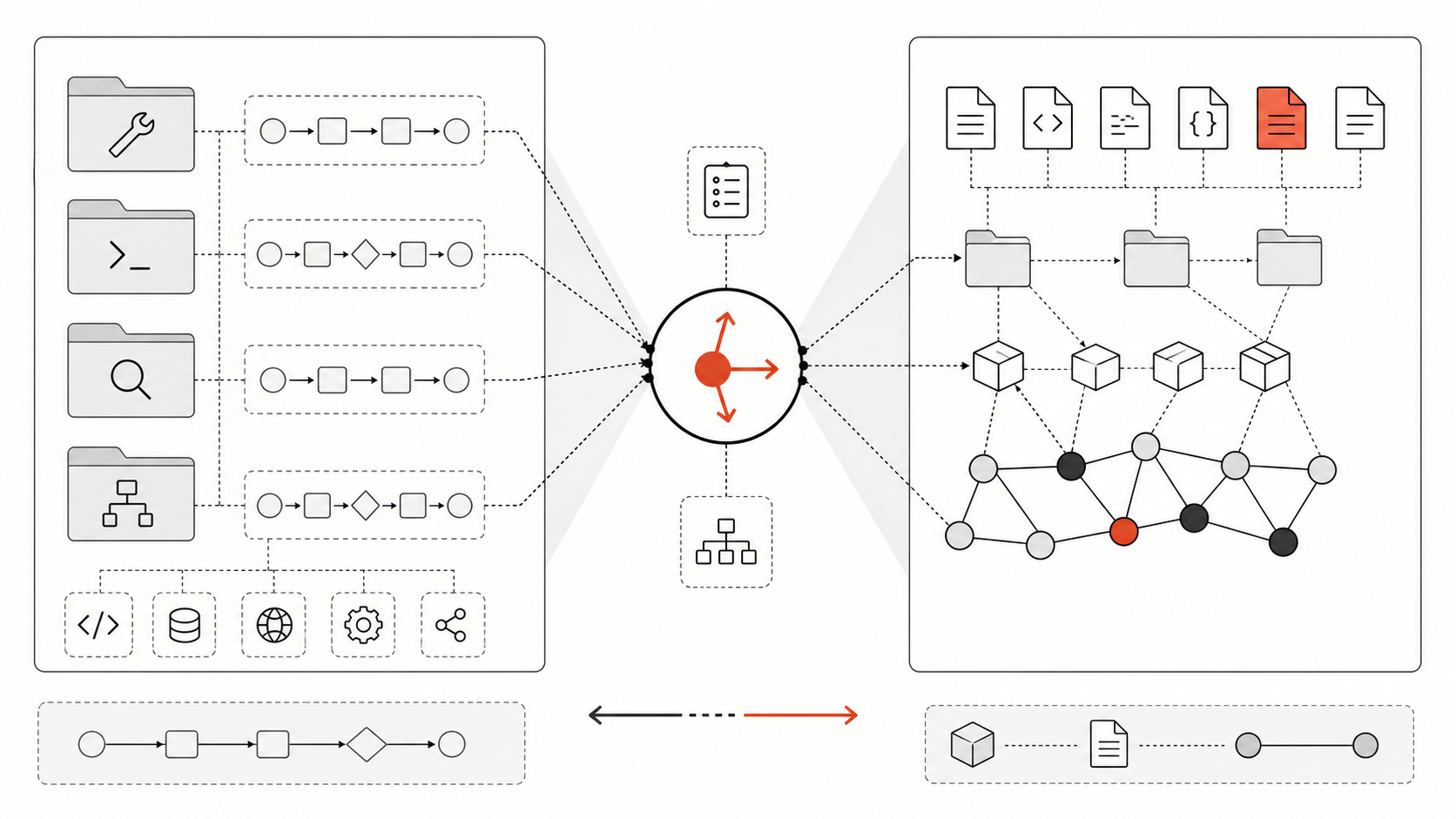
The strongest pattern keeps the workflow portable while deriving repository facts from a refreshable source.
This separation helps monorepos in particular. Claude Code can discover nested project skills, allowing one package to define specialized procedures. Yet package-local instructions still benefit from a shared view of cross-package relationships. Otherwise, an agent may follow the frontend workflow correctly while missing that the proposed change alters a generated client or backend contract.
Versioning matters too. Project skills should live beside the code when they describe repository-specific procedures. Review skill changes like code changes: inspect the diff, test the workflow in a fresh session, and record which tools and permissions it needs. Avoid automatically trusting a downloaded skill merely because it appears in a popular collection.
How Graphify Fits as a Project Memory Layer
Graphify can complement Agent Skills by supplying a queryable project-memory layer.
Graphify turns repository materials into graph artifacts that represent entities and relationships. Its knowledge graph guide explains why typed structure can answer questions that a flat file list cannot. Its CLI supports queries, paths, explanations, updates, and watch workflows.
A project skill can then define a safe retrieval procedure:
Before planning a repository-wide change:
1. Query the graph for the affected entity.
2. Trace dependency paths and linked tests.
3. Open the current source files named by the result.
4. Report stale or ambiguous graph evidence.
5. Do not edit until current source confirms the path.
This design has three advantages.
First, the skill stays compact. It contains the method, not an ever-growing copy of the repository.
Second, multiple agents can share the same project map. Claude Code, OpenCode, Codex, or another compatible assistant can follow equivalent retrieval rules even when their skill features differ.
Third, provenance remains visible. The graph can carry source locations and generation metadata, while the skill requires the agent to verify current code before acting.
Graphify already hosts a code graph for addyosmani/agent-skills, a public repository that packages engineering workflows for coding agents. That example illustrates the two layers directly: the repository contains reusable skills, while Graphify maps the repository's own implementation structure.
Limits and Integration Questions
Skills expand an agent's operating instructions, so teams should treat them as executable supply-chain inputs.
Review the complete skill folder before trusting it. Supporting scripts can run commands, reference external resources, or request broad tool permissions. Check licenses per repository and file; do not assume every example in a mixed collection has the same terms.
Keep sensitive data out of the package. A project skill may describe how to access secrets safely, but it should not contain credentials, customer records, production tokens, or copied private conversations.
Plan for client differences. Claude Code documents invocation controls, subagent execution, dynamic context, and Claude-specific frontmatter. OpenCode recognizes a smaller defined frontmatter set and ignores unknown fields. A cross-client skill should use the common core or document client-specific behavior explicitly.
Finally, decide what happens when knowledge is stale. A skill should not force the agent to trust a graph or generated report blindly. Require a source revision, a refresh threshold, and a fallback to direct inspection.
FAQ
Which skills should be project-specific?
Make a skill project-specific when it depends on that repository's commands, architecture, deployment path, review gates, or generated artifacts. Keep broadly reusable practices personal or shared at the organization level, then layer project rules on top.
How should teams version code knowledge skills?
Store project skills in version control, review their changes, and test them in fresh sessions. Pin external dependencies where possible. Record the expected tools, permissions, and generated knowledge artifacts so a skill update cannot silently broaden its authority.
What should not be stored inside a skill?
Do not store secrets, private customer data, unrestricted transcripts, volatile symbol inventories, or large copied source trees. Store procedures and stable rules. Retrieve current repository facts from source-backed files, generated reports, or a maintained code graph.
Conclusion
The Skill Zoo idea is useful as a description of today's expanding Agent Skills ecosystem, not as an unverified product claim. Skills make coding workflows reusable, discoverable, and easier to audit. They answer how an agent should work.
They do not automatically answer what the current repository means. For complex projects, pair procedural skills with refreshable source evidence and a queryable structural layer. The decision rule is straightforward: put stable methods in the skill; keep changing project facts close to the code.
Leave a Reply