Claude Sonnet 5 is a credible option for large-codebase work because Anthropic gives it a one-million-token context window and positions it for complex, multi-file coding. That capacity can keep more source, documentation, and tool history available during a task. It does not automatically reveal architecture, dependency boundaries, ownership, or the reasons behind past design decisions.
The practical question is therefore not whether Sonnet 5 can ingest a large repository. It is whether your Claude Code workflow supplies the right evidence, lets the model navigate selectively, and verifies changes against the repository’s actual constraints.
Why Large Codebases Stress Coding Models
Large repositories are difficult because relevant knowledge is distributed rather than merely long. A change that looks local may depend on a schema, generated client, build rule, feature flag, deployment contract, or convention defined elsewhere.
Repository work also contains several kinds of context:
- Source context: functions, types, tests, configuration, and generated artifacts.
- Structural context: imports, calls, inheritance, data flow, package boundaries, and service dependencies.
- Operational context: build commands, CI rules, deployment order, observability, and rollback requirements.
- Institutional context: ownership, accepted patterns, rejected alternatives, and design intent.
A model can read source without knowing which relationships matter. For example, finding every textual reference to a type is not the same as identifying every runtime consumer of the data it represents. Large-codebase work stresses retrieval, prioritization, planning, execution, and regression control at the same time.
Claude Code can reduce some friction because it lets the model inspect files, search the repository, edit code, and run commands. However, tool access changes the workflow, not the truth available inside the repository. Missing documentation and weak tests remain missing evidence.
What a Larger Context Window Can Help With
Anthropic’s current documentation lists Claude Sonnet 5 as claude-sonnet-5, with a one-million-token context window by default and up to 128,000 output tokens. Anthropic also says the model is available through Claude Code, Claude.ai, the Claude API, and supported cloud platforms.
That larger working space can help in four practical ways.
First, it reduces premature eviction. The agent can retain more of the issue, inspected files, tool results, plans, and test failures before it must compress or discard earlier material.
Second, it supports wider evidence gathering. A migration task may require reading interface definitions, several implementations, representative tests, and build configuration together.
Third, it gives long-running tool workflows more room. Planning, editing, testing, diagnosing, and revising all consume context. A larger window can preserve continuity across those steps.
Fourth, it can make cross-file comparison easier. Anthropic describes Sonnet 5 as suitable for reasoning across complex multi-file codebases and large-scale refactors. This is a vendor capability claim, not independent proof for every repository, but it is consistent with the model’s intended use.
Nominal window size still needs interpretation. Anthropic says Sonnet 5 uses a new tokenizer that can produce roughly 30% more tokens for the same text than Sonnet 4.6. A “one-million-token repository” is therefore not a stable number of files, lines, or modules across models.
What Context Windows Still Miss
A context window stores selected material for a run. It does not turn that material into a maintained model of the system.
The window does not inherently know:
- which service owns a shared contract;
- whether an import is architectural or incidental;
- which dependency is loaded dynamically;
- why a team rejected an apparently simpler design;
- which generated files must never be edited;
- which downstream repository consumes an API;
- whether a passing unit test misses a production invariant.
More raw text can even create a selection problem. Loading broad directory trees may bury the critical interface among duplicated fixtures, generated code, vendored packages, and stale documents. Attention is finite even when capacity is large.
Long-context evaluations reinforce this distinction. They can measure retrieval or reasoning over long inputs, but accepting a long prompt is not equivalent to perfect recall, correct impact analysis, or compliance with undocumented conventions.
The safest workflow treats context capacity as room for evidence, not as proof that the evidence is complete or correctly organized.
Where Code Knowledge Graphs Fit
A code knowledge graph can act as a query layer over repository structure. Instead of repeatedly asking the model to rediscover relationships from raw files, the workflow can expose nodes such as symbols, modules, APIs, tests, owners, and documents, connected by typed relationships.
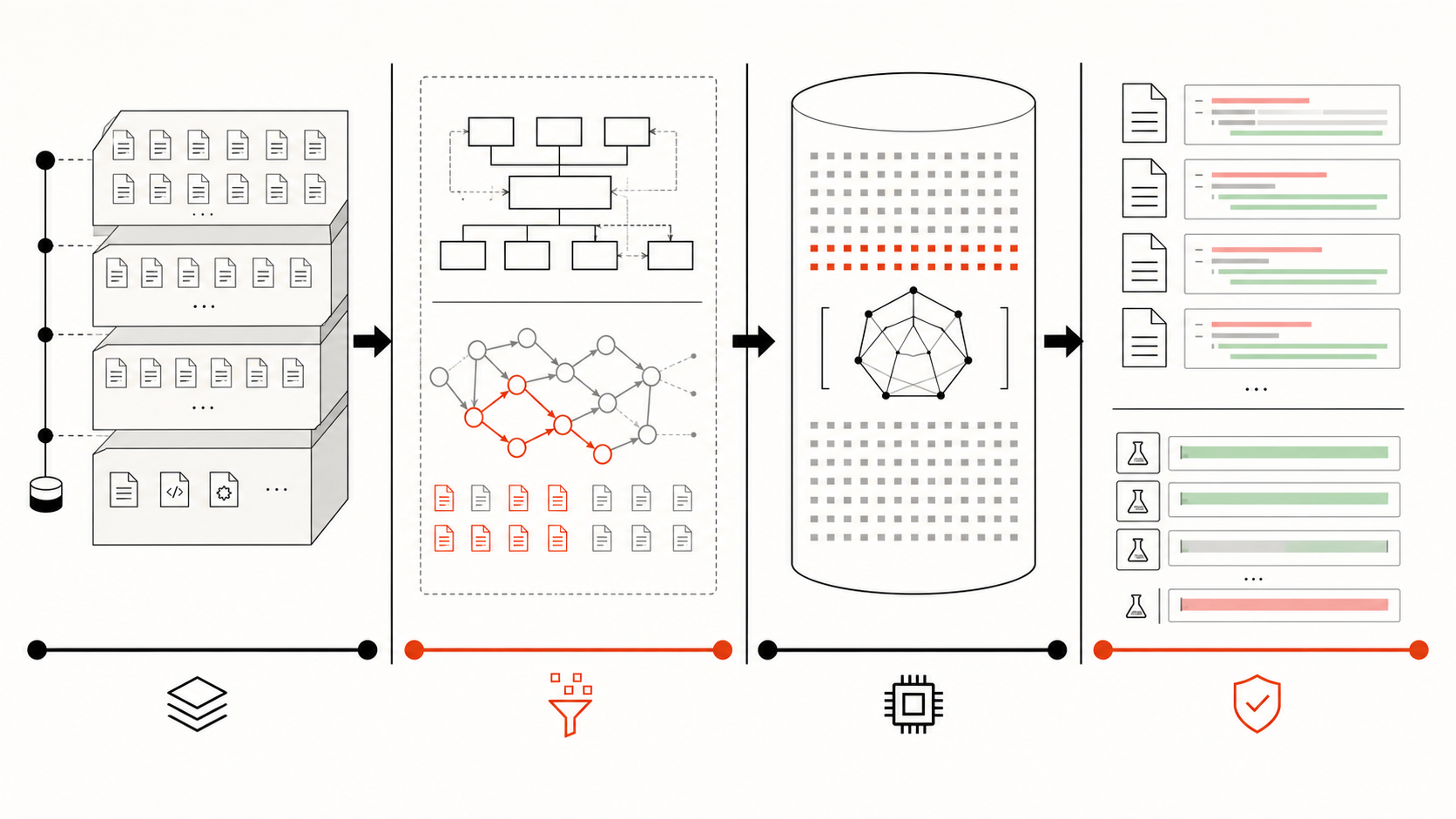
This changes the initial question from “Which files should fit in the prompt?” to “Which entities and relationships are relevant to this change?” The graph can identify a smaller evidence set, while Sonnet 5 reads the underlying code and reasons about the requested task.
A useful division of labor is:
| Layer | Best use |
|---|---|
| Context window | Hold task-specific source, plans, tool output, and current reasoning |
| Repository search | Find exact text, filenames, symbols, and recent changes |
| Code knowledge graph | Query dependencies, callers, ownership, tests, and cross-module paths |
| Project documentation | Explain architecture, policy, and design intent |
| Test and build system | Verify behavior and detect regressions |
Graphs have limits too. A stale graph can confidently return obsolete relationships. Dynamic calls, reflection, generated code, runtime configuration, and external consumers may be incomplete. Graph results should point the model toward source evidence, not replace source inspection.
For a practical setup, see how to help Claude Code understand a complex repository and the broader comparison of context windows and code graphs.
What to Verify Before Relying on Sonnet 5
Do not select a coding model for a large repository from its advertised context window or a single leaderboard score. Run a private pilot against work that resembles your team’s real changes.
Use a frozen repository commit and a balanced task set:
- a localized bug with clear tests;
- a cross-module change involving a public interface;
- a refactor constrained by architecture rules;
- a CI or build failure with environmental dependencies;
- an impact-analysis task that does not require editing.
Record the model ID, Claude Code version, effort setting, tool permissions, network policy, starting prompt, context supplied, commands, patch, test results, elapsed time, and token cost. Repeat each task because one successful trajectory does not establish reliability.
Benchmark evidence needs similar care. OpenAI reported in February 2026 that SWE-bench Verified had contamination and flawed-test problems. In July, it estimated that roughly 30% of SWE-Bench Pro tasks were broken. Those findings do not make repository benchmarks useless; they mean teams should inspect task design and avoid treating a headline pass rate as a universal measure of codebase understanding.
Human review should focus on dependency impact, unnecessary edits, missing consumers, test adequacy, and violations of repository conventions. Architecture-sensitive or production-critical changes should require approval even when the patch passes its visible tests.
FAQ
What repo docs should be prepared first?
Prepare a short repository map, build and test commands, module ownership, architecture boundaries, public contracts, generated-file rules, and links to current design decisions. Keep instructions concise and route deeper details through linked documents so the model can retrieve them when relevant.
How should teams test large-repo behavior?
Use private tasks from the target repository, hidden acceptance and regression tests, isolated environments, and repeated runs. Include both editing and analysis tasks. Compare correctness, regression rate, review effort, diff size, latency, and cost rather than context size alone.
When should model output require architecture review?
Require architecture review when a change crosses service or package boundaries, alters a public contract, changes persistence or security behavior, introduces a new dependency, modifies deployment topology, or relies on an inferred relationship that the repository does not verify automatically.
Conclusion
Claude Sonnet 5 gives Claude Code substantially more working room and is officially aimed at demanding coding and agent workflows. That makes it useful for large repositories, but not self-sufficient.
Use its long context to hold the evidence selected by repository search, documentation, and structured code relationships. Then use tests and human review to verify the result. The decision rule is simple: choose Sonnet 5 when it improves real repository outcomes under your harness—not because one million tokens sounds large enough to contain the codebase.
Leave a Reply