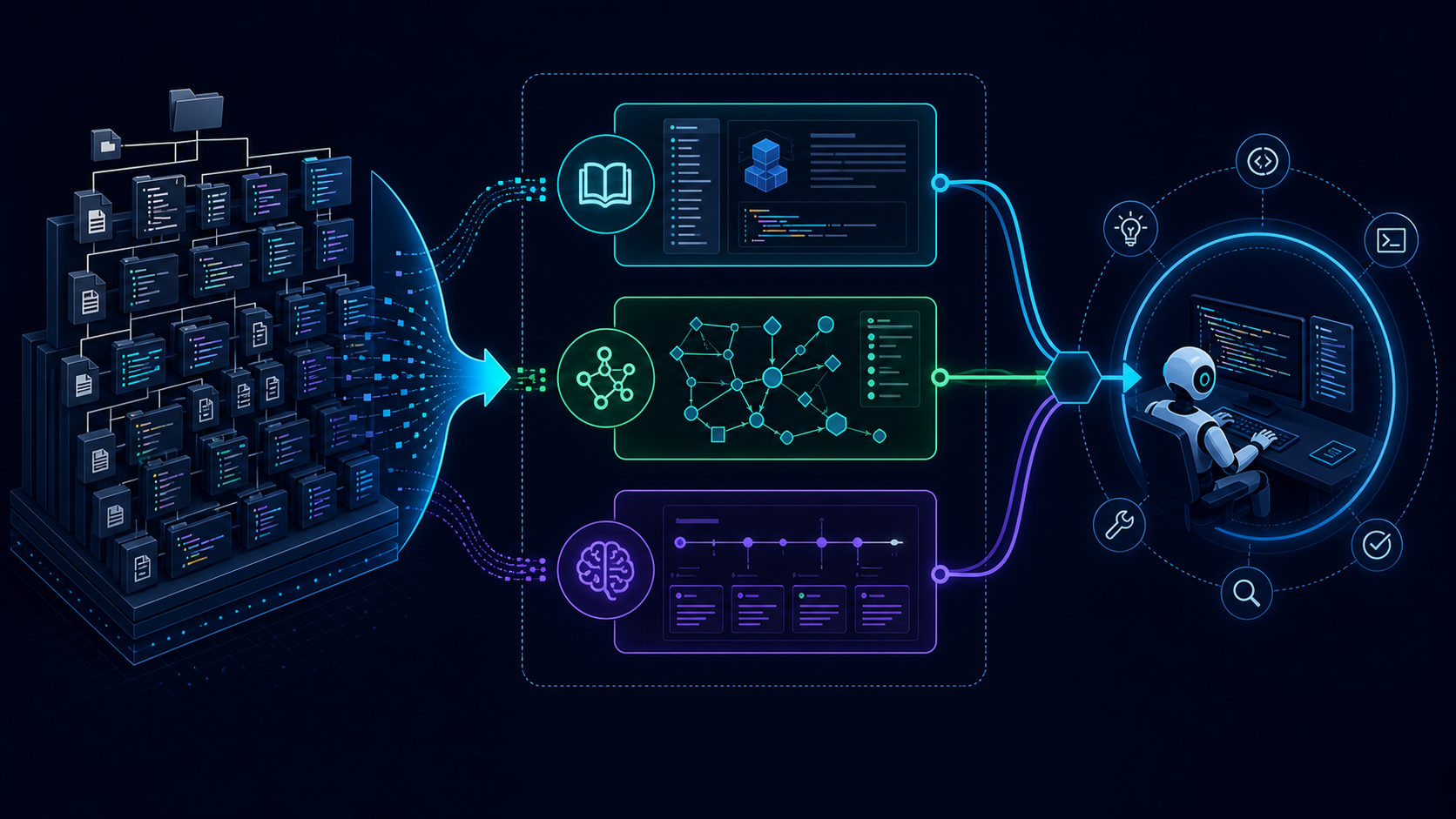
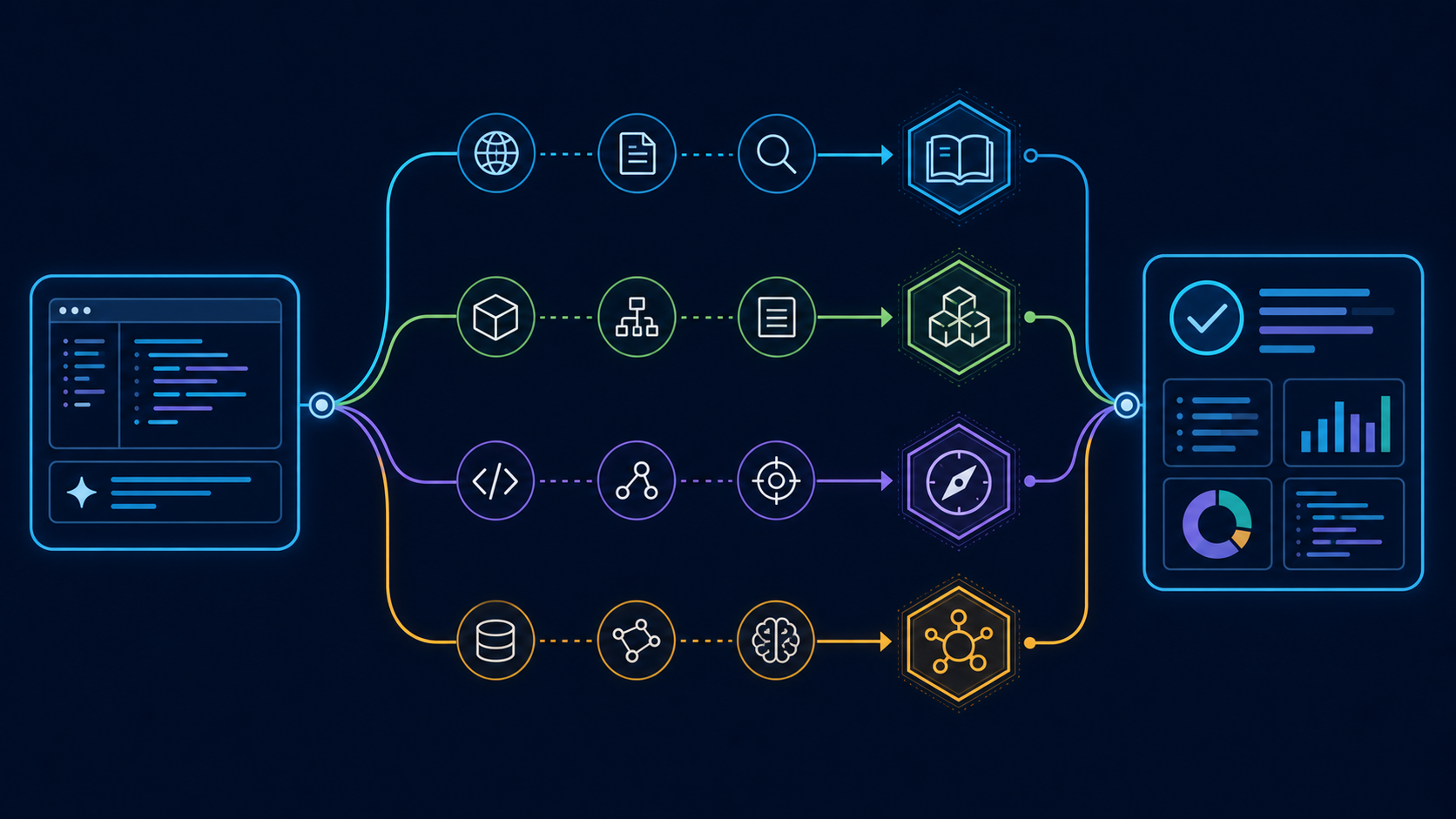
Code intelligence MCP servers give AI coding clients better evidence than a raw chat window can hold. Some retrieve current library documentation. Some package repository text. Some navigate symbols and references. Others preserve knowledge as a graph or scan code for quality and security findings.
No single server wins every task. Choose the context model that matches the question. Use Context7 for version-aware library docs, Serena for symbol-level repository work, a code index for retrieval, static-analysis servers for findings, and a knowledge graph when relationships and memory must survive across sessions.
Short answer: Documentation retrieval answers “How does this API work?” Symbol intelligence answers “Where is this behavior implemented?” Static analysis answers “Which rule is violated?” A knowledge graph answers “How are these code, document, and system entities connected?”
What Is a Code Intelligence MCP Server?
A code intelligence MCP server is an MCP implementation that exposes code or documentation operations as tools. The server may search an index, resolve a symbol, find references, retrieve versioned docs, package files, query a knowledge graph, or return scanner findings.
The key entity relationship is simple: an MCP client invokes a tool; the tool queries an evidence system; the server returns structured context; the model uses that context to plan or edit. Quality depends on what the evidence system represents and how fresh, scoped, and attributable its results are.
Which Code Intelligence MCP Server Should You Use?
Select by the question your agent must answer.
Primary question
Context approach
Good starting points
Limitation
“What does the current library API require?”
Documentation retrieval
Context7
Does not model your full codebase architecture
“What files should enter the prompt?”
Repository packaging
Repomix
A snapshot loses live symbol semantics
“Where is this symbol defined and referenced?”
Symbol/LSP intelligence
Serena, Sourcegraph, code index
Requires indexing or language support
“What does this repository do?”
Repository documentation
DeepWiki-style systems
Generated docs can lag the source
“What relationships persist across sessions?”
Graph memory
Graphiti, Cognee, Graphify
Ingestion and update policy matter
“Which defect or vulnerability is present?”
Static analysis
SonarQube, Semgrep, Snyk
Findings still need triage and context
The best stack often combines two layers. Fresh external docs plus symbol-aware local code navigation is more reliable than either alone.
How Does Context7 MCP Improve Documentation Retrieval?
Context7 MCP retrieves current, version-relevant library documentation and examples. Its official repository describes two core MCP tools: one resolves a library name to a Context7 library ID, and another queries documentation for that ID. Supplying an exact library ID or version reduces ambiguity.
The existing Context7 MCP profile remains canonical for context7 mcp, context7-mcp, mcp context7, context7 mcp server, and configuration details. The profile also owns queries such as context7 mcp documentation, context7 mcp official docs, and context7 mcp server documentation.
Use Context7 when the failure mode is stale training knowledge: removed methods, changed configuration keys, or version-specific APIs. Cite the retrieved library and version in the final answer. Do not treat community-contributed documentation as infallible; verify security-sensitive behavior against the library owner's docs.
When Is Serena MCP Better Than Text Search?
Serena MCP exposes semantic code retrieval, editing, refactoring, and debugging operations at the symbol level. Its official repository explains that it can use Language Server Protocol backends or a JetBrains plugin to understand symbols and relationships.
Use the existing Serena MCP profile for the canonical serena mcp, serena mcp server, and mcp serena installation details.
Serena is strong when a task requires:
Finding a symbol without reading the whole file.
Listing references before a change.
Understanding type or implementation relationships.
Editing a symbol body rather than applying brittle line-based replacement.
Preserving project memory across a longer coding workflow.
Text search remains faster for an exact literal or tiny repository. Symbol intelligence pays off when the codebase is large, names are overloaded, or a refactor crosses files.
What Do Code Index MCP and Sourcegraph MCP Provide?
A code index MCP exposes an indexed representation of a repository. The exact tools vary, but useful servers support file discovery, lexical or semantic search, symbol lookup, reference traversal, and incremental refresh. Search variants code index mcp and code-index-mcp should resolve to one canonical comparison section, not two pages.
Before adopting an implementation, test five properties:
Freshness: how quickly do commits enter the index?
Scope: can it isolate repository, branch, and tenant?
Semantics: does it understand symbols or only chunks?
Evidence: does every result include file, range, revision, and retrieval method?
Operations: can you rebuild, inspect, and delete the index?
Sourcegraph MCP belongs to the same broad category but may connect to a larger code search and intelligence platform. Validate current MCP availability and supported operations in Sourcegraph's official documentation before planning a rollout; product integration details can change faster than the general selection framework.
Where Do DeepWiki and Repomix Fit?
deepwiki mcp and deepwiki mcp server represent repository-explanation intent. A DeepWiki-style system turns a repository into navigable documentation and answers. It is useful for orientation, but any generated explanation should link back to the exact revision and source files.
repomix mcp represents repository-packaging intent. Repomix-style tools collect selected files into an AI-friendly artifact. Packaging is simple and portable, but a packed snapshot has three limits: it can exceed the context budget, become stale, and flatten relationships that a symbol graph preserves.
Use packaging for bounded review or handoff. Use an index for repeated retrieval. Use symbol intelligence for navigation and refactoring.
How Do Graphiti, Cognee, and Knowledge-Graph MCP Differ?
graphiti mcp and graphiti mcp server target temporal or evolving graph memory. Graphiti's official repository describes a system that builds and queries knowledge graphs for AI agents, with relationships that can change over time.
cognee mcp server targets persistent AI memory constructed from ingested data. Cognee's official repository exposes memory-oriented operations and an MCP server path within its broader data and graph stack.
The generic queries knowledge graph mcp, mcp knowledge graph, knowledge graph memory, and knowledge graph memory mcp describe a pattern, not one product. A useful knowledge-graph MCP implementation should expose:
Entity and relationship provenance.
Time or revision boundaries.
Upsert, deletion, and conflict rules.
Tenant and dataset isolation.
A way to explain which source supports each edge.
Graph memory does not replace repository truth. It accelerates reasoning by preserving relationships; the agent should still verify a proposed code change against the current branch.
Where Does Greptile MCP Fit?
greptile mcp represents hosted repository intelligence and code-review context. Treat Greptile as a product-specific option whose current tool surface, repository permissions, and retention policy must be verified in official documentation. The comparison questions remain stable: what gets indexed, which revisions are searchable, how evidence is cited, and whether the service can delete stored code.
For private repositories, include data residency, model-provider access, retention, and organization-level authorization in the review—not only search quality.
How Do SonarQube, Semgrep, and Snyk MCP Servers Differ?
Static-analysis MCP servers expose findings, rules, locations, and sometimes remediation actions. They should complement, not replace, their underlying scanners.
Server category
Evidence
Best use
Guardrail
SonarQube MCP
Quality and security findings from analyzed projects
Explain issues, inspect quality gates
Pin project and branch
Semgrep MCP
Pattern and data-flow findings
Search rules, triage findings, explain matches
Keep rule and engine version
Snyk MCP
Vulnerability and code-security findings
Prioritize and remediate security issues
Preserve severity, dependency, and path evidence
Keyword variants such as sonarqube mcp, sonarqube-mcp-server, sonarqube mcp server, and mcp sonarqube belong to one entity cluster. The same is true for semgrep mcp and semgrep mcp server, and for snyk mcp and snyk mcp server.
Require the server to return the scanner source, rule ID, file and range, revision, severity, and a stable finding identifier. A model-generated explanation without those fields is advice, not a verified finding.
How Should You Combine Documentation, Code, and Memory?
Use a layered retrieval plan. Each layer answers a different kind of question and supplies a different evidence type.
Clarify the task. Identify target repository, branch, library version, and expected output.
Retrieve external contracts. Use current official or Context7 documentation for APIs and frameworks.
Inspect local structure. Use symbol or index tools to find definitions, references, tests, and configuration.
Consult memory. Use graph memory for prior decisions, architecture relationships, and cross-artifact context.
Verify with scanners and tests. Static analysis and tests check the proposed change.
Cite evidence. The answer names the revision, files, symbols, docs, and findings it used.
This sequence reduces a common error: applying a correct current API example to the wrong part of the local architecture.
How Can You Evaluate Code Intelligence MCP Servers?
Create a benchmark from real repository tasks and keep the expected evidence set hidden from the tool under test.
Task
Success criterion
Locate implementation
Finds the correct symbol and revision
Trace impact
Finds callers, tests, and configuration
Answer versioned API question
Cites the right library version
Explain architecture
Links claims to code and documents
Detect stale index
Reports revision mismatch instead of guessing
Triage a finding
Preserves scanner rule and location
Reject cross-tenant request
Returns no unauthorized evidence
Measure precision, recall, citation completeness, context tokens, latency, freshness delay, and authorization failures. Also run a no-tool baseline. The server earns its place only if it improves task outcomes enough to justify its context and operational cost.
Where Does Graphify Add Unique Value?
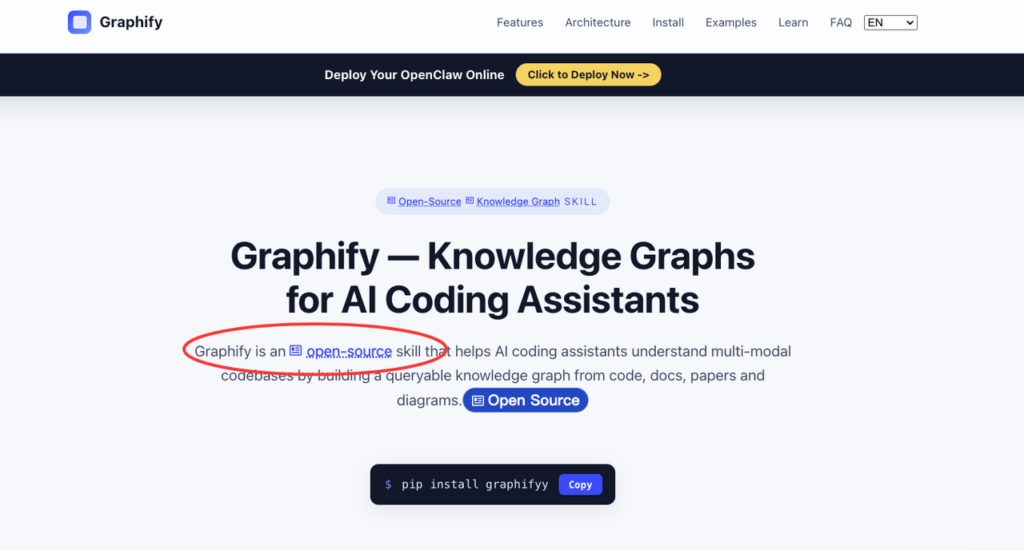
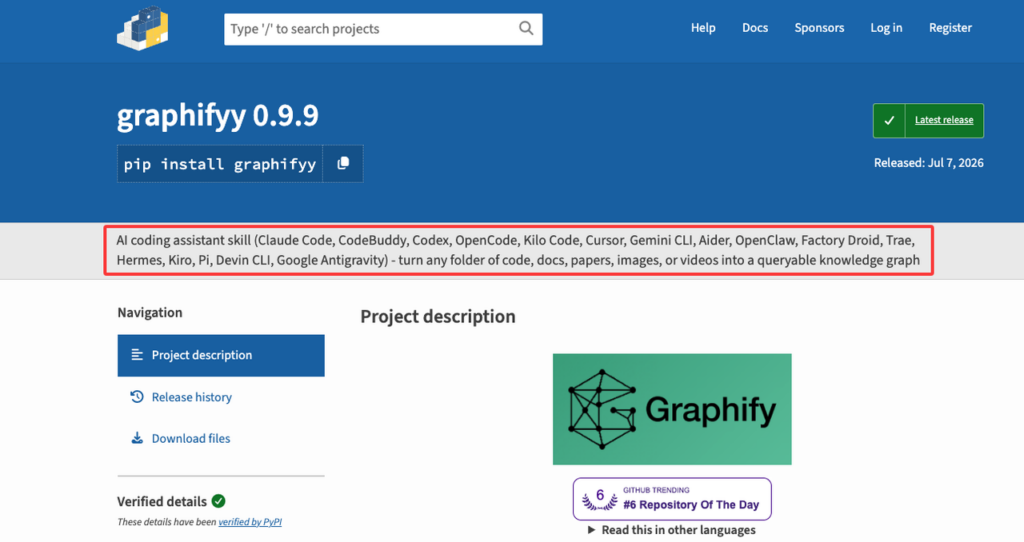
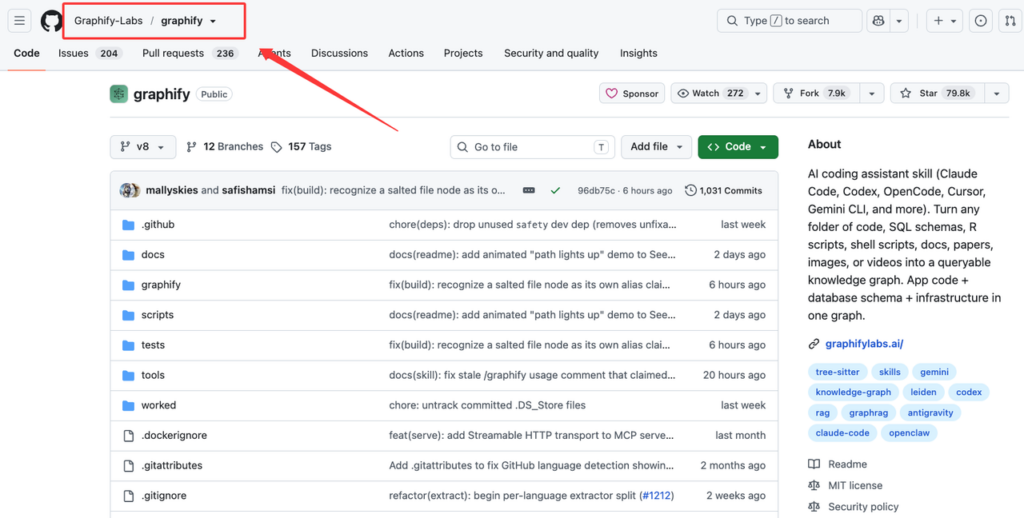
Graphify is a knowledge-graph layer for AI coding assistants. It connects code, documents, and design artifacts into queryable structures so an agent can reason about a complex system instead of treating the repository as unrelated chunks.
That makes Graphify complementary to the tools in this guide:
Context7 supplies fresh external library facts.
Serena supplies precise symbol operations.
Static analyzers supply verified findings.
Graphify supplies cross-artifact structure and relationships.
For a large codebase, the strongest workflow combines these evidence types and keeps provenance attached. The model can then explain not only what to change, but why the change belongs in that subsystem and what it may affect.
Frequently Asked Questions
Is code index MCP the same as a knowledge graph MCP?
No. A code index optimizes retrieval over code artifacts. A knowledge graph stores explicit entities and relationships, often across code, documents, and decisions. Some products combine both, but the data models and query guarantees differ.
Is Context7 MCP enough to understand my repository?
No. Context7 is strongest for external library documentation. Pair it with repository search, symbol intelligence, or a code knowledge graph for local architecture and implementation evidence.
Is Serena MCP a code index?
Serena can retrieve code semantically through language-aware tooling, but its value is broader than a generic text index: it exposes symbol relationships and structured editing/refactoring capabilities.
Can graph memory become stale?
Yes. Every stored entity and relationship needs source provenance and a revision or time boundary. Re-index changed artifacts and delete invalid edges instead of allowing memory to silently diverge from the repository.
Should a scanner MCP server be allowed to edit code automatically?
Default to read and propose. Let the agent prepare a patch, then run tests and the underlying scanner before approval. An MCP explanation is not proof that a remediation is safe.
Final Recommendation
Choose by evidence model. Use documentation retrieval for external contracts, symbol intelligence for local code, static analysis for verified findings, and a knowledge graph for system relationships and durable memory. Then evaluate the combined stack on real tasks with revision-aware citations. More context is useful only when it is current, scoped, attributable, and connected to the decision.
01 | Claude Code accused of hidden China-user detection; Alibaba bans Claude
A reverse-engineering report claimed Claude Code had used timezone checks, proxy-domain matching, and Unicode-based prompt markers to identify suspected China-based users. Anthropic said the mechanism was an anti-abuse experiment aimed at resale and distillation risks, and that the code was removed in a July 2 update. Alibaba later classified Claude products as high-risk software and ordered employees to uninstall them from work environments starting July 10.
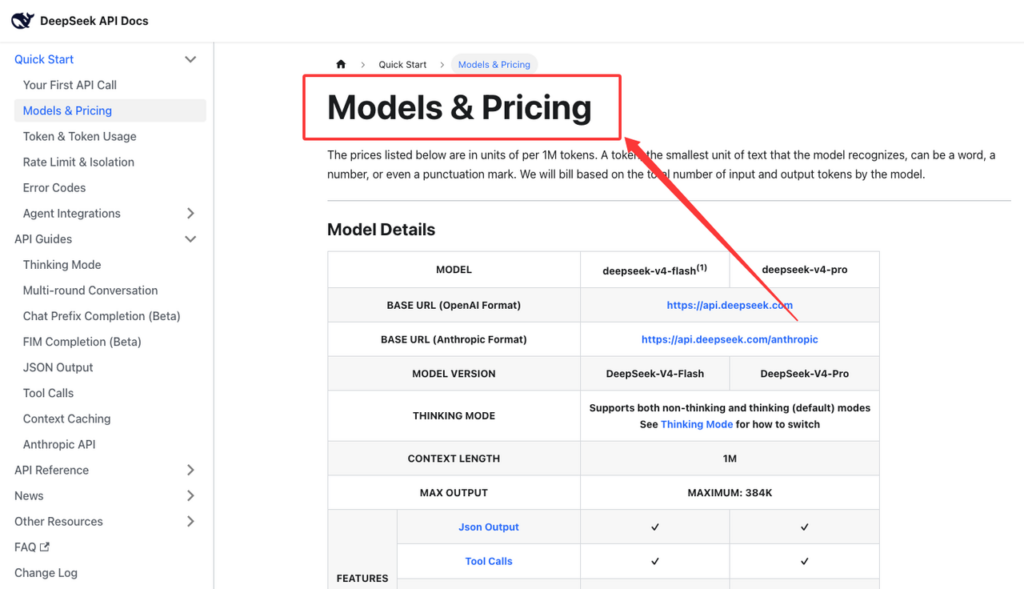
02 | DeepSeek V4 set for mid-July release, with peak-hour API pricingDeepSeek V4 is moving out of preview and is expected to launch officially in mid-July. The new pricing model doubles API prices during weekday peak hours in Beijing time: 9:00-12:00 and 14:00-18:00. Off-peak pricing remains unchanged. The older deepseek-chat and deepseek-reasoner endpoints are scheduled to shut down on July 24.
03 | Meituan releases LongCat-2.0, a trillion-parameter model trained on domestic chips
LongCat-2.0 has 1.6T total parameters, around 48B active parameters on average, a dynamic activation range of 33B to 56B, and native 1M-token context support. Meituan says the model was pretrained from scratch on a 50,000-card domestic accelerator cluster, making it a large-scale test of China’s local AI compute stack. Independent third-party benchmarks are still limited.
04 | Claude Sonnet 5 launches, beating Opus 4.8 on Terminal-Bench
Anthropic released Claude Sonnet 5, positioning it as the strongest agentic model in the Sonnet line. It scored 80.4% on Terminal-Bench 2.1, ahead of Claude Opus 4.8 at 74.6%, while reaching 63.2% on SWE-bench Pro. The limited-time API price is $2 per million input tokens and $10 per million output tokens, rising to $3 and $15 after August 31.
05 | Fable 5 returns globally, then moves from subscription to usage billing
After the U.S. Commerce Department lifted restrictions on June 30, Claude Fable 5 returned to global availability on July 1. Three days later, Anthropic announced that Fable 5 would be removed from Pro-style subscriptions and moved to separate usage credits from July 7. Pricing is $10 per million input tokens and $50 per million output tokens.
06 | Anthropic launches Claude Science for labs and pharma teams
Claude Science is Anthropic’s new research workbench for scientific users. It is designed to support literature review, experimental planning, data analysis, chart generation, and manuscript iteration inside longer research workflows. The initial target customers are academic labs and pharmaceutical R&D teams.
07 | Gemini Spark lands on Mac as Google rolls out new image and video models
Gemini Spark is now available on Mac, with integrations across Google Tasks, Keep, Canva, Dropbox, and other apps. Google also launched Nano Banana 2 Lite and Gemini Omni Flash for developers. Nano Banana 2 Lite focuses on fast, low-cost image generation, while Omni Flash supports mixed text, image, and video inputs for video generation.
08 | Cursor and OpenClaw both move onto mobile
Cursor Mobile lets users manage cloud coding agents from a phone and stay in sync with desktop sessions. OpenClaw launched native iOS and Android apps that connect to a self-hosted OpenClaw Gateway, allowing users to approve actions and expose selected device capabilities to agents.
01 | Claude Code Accused of Hidden Detection Logic; Alibaba Bans Claude
A developer reverse-engineering Claude Code found hidden logic that had not appeared in the changelog. According to the public analysis, the code had been present since version 2.1.91 on April 2 and checked whether the system timezone matched Asia/Shanghai or Asia/Urumqi when proxy use was detected.
The more sensitive part was domain matching. The report said Claude Code contained a 147-entry domain list covering Chinese companies such as Baidu, Alibaba, ByteDance, Moonshot AI, MiniMax, and StepFun, as well as Claude resale and mirror services. The detection result was allegedly encoded through subtle formatting changes: switching slashes and hyphens in dates, and replacing apostrophes with visually identical Unicode characters.
Anthropic engineer Thariq Shihipar said the mechanism was an experimental anti-abuse measure introduced in March to prevent unauthorized resale and model distillation. The company said the code was removed in a July 2 update. The dispute was later covered in broader reports on the Claude Code security controversy. Alibaba responded by adding Claude products to its high-risk software list, banning workplace use of Claude Sonnet 5, Claude Opus 4.8, Claude Fable 5, Claude Code, and related agent tools from July 10.
DeepSeek announced on June 29 that DeepSeek V4 is expected to launch officially in mid-July, graduating from preview. The production version is expected to bring additional performance and feature updates, but the bigger operational change is pricing.
Under the new model, weekday peak hours in Beijing time, from 9:00 to 12:00 and 14:00 to 18:00, will cost 2x the base API price. Evening and weekend usage stays at the preview-period rate. For teams that call DeepSeek heavily during Chinese business hours, this directly raises daytime costs; teams with batch or async workloads can shift jobs to off-peak windows to avoid the premium. DeepSeek’s public API pricing documentation is now worth watching more closely than the model card itself.
The older deepseek-chat and deepseek-reasoner endpoints will be retired on July 24 and will stop accepting requests after that date. Any production system still using the old endpoints needs to migrate before then.
03 | Meituan Releases LongCat-2.0, a Trillion-Parameter Model on Domestic Compute
Meituan released LongCat-2.0 on June 30. The model has 1.6T total parameters, around 48B active parameters on average, and a dynamic activation range between 33B and 56B. It also supports a native 1M-token context window.
The model uses an ultra-sparse MoE architecture, activating different parameter ranges depending on the task. Meituan says the model was pretrained from scratch on a 50,000-card domestic AI accelerator cluster and describes it as the first trillion-parameter model to complete both training and inference fully on Chinese-made chips. External coverage of Meituan’s LongCat-2.0 release frames it as an infrastructure milestone as much as a model launch.
Independent evaluation is still thin, so capability claims need more testing. But from a systems point of view, the important part is that a domestic compute cluster at this scale appears to have supported full pretraining, inference, and long-context service.
04 | Claude Sonnet 5 Launches, Passing Opus 4.8 on Terminal-Bench
Anthropic released Claude Sonnet 5 on June 30, positioning it as the strongest agentic model in the Sonnet family. On Terminal-Bench 2.1, it scored 80.4%, ahead of Claude Opus 4.8 at 74.6%. On SWE-bench Pro, it reached 63.2%, close to Opus 4.8’s 69.2%, and it scored 84.7% in BrowseComp single-agent search evaluation.
Claude Sonnet 5 supports a native 1M-token context window and up to 128K tokens of output in a single response. The limited-time API price is $2 per million input tokens and $10 per million output tokens. After August 31, pricing returns to $3 input and $15 output. Sonnet 5 is now the default model for Claude Code as well as free and Pro Claude users.
Anthropic staff also said Claude Code’s system prompt has been cut by roughly 80%. The message is interesting: newer models seem to need less handholding, and too many examples or constraints may start to limit performance instead of improving it.
05 | Fable 5 Returns Globally, Then Moves to Usage Billing
Claude Fable 5’s export-control episode lasted almost three weeks. The U.S. Commerce Department notified Anthropic on June 30 that the restrictions had been lifted, and Fable 5 returned to global availability on July 1. Before that, the model had been pulled globally on June 12, with Claude Mythos 5 partially restored to around 100 organizations on June 26.
Access came back with new safety controls. Anthropic introduced an updated safety classifier and worked with partners including Amazon, Microsoft, and Google on jailbreak severity evaluation. Reports on Fable 5 access being restored also noted that the free-access window would be brief.
On July 7, Fable 5 was removed from Pro-style subscription plans and moved to a separate usage-credit system. Pricing is $10 per million input tokens and $50 per million output tokens, five times the limited-time Sonnet 5 price. Anthropic says this is not permanent and that Fable may return to subscriptions when server capacity allows, but heavy users will feel the cost change immediately.
06 | Anthropic Launches Claude Science for Labs and Pharma
Anthropic also introduced Claude Science, a research workbench aimed at scientists. It supports literature review, experimental planning, data analysis, chart generation, and manuscript drafting inside longer research workflows, so users do not need to keep moving between separate tools for every step.
The initial audience is academic labs and pharmaceutical R&D teams. Anthropic wants scientists to spend more time on judgment and creative research, and less time formatting, moving data, and repeating analysis steps. The launch has been described as an AI workbench for scientific research, with life sciences and scientific computing as early focus areas.
This also shows how Anthropic is splitting the Claude product line. Sonnet 5 pushes coding and agents, Fable 5 moves toward high-end usage billing, and Claude Science goes after vertical research workflows.
07 | Gemini Spark Comes to Mac, Alongside New Image and Video Models
Gemini Spark launched on Mac on July 1. It integrates with Google Tasks, Google Keep, Canva, Dropbox, and other third-party apps, and can handle multi-step tasks such as ordering, shopping, design, and real-time topic tracking. Compared with a normal chat assistant, Spark is closer to a desktop agent that can operate across files and apps.
On the same day, Google released Nano Banana 2 Lite and Gemini Omni Flash for developers. Nano Banana 2 Lite is built for low-cost, high-speed image generation, producing an image in around four seconds at a reported cost of $0.034 per thousand images. Gemini Omni Flash supports mixed text, image, and video inputs for video generation, with natural-language editing after generation.
The direction is clear: Gemini is moving from answering questions toward operating apps, tracking context, and generating media across modalities.
08 | Cursor and OpenClaw Both Launch Mobile Apps
Cursor released Cursor Mobile on June 30. Users can talk to cloud coding agents from their phones, check generation progress, and stay synced with the desktop app. Cursor’s bet is that developers are shifting from writing every line of code themselves to managing code-generation agents, and mobile access makes that management layer more continuous.
OpenClaw launched native iOS and Android apps the day before. Unlike a standalone chatbot, the mobile app acts as a control node. It connects to a self-hosted OpenClaw Gateway, which then routes requests to backend AI agents. Users can authorize access to device capabilities such as camera, screen, location, contacts, and calendar.
The two launches point in the same direction. AI coding tools are moving beyond “sit at a computer and type prompts.” The next interface is about monitoring, approving, and taking over agent work from wherever you are.
I started using AI to write code in 2024. Two years later, my day-to-day development work looks very different. I hand tasks to agents: Codex handles refactors, Claude Code fixes bugs, and several projects often run in parallel. The tools themselves are strong enough that I initially assumed the bottleneck would be model quality.
It was not. The real friction sits around the model.
I switch to another project and have no idea whether the agent is still working or has been waiting at a confirmation prompt for half an hour. Two agents touch the same workspace and Git turns into a crime scene. A long task is halfway done, but I need to leave my desk. I want an agent to query a test database, but giving it credentials is obviously a bad idea. Every new session needs the same project rules repeated again. At the end of the month, I still do not know which project, model, or worktree burned the tokens.
I looked around and did not find something that fit the way I work.
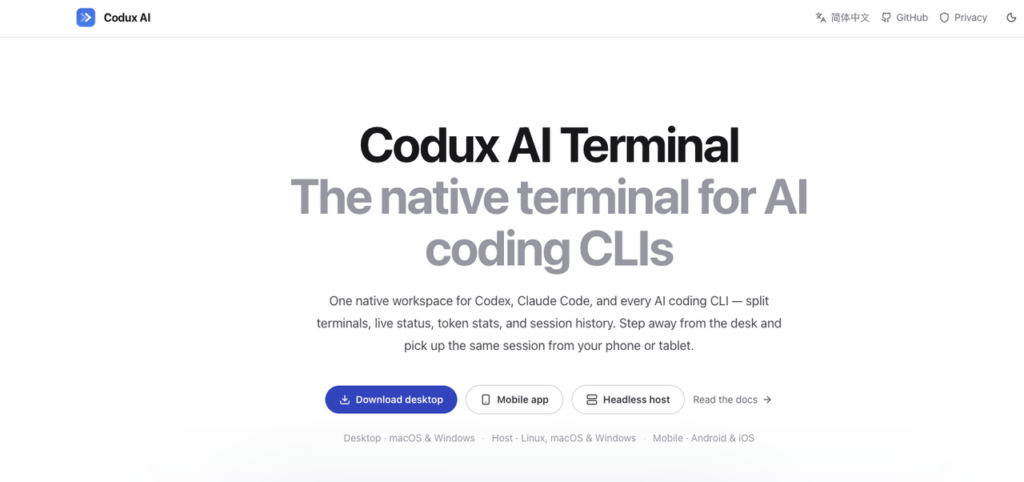
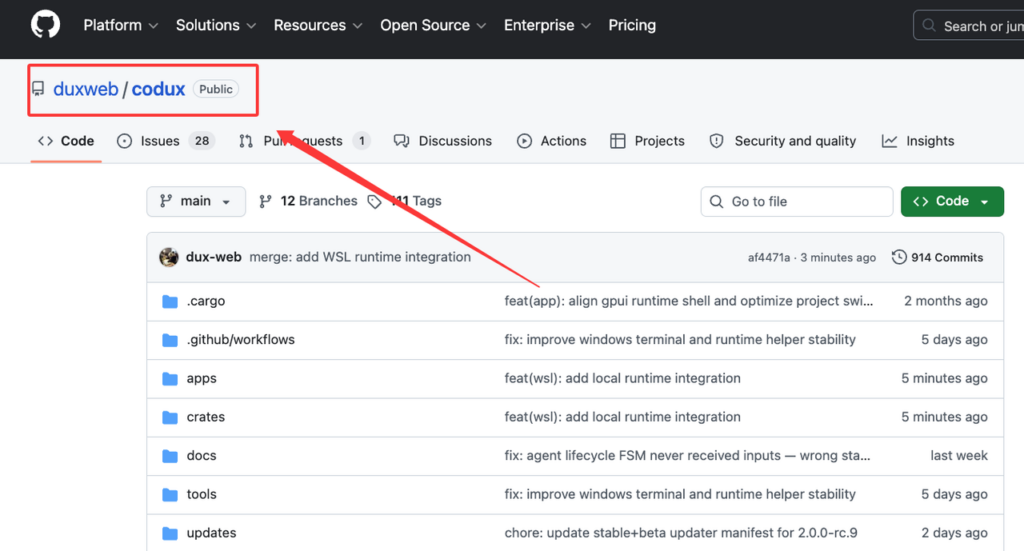
So three months ago, I started building my own tool. That became Codux: a GPL-3.0 open-source native terminal for AI coding, now at 2.0 RC. This is not meant to be a feature dump. I want to explain the design decisions, because every feature came from a specific failure mode.
Why Not Electron
The first decision was the UI stack.
Codux is not an app I open once in a while. It is a desktop workspace that stays open all day. It needs to render several fast-scrolling terminals at once, while also showing Git state, files, agent status, token usage, remote sessions, and local memory. Electron can do a lot, but it was not the direction I wanted.
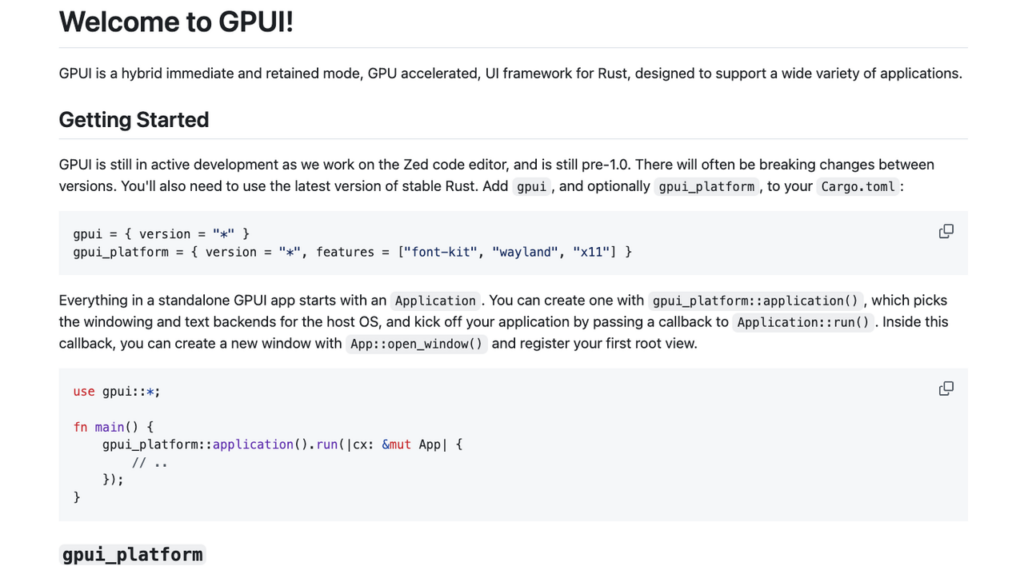
I ended up choosing GPUI, the UI framework behind Zed. The reasons were practical.
First, GPU rendering. Multiple terminals can be noisy, and frame stability matters.
Second, Rust all the way down. The terminal layer uses the alacritty crate, and PTY, networking, and state management are all Rust as well. I did not want to keep crossing language boundaries for a tool that lives close to the terminal.
Third, the state model fits this kind of app. GPUI’s Entity plus observer model, combined with snapshot rendering, means unchanged data does not need to trigger unnecessary redraws. For a long-running terminal workspace, that matters.
The cost is real. Documentation is thin. Many controls have to be built by hand. Linux desktop support is still not mature enough, which is why Codux currently only supports Linux as a headless host.
There were also plenty of sharp edges. You cannot read back a view entity inside a snapshot builder. An observer can fire while an entity is still inside an update lease, and reading it there will panic. If an observer is synchronously reachable from an action handler and needs to write back into app state, that write has to be deferred.
Each of those deserves its own post. But the upside is that the terminal can be refined at a very low level.
Codux supports things like:
⌘F search through scrollback with direct jump
Floating terminal windows
Pasting a screenshot into the terminal and turning it into a file path automatically
IME candidate windows that follow the cursor precisely
Terminal titles that show the active AI tool and model
Multiple active terminals without status updates dragging down rendering
These are not checklist features. They come from spending ten hours a day inside terminals. After a while, your hands remember what is annoying.
Status Detection Without Writing Files, Changing Config, or Installing Hooks
Codux needs to support multiple AI CLIs: Codex, Claude Code, OpenCode, Kiro CLI, Kimi Code, CodeWhale, MiMo Code, and Agy. It needs to know what each one is doing: generating, waiting for confirmation, idle, or finished. It also needs to track token usage and inject context where the tool supports it. The easiest approach would be obvious: write prompt files into the user’s repo, mutate global config, or install hooks.
A lot of tools go that way. I made all three red lines.
Codux detects state through process inspection and incremental parsing of each tool’s session files. It can distinguish between generating, waiting for confirmation, idle, and finished. “Waiting for confirmation” gets its own visible state, because yes, I have had an agent sit at a y/n prompt for forty minutes. More than once.
Context injection only uses official or clearly controlled channels. Codex uses developer instructions. Claude Code uses --append-system-prompt. OpenCode uses a managed plugin. Kimi uses --agent-file. If a tool does not have a confirmed non-invasive injection path, Codux does not force one by writing files into the project.
That line costs engineering time. But when a user uninstalls Codux, their environment should be clean. Their repo should not be left with my “smart” prompt files scattered around. That tradeoff feels right.
Worktrees Are the Task Container
The biggest problem with parallel agents is not that they misbehave. It is that they share a workspace. If two agents edit the same repo at the same time, no amount of polite prompting will keep Git clean forever. Instead of asking agents to avoid stepping on each other, Codux isolates the work physically.
In Codux, every task is a git worktree. A task owns its terminals, Git state, file view, and AI sessions. Switching tasks is not just switching tabs. It is switching the whole working context atomically.
ome back three days later, and the terminal is still exactly where it was.
The Git panel follows the same idea. You can stage, unstage, and discard at the directory level. You can inspect what the agent changed, keep what is good, and throw away what is not. The more I use this model, the more obvious it feels.
For agent-based development, a worktree should not be an advanced Git trick. It should be the default task boundary.
Credentials: The Process That Knows the Secret Should Not Be the Model
The part I am most strict about is credentials.
The threat model is simple: once a password enters a prompt, it enters model context. Once it enters context, it may enter transcripts. From there it may enter logs. In the worst case, it may travel farther than you expected.
Letting an agent read config files is even worse. That is basically handing it your ~/.ssh, database URLs, and test environment secrets. Writing “do not leak this” in a prompt is not a security boundary. So Codux separates knowing a credential from using a credential.
Connection profiles are stored in the desktop app and can be tested there. On the agent side, only two commands exist:
list only returns profile names and hostnames. The real password, private key, and connection string are injected inside a helper process. The model only ever sees the profile name.
If a database profile is marked read-only, the wrapper enforces a single-statement allowlist at the syntax layer. DROP and UPDATE are rejected before they get anywhere dangerous. This does not depend on the model “being careful.”
The boundary belongs at the process layer, not inside the prompt.
You Can Leave. The Task Should Not.
“Phone takeover” sounds like remote desktop, but Codux is not built as remote desktop.
The desktop app, mobile app, and headless host are peers. The transport layer uses end-to-end encrypted P2P when possible, and falls back to a relay when NAT gets in the way. The relay only sees ciphertext. No public IP is required. The important part is the session model: the work always stays on the host.
The PTY, agent process, terminal history, and task state all live on the host machine. The phone connects to the same running session. You can press enter, approve a permission request, or watch live output from your phone. When you return to the desktop, you keep working with the same processes.
Disconnect and reconnect, and you get the same task back. The headless codux-agent installs with one script and detects the system architecture automatically. If GitHub is slow, there is a --mirror option. codux install registers a launchd or systemd service. codux qrcode prints a pairing code. codux update upgrades itself.
My unused Mac mini finally has a job.
The hardest part here was the remote terminal protocol. Incremental frames plus baseline snapshots. Per-viewer acknowledgements. A single-owner lease for terminal size, because a phone and desktop cannot both resize the same PTY at once. Scrollback that does not reflow incorrectly across widths. It took four iterations to make that stable.
That also deserves its own post.
I also added a tunnel browser. Once the desktop connects to a host, the built-in browser can browse as the host. If Vite is running on the host at 127.0.0.1:5173, you type that locally and it opens through the Codux link. HMR, WebSocket, .local, VPN routes, all of it works without manual port forwarding. That is not a party trick. In remote development, “I just want to open the page running on that machine” is a daily need.
Memory and the Token Ledger
AI coding has two long-term problems: context disappears, and usage is hard to account for.
Codux has three layers of local memory:
User preferences
Project profiles
Module notes
When a new session starts, Codux injects that memory through the supported official channels mentioned earlier. The result is simple: you do not need to repeat that this repo uses pnpm, tests run with just test, generated files should not be touched, or a module has a known historical trap.
This is not meant to be a grand memory system. It just stores the boring things I got tired of saying again. Token tracking is split by tool, model, project, worktree, and date. It uses 30-minute buckets and a daily heatmap, stored in local SQLite.
Which project burned money? Which model was expensive? When was I actually working? You can see it. No cloud. No account. The data stays on the user’s machine.
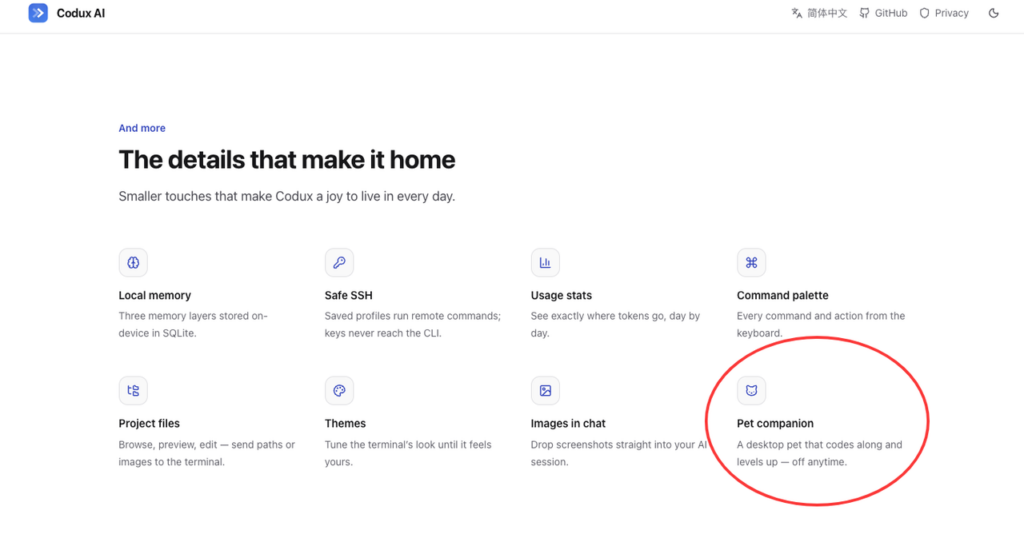
And a Pet
This part has almost no productivity value, and I like it anyway. Every token an agent burns feeds a pixel pet. It has five stats: wisdom, chaos, night, stamina, and empathy. Those stats grow from real usage patterns and working hours. If you work late, the night stat gets very real.
You can use custom skins, and old pets can retire into a hall of fame instead of disappearing. Pointless? Mostly. But I still want to check it every day.
I no longer think small emotional details are out of place in developer tools. If you spend ten hours a day with a workspace, a little personality is not a defect.
Current Status
Codux is most stable on macOS 14 and later. Windows 11 works, but still needs polish. Linux desktop is blocked by GPUI maturity for now, so Linux currently runs as a headless host. Host pairing is beta.
Updates are frequent.
macOS desktop:
brew install --cask duxweb/tap/codux
Headless host:
curl -fsSL https://raw.githubusercontent.com/duxweb/codux/main/apps/agent/scripts/install.sh | sh
When companies evaluate AI coding tools, they often start with a public leaderboard and a price-per-million-tokens table. Both are useful, but neither tells you what it actually costs to finish work in your own codebase. A benchmark may not represent your languages, build system, or engineering conventions. A cheap token can also become expensive when an agent reads too much context, retries repeatedly, or fails often enough to require human rescue.
In July 2026, Databricks published an internal benchmark built from real pull requests against its multi-million-line codebase. The tasks span Python, Go, TypeScript, Scala, Rust, Java, Protobuf, gRPC, Bazel, and other technologies. Instead of answering isolated coding questions, agents had to inspect a repository, use tools, modify files, and pass held-out tests.
The official findings are valuable on their own. The more important question for engineering leaders is what happens after pass rate, retry cost, harness behavior, and human rework are included. This article extends the Databricks benchmark with success-adjusted cost calculations, a closer look at context overhead, and a practical enterprise evaluation framework.
Bottom line: The correct procurement unit is not “one model” or “one million tokens.” It is a complete configuration: model × harness × reasoning effort × tool permissions × version. The metric that matters is the cost of work that clears your quality bar.
Alternate GLM 5.2 banner from the original WeChat article.A Chinese-localized screenshot of a post by Ali Ghodsi on X, reproduced from the source article. The benchmark itself was documented by Databricks engineering leaders.
Databricks Measured Real Engineering Work, Not Coding Puzzles
Public benchmarks are useful for tracking the frontier, but they cannot fully represent a private codebase. A dataset built mostly from public GitHub issues will not capture internal APIs, build tools, framework conventions, and years of architectural decisions. Once tasks and solutions are public, benchmark answers may also enter future training data.
Databricks therefore selected candidate tasks from recent internal pull requests and applied several filters:
Bot commits, service accounts, fully AI-generated changes, and generated files were excluded.
Tasks needed high-quality tests that could validate behavior.
Changes were kept relatively self-contained across a small number of modules.
The sample covered frontend, backend, systems code, interface definitions, and build configuration.
Reviewers extracted the real goal and constraints from each pull request while removing solution clues.
Databricks filtered recent human-authored pull requests, reconstructed blind coding tasks, and manually vetted the resulting benchmark samples. Source: Databricks.
During evaluation, the agent had to reconstruct the non-test changes from a clean benchmark state. Relevant tests were held back and applied only after the agent declared the task complete. The result was scored with executable tests rather than an LLM judge.
That approach is more objective than asking another model whether the answer “looks right,” but the tests themselves still required engineering. Databricks found cases where an exact-string assertion rejected a valid alternative implementation, so reviewers rewrote tests to validate behavior instead of one developer's precise wording.
Some tests were rewritten to check behavior rather than an exact string or implementation detail. Source: Databricks.The repository was rewound, the agent worked without the original patch or tests, and held-out tests produced an objective pass-or-fail result. Source: Databricks.
The team also discovered a classic benchmark leak: an agent could walk through Git history and recover the original implementation. Databricks fixed this by isolating the working copy from repository history during each run.
A coding agent can recover the original patch from Git history, so the benchmark isolated history to prevent answer leakage. Source: Databricks.
The lesson is broader than this benchmark: building a credible private evaluation set requires task design, held-out verification, environment isolation, and leak prevention. It is not enough to sample a few historical tickets and run an agent against them.
Four Findings That Change How Coding Agents Should Be Compared
1. The Efficient Frontier Does Not Belong to One Vendor
The benchmark's quality-cost Pareto frontier includes OpenAI, Anthropic, and open-weight models. On this workload, no single supplier dominated every useful price-quality point.
The Pareto frontier spans proprietary and open-weight models, showing that no vendor dominates every cost and quality point. Source: Databricks.
The charts compare complete model-harness-effort configurations, not isolated models. Databricks found substantial cost differences even inside the same capability band:
In the top band, with pass rates around 82%–90%, GPT-5.5 with Pi at medium effort was about 2.2× cheaper than Opus 4.8 with Claude Code at high effort.
In the middle band, around 71%–82%, Sonnet 4.6 with Claude Code was about 1.8× cheaper than Sonnet 5 with Claude Code.
In the lower band, around 51%–60%, GPT-5.4 Mini with Codex was about 1.3× cheaper than Haiku 4.5 with Claude Code.
Model-harness combinations cluster into capability bands, with large cost differences among configurations delivering similar pass rates. Source: Databricks.
The practical question is therefore not “Which model is best?” It is: Which complete configuration meets the quality threshold for this task class, under these permissions and this failure budget?
2. Open-Weight Models Have Entered the High-Capability Tier
GLM 5.2 landed in the benchmark's top capability tier and was statistically tied with Opus 4.8 on quality. Databricks reported a mean task cost of $1.28 for GLM 5.2 versus $1.94 for Opus 4.8.
This result aligns with the direction described in Z.ai's GLM 5.2 release. The model targets long-horizon work, provides a one-million-token context option and adjustable reasoning effort, and releases its weights under the MIT License. Z.ai also describes architectural changes such as IndexShare and speculative decoding optimizations intended to reduce long-context serving cost.
The two sources must still be separated. Z.ai reports vendor benchmarks, while Databricks reports a private benchmark from one company's codebase. Neither proves that GLM 5.2 can replace a closed frontier model across every language and repository. The defensible conclusion is that it deserves a place in an internal candidate pool, not that every team should switch by default.
3. A Lower Token Price Can Produce a Higher Task Cost
Sonnet 5 was about 1.7× cheaper per token than Opus 4.8, yet Databricks measured the following task-level results:
Configuration
Mean cost per attempt
Task completion rate
Relative token usage
Opus 4.8
$1.94
87%
1.0×
Sonnet 5
$2.09
81%
1.9×
Sonnet 5 worked longer and read more context, erasing its unit-price advantage. We can extend the published data with a simple success-adjusted calculation:
Opus 4.8: $1.94 ÷ 87% = about $2.23 per first-pass success.
Sonnet 5: $2.09 ÷ 81% = about $2.58 per first-pass success.
On this benchmark, Sonnet 5 cost roughly 16% more for each first-pass success despite its cheaper tokens. The estimate excludes retries, developer waiting time, and rework, so it is not a full total-cost model. It is still enough to show why a pricing table is not a procurement model.
4. The Harness Can Multiply Context Cost
A harness is the execution layer that turns a model into a coding agent. It decides how files are discovered, how the working set is maintained, which tools are called, when the agent retries, how context is compacted, how results are verified, and when the run stops.
Databricks compared Pi with Claude Code or Codex while holding the model and reasoning effort constant. Some paired configurations differed by more than 2× in cost.
For the same model, Pi was 1.20×–2.08× cheaper across the tested configurations, while pass-rate differences ranged from −7 to +3 percentage points. Source: Databricks.
The context chart explains much of the gap:
With Opus 4.8, Claude Code re-fed a median of roughly 742k context tokens per task, versus 236k for Pi—a 3.2× difference.
With GPT-5.5, Codex re-fed roughly 1,235k tokens, versus 665k for Pi—a 1.9× difference.
Repeated context, not only model pricing, drives harness-level cost. Pi re-fed substantially less context in these comparisons. Source: Databricks.
Less context does not automatically mean equal quality. In the Opus 4.8 max-effort pairing, Pi was cheaper but passed 82% of tasks versus 89% for Claude Code. In other pairings, Pi was similar or slightly better. Harness optimization therefore needs a quality floor: the goal is to reduce repeated context and unnecessary turns without crossing the organization's failure threshold.
From Model Price to Expected Business Cost
A more useful comparison starts with a simple equation:
Failure impact includes far more than a second API call:
Developer time spent reconstructing context and taking over the task.
Additional CI runs, test-environment usage, and reviewer time.
Delivery delay and requirement rework.
Rollbacks, security incidents, and technical debt when a defect reaches the main branch.
Interactive latency from long-running agent sessions.
For a low-risk configuration change, failure impact may be small enough to justify a cheaper configuration. For authentication logic, database migrations, security fixes, or cross-service refactors, the failure impact may dwarf the model-price difference. A more expensive but more reliable configuration can therefore have the lower business cost.
Routing should not be based only on task complexity. It must also account for risk and verifiability.
The Task Distribution Supports Tiered Routing
Databricks used Unity AI Gateway logs to classify its internal coding-agent sessions:
Trivial: 7.6%
Low: 19.3%
Medium: 61.1%
High: 12.1%
In other words, 26.9% of work was below medium complexity, while only about one in eight tasks was high complexity. Making the most expensive model the default for every task creates a structurally inefficient cost profile.
Most sessions were medium-complexity tasks; only 12.1% were classified as high complexity. Source: Databricks.
A safer three-tier routing design looks like this:
Low-Risk Tasks With Strong Verification
Examples include configuration changes, dependency updates, and local styling fixes. Start with a lower-cost model and lightweight harness, restrict writable directories, and require deterministic tests. Escalate automatically when verification fails or confidence is low.
Medium-Complexity Tasks
Examples include routine feature work and single-service debugging. Use the primary coding configuration, provide module-level context and repository rules, and enforce token, turn, and time budgets.
High-Risk or Cross-System Tasks
Examples include authorization, data migrations, performance-critical paths, and cross-service refactors. Use a stronger model, require plan review, execute in stages, and add independent verification, security checks, and human approval.
Routing keys should include complexity, risk, test coverage, language, repository area, and escalation conditions—not merely the title or prompt length.
Enterprises Also Need a Control Plane Above the Harness
Databricks extends model and harness portability through Omnigent. According to the Omnigent documentation, it provides a common layer across Claude Code, Codex, Cursor, Pi, and custom agents. Teams can preserve tools, prompts, skills, and policies while changing the underlying harness or model.
The related Unity AI Gateway addresses platform concerns such as identity, permissions, rate limits, budgets, usage tracking, model access, MCP access, and policies that can allow, deny, or require approval for a request.
This direction shows how AI coding is moving from “buy an assistant for each developer” toward “operate a probabilistic software-delivery system.” Omnigent and the current Unity AI Gateway experience are still early-stage or beta products, and some policy and budget features have coverage limits. Intelligent routing should not be presented as a fully solved enterprise capability.
A Practical 30-Day Internal Benchmark Pilot
The following plan is a Graphify recommendation derived from the Databricks method, not an official Databricks prescription.
Week 1: Build a Minimum Task Set
Select 30–50 merged pull requests from the last three months and stratify them by language, module, complexity, and risk. Exclude generated changes and tasks without meaningful verification. Hide the original implementation and Git history.
Thirty to fifty tasks can reveal obvious cost and failure patterns. Do not treat a one-to-three-point pass-rate difference as significant without repeated runs and a power analysis. The pilot should eliminate clearly unsuitable configurations, not produce a universal leaderboard.
Week 2: Standardize the Run Protocol
Pin the model version, harness version, reasoning effort, tool permissions, network policy, system instructions, time budget, and stopping rule. Preserve the full trajectory, patch, test result, token usage, latency, and failure category for every run.
Week 3: Measure Quality and Cost
Track more than pass rate:
Metric
Why it matters
Model cost per successful task
Prevents token-price bias
First-pass and post-escalation success
Measures routing value
Total and repeated context
Identifies harness waste
Median and P95 latency
Tests suitability for interactive work
Human review and rework minutes
Approximates real TCO
Rollbacks, security defects, regressions
Prevents over-optimization for tests
Results by language and task type
Stops averages from hiding weak segments
Week 4: Shadow and Canary
Run candidates in shadow mode before they affect a developer's primary workflow. Then roll out the best configurations as canaries on low-risk tasks. Expand default routing only after quality floors, cost ceilings, and security policies remain stable.
What This Benchmark Still Cannot Tell Us
The method is more production-relevant than a generic leaderboard, but it has important limits:
Databricks did not publish the full sample size, tasks per language, repeated-run count, random seeds, confidence intervals, or the statistical test behind “statistically tied.”
Requiring strong tests and relatively self-contained changes creates selection bias against ambiguous requirements, multi-service migrations, greenfield architecture, and long-running refactors.
Passing held-out tests does not guarantee security, performance, maintainability, architectural consistency, or low technical debt.
Reported cost is primarily a token-cost proxy. It does not fully include open-model infrastructure, latency, developer waiting time, review, and failure recovery.
The private code, tasks, prompts, tool configuration, and trajectories are not public, which limits reproducibility.
Models, default prompts, prices, and harness behavior change quickly. The results are a point-in-time snapshot, not a permanent ranking.
Benchmark contamination is not hypothetical. The SWE-rebench paper continuously collects fresh tasks for decontaminated evaluation and reports evidence that some model performance on SWE-bench Verified may be inflated by contamination. Recent private tasks reduce that risk, but teams must still isolate Git history, caches, logs, and internal knowledge systems that might expose answers.
Procurement and Rollout Checklist
Does the comparison unit include model, harness, reasoning effort, permissions, and version?
Are results segmented by language, task type, complexity, and risk?
Are tests hidden, non-vacuous, behavior-focused, and capable of distinguishing configurations?
Are Git history, networks, caches, and other answer-leak paths isolated?
Is cost measured per successful task rather than per token?
Are latency, human rework, security defects, and rollbacks included?
Do cheaper routes have a quality floor and automatic escalation?
Are new models and harnesses introduced through shadow and canary stages?
Can the organization switch vendors and harnesses without rewriting the entire workflow?
Is the benchmark rerun regularly as models and tools change?
Conclusion: Optimize the Delivery System, Not the Model Score
The most valuable part of the Databricks benchmark is not that one model “won.” It is the shift from token economics to delivery-system economics.
The model sets the capability ceiling. The harness determines how context and tools are used. Routing decides which capability is assigned to which task. Tests and governance decide whether the output can safely enter production. A failure in any layer can make a cheap model expensive—or turn an expensive model into waste.
Engineering teams should stop searching for one default model that solves everything. The better approach is to use their own code, tests, failure costs, and security boundaries to build a continuously updated evaluation and routing system.
SemiAnalysis has not exactly been enjoying a spotless reputation lately, but this Anthropic breakdown is still worth reading.
The reason is simple: Anthropic’s full financials are not public. We only get fragments from outside reporting. Barron’s has reported that Anthropic confidentially filed IPO paperwork, and AP has covered Anthropic’s latest funding and annualized revenue claims. SemiAnalysis goes further: it lays out a detailed model for revenue mix, ARR growth, token economics, and a possible long-term valuation path.
The most interesting part is not whether Anthropic is “really” worth $6 trillion.
It is that the model starts to answer a bigger question: if AI creates the first $10 trillion company, does Nvidia get there first, or does a frontier model company?
Consumer AI Is Loud. Enterprise AI Pays.
According to SemiAnalysis’s model, most of Anthropic’s ARR comes from API revenue. Subscription revenue is only around 15% of total ARR, and consumer subscription revenue is closer to 5%.
That is very different from OpenAI’s profile. SemiAnalysis estimates that more than 65% of OpenAI’s Q1 2026 revenue came from subscriptions, with consumer subscriptions still around 40% of revenue by the end of Q2 2026.
So yes, both companies sell frontier models. But the quality of the revenue is not the same.
OpenAI looks more like a massive consumer app with an enterprise API business attached. ChatGPT has enormous mindshare, but free users and heavy subscription users also create real inference costs.
Anthropic looks more like B2B infrastructure. Companies plug Claude into coding workflows, customer support, internal agents, security review, analytics, and operational processes. They pay based on usage.
That distinction matters.
Consumer AI has a strange cost structure. Users want unlimited access, but every inference costs real money. In the old internet model, free users were cheap to serve. In AI, free users are not free.
So consumer AI can build brand, habit, and distribution. But the cleaner revenue may come from enterprise use cases, where the buyer is not paying for chat. They are paying for labor substitution, workflow automation, and productivity.
That is the harder, more durable business.
The Wild Metric: Net Dollar Retention
The most aggressive number in the SemiAnalysis model is Anthropic’s net dollar retention, which it places around 500%.
In SaaS, that is absurd.
Net dollar retention measures how much more the same customer cohort spends after a year. A strong SaaS company may reach 120% or 130%. Anything above 150% is elite. 500% is a different animal.
Why can API revenue do this?
Because it is not seat-based. It is usage-based.
A SaaS customer can add more employees. That helps, but it has a ceiling. An API customer can expand usage across more workflows, more agents, more departments, and more automated tasks. Token consumption can scale far beyond the original use case.
At first, a company may use Claude for coding. Then it adds customer support, legal review, finance work, data analysis, security scanning, and internal operations. Eventually, the workflow itself becomes multi-agent.
Same customer. Much higher spend.
SemiAnalysis estimates that in Q1 2026, around $12 billion of Anthropic’s roughly $30 billion ARR came from customers that contributed only about $2 billion ARR in Q1 2025.
That is the core of the story: Anthropic does not only need new customers. Existing customers can become much larger revenue streams as agent workflows spread.
Falling Token Prices Are Not the Problem
A lot of people see lower model prices and assume model revenue must compress.
That is too simple.
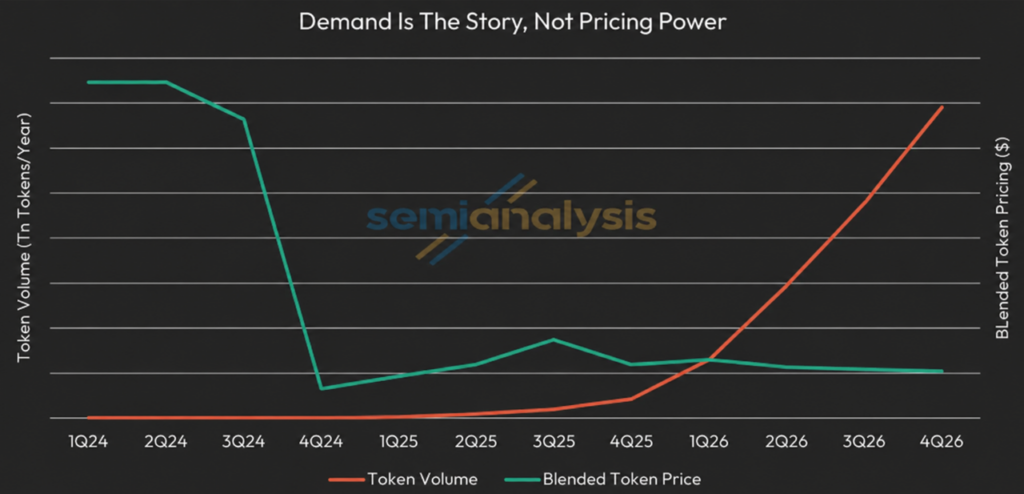
SemiAnalysis’s model argues that the key driver is not token price. It is token volume.
Average token pricing has fallen sharply since 2024. That makes sense. Inference systems get better, hardware gets faster, batching improves, and the same GPU cluster can generate more tokens. Unit cost falls.
But revenue can still grow if token consumption grows faster.
Traditional chat has a natural ceiling. A user asks a question, the model answers.
Agent workflows are different. They read files, search context, call tools, write code, run tests, inspect outputs, revise the plan, and start another pass. One agent task can consume many times more tokens than a normal chat session.
So the real formula is not:
Revenue = token price
It is:
Revenue = token price × token volume
Price can fall while volume explodes.
This is also why better hardware does not automatically hurt model companies. If GB300-class infrastructure or future systems lower the cost per token, that can unlock more use cases. The cheaper the token, the more workflows become economically viable.
Demand eats the new capacity.
ARR Growth Has Not Clearly Slowed
Another key SemiAnalysis claim is that Anthropic’s net new ARR has not meaningfully slowed.
Its model shows roughly $3 billion of net new ARR in January, $7 billion in February, and $11 billion in March. The company’s monthly net new ARR is now modeled at more than $10 billion.
If that is close to reality, the “AI revenue growth is topping out” narrative does not fit Anthropic very well.
The next question is whether new models create new workloads.
SemiAnalysis treats Fable as the next growth catalyst. The logic is straightforward: a stronger model can justify higher pricing and handle tasks that were previously out of reach, especially in coding agents, security analysis, and high-value enterprise workflows.
That is also why government restrictions matter. If top-end models cannot be fully commercialized, revenue growth gets capped. If access opens back up, new workloads can push ARR higher.
This is not just a product launch issue. It is a revenue curve issue.
B2B May Have Better Gross Margins Than Consumer AI
This is where the comparison with OpenAI gets more interesting.
OpenAI’s problem is not lack of demand. It is the cost of serving huge consumer volume. SemiAnalysis estimates that OpenAI supports more than 900 million free users, with monthly service cost around $0.70 per user.
That sounds small until you multiply it by 900 million.
Free users become a gross margin drag.
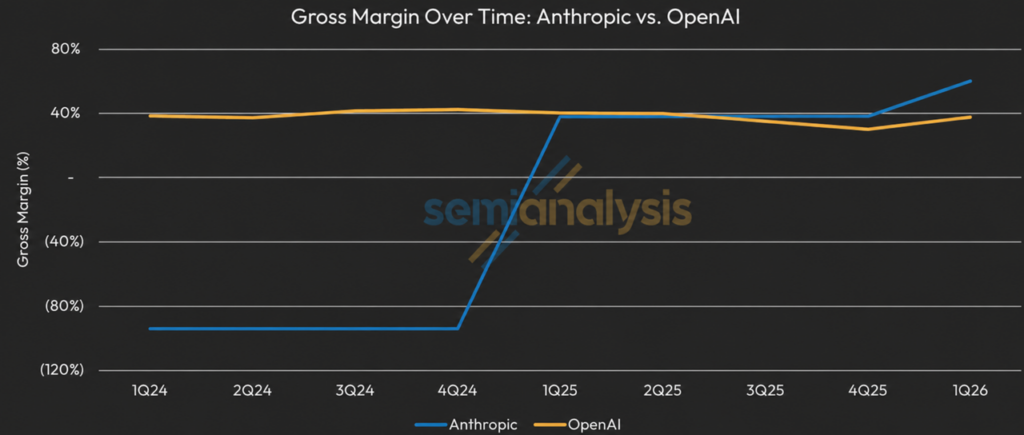
SemiAnalysis argues that if OpenAI and Anthropic both reached $100 billion of ARR, OpenAI could generate around $25 billion less gross profit than Anthropic because of the consumer cost burden.
That is a serious gap.
AI companies are not traditional software companies. A free user in software may cost bandwidth and storage. A free user in AI consumes inference compute.
This is why the subscription model is starting to look awkward. A Tom’s Guide piece summarizing SemiAnalysis’s work on AI subscription cost pressure made the same point: heavy users can consume far more compute than their monthly fee covers.
Anthropic’s B2B/API model is cleaner. Customers use more, they pay more. High-value workflows can support higher pricing. There is less free consumer traffic sitting on the P&L.
That matters because gross profit becomes fuel.
More gross profit means more money for next-generation training. Better models unlock new use cases. New use cases drive more usage. More usage funds more training.
That is the flywheel frontier model companies are trying to build.
The ROI on Frontier Model Training May Be Better Than It Looks
Everyone knows training frontier models is expensive.
But SemiAnalysis frames the cost differently. From a venture return perspective, Anthropic’s training spend may have produced an extraordinary business.
Its estimate: since Q1 2024, Anthropic has spent around $8 billion in cumulative training cost and built a business with roughly $60 billion of ARR.
If that model is directionally right, the return on invested capital is remarkable.
This does not mean every company can spend $8 billion and become Anthropic. Most cannot. Most model companies will burn capital and fail to create a durable distribution or revenue base.
But for the few winners, training cost starts to look less like ordinary expense and more like capital investment.
Train the next model.
Unlock new tasks.
Sell into higher-value workflows.
Generate more token consumption.
Reinvest cash flow into the next model.
That is why a top model company cannot be valued exactly like a traditional SaaS company. It has pieces of software, cloud infrastructure, semiconductor economics, and platform business all mixed together.
Messy, yes. But potentially very powerful.
Where the Next Growth Comes From
SemiAnalysis points to three main growth drivers.
First, existing customers continue to ramp usage in late 2026 and 2027.
This is the NDR story. New customers may start small, but once an agent workflow works, usage can expand quickly.
Second, cybersecurity could become a major market.
If Mythos or Fable-class models can reliably support security analysis, vulnerability discovery, threat detection, and code audit, the commercial value is obvious. Security teams already pay for high-value automation, and the work is complex enough to justify premium pricing.
Third, vertical industries expand the TAM.
Healthcare, finance, biotech, law, and scientific research all have expensive labor, complex workflows, and high-stakes analysis. If frontier models become good enough to enter core workflows, AI stops being a productivity toy and becomes part of production.
SemiAnalysis’s optimistic case is that Fable-driven pricing and new use cases could push Anthropic’s monthly net new ARR from more than $10 billion to around $15 billion.
If that happens, $300 billion of year-end ARR in 2027 becomes possible in the model.
From there, SemiAnalysis assumes long-term EBIT/free cash flow margins of 30% to 40%. That implies the possibility of roughly $100 billion in annual free cash flow by 2028.
That is how the $6 trillion valuation appears: $300 billion of 2027 expected ARR at 20× sales.
Aggressive? Absolutely.
But the point is not that Anthropic must be worth $6 trillion. The point is that if API revenue, agent workflows, very high net dollar retention, and strong gross margins all hold together, the valuation ceiling for model companies is much higher than many investors assumed.
The Real Takeaway
The most important part of the SemiAnalysis piece is not the $6 trillion number.
You can argue about the multiple. You can argue about the assumptions. You should definitely treat the figures as model estimates, not official company disclosures. Anthropic has not publicly released a full IPO filing.
But the bigger idea is hard to ignore:
AI monetization may not be about who has the most people chatting with a model. It may be about who gets the model embedded into enterprise workflows deeply enough that token consumption grows with business activity.
Consumer drives attention.
Enterprise drives revenue quality.
Agents drive token volume.
New models unlock new workloads.
That is why the market keeps grouping Anthropic, OpenAI, and SpaceX into the same IPO conversation. Investor’s Business Daily recently wrote about why the AI IPO path is getting more complicated. The core question is the same: will public markets keep paying for companies with explosive growth, massive capital needs, and a real shot at reshaping profit pools?
SemiAnalysis’s model is useful because it puts the pieces on one page: model capability, API usage, agent workflows, token demand, enterprise budgets, and long-term margin structure.
Even if you discount the valuation, the structure is worth paying attention to.
If the flywheel works, Anthropic is not just an app company. It is not just a cloud vendor either.
It starts to look like a new kind of infrastructure company.
Nvidia sells the shovels. Anthropic sells the labor replacement.
White paper · Research and editorial analysis · July 2026
AI coding has moved beyond autocomplete, but that does not mean a single oversized prompt can reliably run an engineering organization. The useful unit of design is increasingly a loop: a bounded system that gives an agent a goal, lets it inspect and act on a real environment, measures the result with independent evidence, records what happened, and either continues, stops, or escalates. This paper calls the discipline of designing that system loop engineering.
That definition is deliberately practical. It is not the name of an Anthropic product or an established formal standard. It is a synthesis grounded in the open-source Loop Engineering repository, the documented behavior of Claude’s agent loop, and a growing body of agent and software-engineering research. The central claim is modest: dependable agentic development comes less from making one prompt more eloquent and more from making the surrounding feedback system observable, constrained, and accountable.
An AI coding agent can examine a repository, write files, run tools, read failures, and try again. That is an internal action loop. An engineering loop is broader. It defines what work may enter the system, what context and authority the agent receives, what evidence can count as success, where durable state lives, how costs are capped, and which decisions remain human decisions. It is the difference between “please keep fixing this” and a reproducible operating model.
Five conclusions follow.
Verification is the center of the loop. A model’s declaration that it is done is not evidence. Tests, builds, linters, screenshots, policy checks, review, and observed production signals are the feedback that closes the loop. Anthropic’s Claude Code best-practices guide makes the same operational point: give the agent a check it can run so it can inspect a pass/fail result and iterate rather than leave validation to a person.
Autonomy needs boundaries, not just more retries. Every loop should have a bounded scope, allowed tools, time or turn limits, a spend budget, an attempt cap, and explicit escalation conditions. A retry without a new signal is not learning; it is often just expensive repetition.
State is a product surface. Git history, issue status, test output, a run ledger, a feature list, and a small durable memory are what allow a system to resume intelligently. Keeping all state in an ever-growing chat transcript is fragile because context is finite and degraded context produces degraded decisions.
Separation of duties improves trust. The agent that proposes or implements a change should not be the only entity that approves it. Independent evaluators, deterministic gates, isolated worktrees, and human review are not bureaucracy; they are the control surfaces that make unattended operation safer.
More “agentic” is not automatically better. For a stable, well-understood task, a deterministic workflow can be cheaper, easier to audit, and more reliable than an open-ended agent. The correct question is not “Can we add a loop?” but “What uncertainty requires adaptive decision-making, and what evidence will tell us that the loop is earning its authority?”
For leaders, the implication is straightforward. Treat loops as production systems with objectives, permissions, budgets, telemetry, and incident response—not as clever prompts. For individual engineers, begin with report-only loops and promote autonomy only after evidence shows that the loop is useful, bounded, and comprehensible.
1. What “loop engineering” means—and what it does not
In this paper, loop engineering is the design of recurring, feedback-driven systems around AI agents. A useful shorthand is:
Each arrow represents a design decision. Who chooses the objective? What sources are trustworthy during observation? Which tools can create side effects? What verification is independent of the agent’s own assertion? What data is retained for the next run? When does the system stop rather than continue? Those questions are engineering questions, even if the model call at the center is probabilistic.
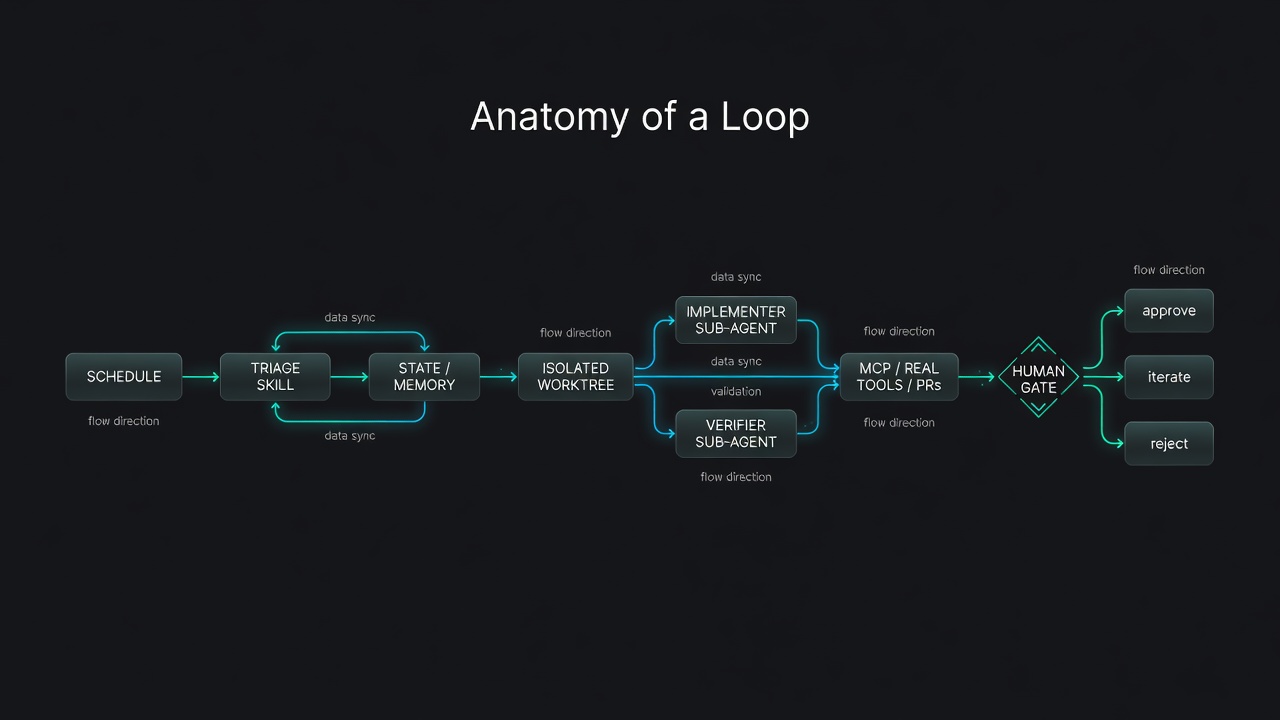
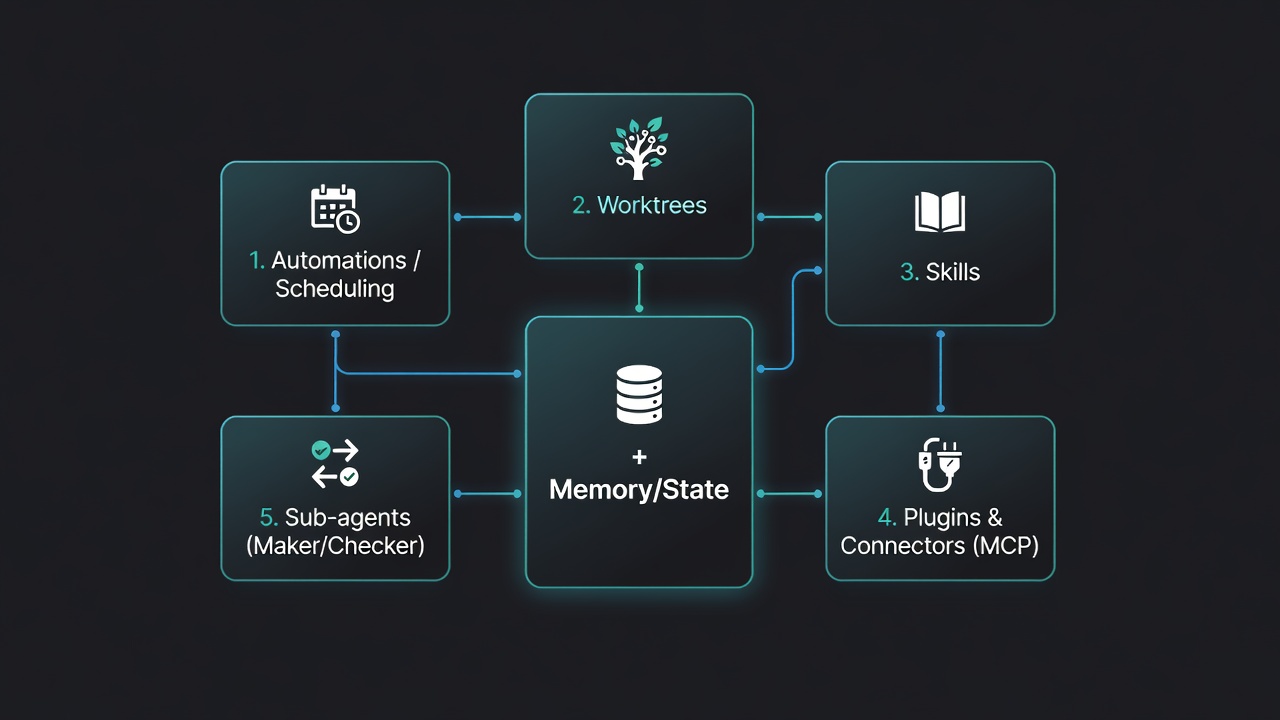
The term is associated in practice with Cobus Greyling’s open-source toolkit and related writing by Greyling and Addy Osmani. The repository presents patterns, starter kits, readiness checks, and command-line tools for recurring coding-agent work. Its conceptual model combines scheduling, isolated worktrees, reusable skills, MCP or other connectors, a maker/checker split, and durable state. Its reference flow is scheduler to triage to state to isolated implementation to verification to a connector or human gate.
That is a useful implementation framing, not a proven universal architecture. The repository’s patterns and failure stories are practitioner guidance, not independently audited outcome research. Its readiness checklist can reveal whether key controls are documented; it cannot prove that a loop is correct, secure, or economically worthwhile. This distinction matters because a scorecard can be mistaken for a safety guarantee.
Loop engineering also does not mean letting a model run indefinitely. It does not mean replacing tests with self-critique, replacing technical judgment with an approval button, or assigning the same permissions to every task. And it is not a claim that a particular vendor officially teaches a product called “Loop Engineer.” Anthropic’s current official vocabulary is more precise: its materials discuss the agent loop, goal conditions and Stop hooks, subagents, hooks, worktrees, non-interactive execution, and evaluation. Those are the building blocks from which a loop can be engineered.
2. From a model turn to an engineered system
At the model level, an agent loop is simple. A user or application supplies a prompt; the model decides whether to call a tool; the tool produces a result; that result returns to the model; and the process continues until the model returns a final response or a limit is reached. The Claude Agent SDK documentation describes this kind of repeated model-and-tool execution and exposes controls such as permissions, hooks, session handling, and turn limits.
The intellectual predecessor is the ReAct pattern: interleave reasoning with actions that retrieve evidence from an environment. Reasoning can update a plan; actions can reveal that the plan was wrong. In software work, the environment is unusually rich: a repository, dependency graph, test suite, issue tracker, CI logs, compiler, linter, browser, monitoring system, and version-control history. The quality of the interface to those tools therefore has a major effect on the outcome. SWE-agent made this argument directly by studying agent–computer interfaces for repository navigation, editing, and test execution.
But an internal tool loop is insufficient for production engineering. Consider a model that sees a test failure, changes a timeout, and gets a green run. It may have silenced a flaky test rather than fixed the defect. It may have changed an assertion to match a broken behavior. It may have passed only a narrow suite while damaging a deployment workflow. The loop had feedback, but the feedback was weak and the action surface was too broad.
An engineered loop adds an outer control layer:
Control layer
Question it answers
Concrete examples
Objective
What outcome is worth pursuing?
“Classify new issues”; “repair one reproducible CI failure”; “draft a changelog.”
Scope
What is in and out of bounds?
Repository, branch, file allowlist, maximum files changed, non-goals.
Authority
What may the system read or change?
Read-only issue access; a disposable worktree; no production database writes.
Git commits, run ledger, issue lock, concise findings, budget counter.
Governance
When must the loop stop or ask?
Risk-path gate, attempt cap, spend cap, ambiguity threshold, human approval.
“Anatomy of a Loop,” from Loop Engineering, used under the project’s MIT License. The diagram makes the separation between actor, verifier, tools, and human gate concrete.
This outer layer makes a loop inspectable by someone who did not author the original prompt. It also makes failures diagnosable. A team can ask whether a failure came from bad task intake, missing context, an overly permissive tool, a poor evaluator, stale state, or a weak escalation policy—instead of treating “the AI failed” as a single undifferentiated event.
3. External verification is the engine, not the last step
Any system can generate a plausible explanation of its own work. That is why self-reported completion is a poor success metric. A robust agent loop needs an evaluator that observes the effect of a proposed change from outside the agent’s narrative. The stronger the consequence of the action, the more independent that evaluator should be.
For coding tasks, tests are often the first useful evaluator. SWE-bench illustrates an outcome-oriented design: a task is built from a real repository state and a real issue, then assessed by whether previously failing tests pass after the candidate patch. This is much more meaningful than scoring a patch by whether it looks sensible in prose. Still, it is not the whole story. A green test suite is evidence about known behavior, not a certificate of architecture, security, operational readiness, or future maintainability.
Anthropic’s documented practice is appropriately concrete: give Claude a test, build, linter, or screenshot comparison it can execute. The agent can then work, run the check, read the result, and iterate. The same guide recommends separating exploration, planning, implementation, and review; it also recommends an adversarial review in a fresh context before a task is considered done. These are not decorations around the loop. They change the information available at the moment the agent decides whether to continue.
Four kinds of evaluator are particularly useful:
Deterministic functional checks. Unit, integration, contract, and end-to-end tests; type checking; compilation; schema validation; and reproducible browser checks. They are usually cheap to repeat and easy to record.
Constraint and policy checks. Secret scanning, dependency policy, static analysis, license checks, path allowlists, migration rules, and deployment policy. These do not prove correctness, but they limit known unsafe classes of action.
Independent review. A fresh agent, a different model, a specialist reviewer, or a human compares the output to explicit acceptance criteria. Fresh context matters because the reviewer is less likely to inherit the implementer’s mistaken framing.
Outcome monitoring. CI status after merge, error rates, rollout metrics, support signals, and incident reports. This is the feedback that tells a team whether a locally successful loop is actually helping the system over time.
The evaluation hierarchy should match the task. A changelog-drafting loop may need source links, a factuality review, and a human editor. A CI repair loop needs reproduction, an isolated test environment, and a strong rule against disabling tests to obtain green. A production deployment assistant needs even more: staged rollout, reversal, and human approval. The point is not to impose every gate on every task. It is to make the evidence proportional to the blast radius.
Research on iterative agents supports feedback, but also reveals its limits. Reflexion explores retaining textual reflections from feedback in episodic memory to guide later attempts. Self-Refine examines generate–critique–revise cycles. These are valuable patterns for making an agent reconsider an answer, yet they are not substitutes for an external test. A system that writes both the proposal and the critique can converge on a shared misconception. Treat model-generated critique as a supplement; make observed evidence the decision signal whenever possible.
4. The seven components of a durable software loop
A practical software loop can be decomposed into seven components. The components need not be separate services, and small projects should avoid unnecessary machinery. The distinction is useful because it exposes missing responsibilities.
4.1 Intake: make the work item testable
Every loop starts with an intake boundary: an issue, failed check, scheduled report, dependency update, or explicit request. The input should include a goal, scope, constraints, and a definition of done. If a ticket is too ambiguous to verify, the safe action is clarification or escalation—not speculative implementation. A good intake record distinguishes facts from assumptions and lists the data sources the agent may trust.
This is where human judgment often belongs. The model can propose questions, search the codebase, and summarize trade-offs, but it should not silently choose product behavior from an ambiguous sentence. A loop that accepts vague work items will generate apparent momentum while embedding unreviewed decisions in code.
4.2 Planner: turn the goal into a bounded approach
Planning is most useful when a change crosses files, services, or unfamiliar territory. The official Claude Code guidance recommends explore–plan–implement for this reason. In an engineered loop, the plan should name the expected evidence: which tests must fail first, which files are in scope, what commands will verify success, and which changes require a gate. This makes a plan a testable contract rather than a private chain of thought.
4.3 Context and memory: store handles, not a novel
Long-running agents create an information-management problem. Logs, source files, tool output, and partial attempts consume context. Anthropic’s context-engineering guidance recommends just-in-time retrieval, compacted summaries, and focused subagents rather than attempting to keep an entire project in one conversation. The lesson is broader: durable state should preserve decisions, identifiers, evidence, and next actions, while detailed artifacts remain retrievable by reference.
A healthy loop state record might contain an issue ID, commit SHA, current branch or worktree, reproduction command, last evaluator result, attempt count, owner, budget consumed, and escalation reason. It should not contain credentials, raw customer data, or unbounded copied logs. State must be read at the start of a run, updated at the end, and pruned when the underlying issue closes. Otherwise the loop begins acting on ghosts.
4.4 Actor: make side effects explicit and reversible
The actor is the portion allowed to modify a file, create a branch, comment on an issue, or open a pull request. Its authority should be smaller than the system’s theoretical capability. In practice that means scoped credentials, read-only defaults, worktree isolation, protected branches, and allowlists for unattended changes. The Loop Engineering safety guide recommends no auto-merge by default, denylisted sensitive paths, and human gates for authentication, payments, personal data, infrastructure, dependency changes, large diffs, and repeated failure.
These controls have familiar software-security analogues. SLSA emphasizes provenance and integrity across a software supply chain. Agentic systems add new paths to the supply chain: instructions, tool definitions, connector permissions, retrieved web content, model output, and automated commits. A loop should therefore record which agent configuration and tool versions produced an action, just as a build system records how an artifact was made.
4.5 Evaluator: judge against evidence, not enthusiasm
The evaluator receives the diff, plan, and acceptance criteria, then runs its checks independently. A maker/checker split is one of the strongest simple patterns available. It may be implemented as a deterministic CI job, a separate model invocation, a code-review agent with narrower tools, or a human review. The evaluator should be able to reject a change and state which evidence is missing. A generic “looks good” is verifier theater.
4.6 Governor: control cadence, cost, and termination
The governor decides whether another attempt is allowed. It enforces max attempts, max turns, wall-clock time, token or currency budget, notification policy, and escalation rules. These are product requirements. A loop that repeatedly applies a near-identical patch to a flaky test is not becoming more autonomous; it is failing to recognize a stop condition.
The official Ralph Wiggum Plugin in Anthropic’s Claude Code repository is a useful concrete example of bounded iteration. It documents a self-referential development loop driven by persisted files, Git state, test feedback, a completion promise, and a required maximum-iteration escape hatch. The original Ralph concept is attributed there to Geoffrey Huntley; neither the pattern nor the plugin makes unlimited retry safe. Its value is that it makes the exit condition explicit.
4.7 Human handoff: turn uncertainty into a useful queue
Escalation is not a failure state. It is the correct output when a task is ambiguous, policy-sensitive, repeatedly unsuccessful, or too consequential for the granted authority. A useful handoff includes the objective, evidence gathered, attempted actions, current state, relevant logs or links, a concise decision request, and a recommended safe next step. It should arrive in a place an owner will actually inspect—not merely be written into an obscure file.
5. Inside the Loop Engineering repository
The supplied Loop Engineering repository is a practical reference implementation of these ideas. At the main-branch revision reviewed for this paper, it is MIT licensed and provides patterns, starter folders, tool-specific examples, safety documentation, and npm command-line tools. It is not a monolithic agent runtime. It is closer to an operational kit for designing the surrounding system.
Repository implementation primitives from Loop Engineering, used under the project’s MIT License. These are the project’s practical building blocks, not a replacement for this paper’s seven control components.
Its primitives documentation identifies automation and scheduling, worktrees, skills, plugins and connectors, subagents, and durable memory or state. The design is cross-tool: the project supplies mappings and examples for Claude Code, Codex, Grok, OpenCode, OpenClaw, Cursor, Windsurf, and GitHub Actions. That portability is valuable because it keeps the control model separate from any one model interface.
The repository also provides seven recurring patterns: Daily Triage, PR Babysitter, CI Sweeper, Dependency Sweeper, Changelog Drafter, Post-Merge Cleanup, and Issue Triage. Each pattern should be read as a starting template, not a mandate. The risk profiles are very different. A report-only changelog loop can safely begin with minimal authority. A loop that changes CI configurations should be one of the last systems promoted to unattended operation.
The maturity model captures that difference well:
Level
Purpose
Minimum posture
L0 — Draft
Document the intended loop.
A goal, scope, and a human owner; no recurring action.
L1 — Report
Observe and summarize.
Read-only access, durable state, useful triage, human decides action.
L2 — Assisted
Propose narrowly scoped changes.
Isolated worktree, independent verification, review before merge.
L3 — Unattended
Act inside a tightly specified envelope.
All prior controls plus budgets, gates, auditability, and proven behavior.
The project’s quickstart explicitly recommends a report-only first week, then a staged progression toward assisted and, only when justified, unattended behavior. This is sound operational advice. The fastest way to lose trust is to start with a high-frequency loop that modifies code before anyone understands its false-positive rate or cost curve.
Its command-line tool set maps directly to the control layers described above:
loop-init scaffolds a selected pattern, state artifacts, budget files, and starter instructions.
loop-audit checks documented readiness signals and suggests missing controls.
loop-cost estimates spend for a chosen cadence and maturity level; it is a planning estimate, not an invoice.
loop-context can read a ledger and trip a circuit breaker for repeated error, failure, iteration, or budget conditions.
loop-worktree helps create and clean up isolated Git worktrees for attempts that change code.
loop-sync checks for drift between state and loop configuration; its auto-fix path is explicitly experimental and should be treated accordingly.
loop-mcp-server offers a read-only runtime lookup surface for patterns, skills, and project state. Read-only does not make it consequence-free: project state may still be sensitive.
The project also documents real failure modes, including infinite fix loops, stale state, verifier theater, notification fatigue, token burn, scope overreach, parallel collisions, and escalation failure. The CI Sweeper failure story is particularly useful as a cautionary case study because it reports high token consumption and a risky proposed change caught in human review. It should not be generalized as benchmark evidence, but it illustrates why cost, approval, and independent verification must be designed before a loop scales.
6. Claude Code: the official foundations, without false attribution
There is no official Anthropic tutorial titled “Loop Engineering.” That absence is informative rather than problematic. Anthropic’s official documentation provides the lower-level mechanisms and design guidance from which teams can build their own loops.
First, the Agent SDK loop supplies a model–tool execution cycle. Second, Claude Code best practices describes how to give agents verifiable checks, explore before planning, use subagents for investigation, manage context, run non-interactively in CI, use worktrees for parallel sessions, and run an adversarial review before accepting a result. Third, the Agent SDK overview explains how applications can programmatically access the tools, context management, and permission controls behind agentic work.
These official materials also make a useful distinction between capability and control. Claude Code can run shell commands and edit files, but it operates with permission modes and tool restrictions. Anthropic’s discussion of Auto Mode describes why permission fatigue is a real problem and why safety cannot be reduced to clicking every prompt. It presents layered controls around what agents read and what they do, including boundaries for file operations, external actions, and subagent handoffs. The general lesson is not “delegate all approvals to a classifier”; it is that a loop needs explicit trust boundaries.
A simple Claude-oriented loop might use the following components:
# A scheduler or CI job starts a bounded session.
claude -p "Read the issue, reproduce the failure, propose the smallest fix,
run the named tests, and stop if a denylisted path is required." \
  --max-turns 20

# A separate evaluator runs deterministic CI and checks the diff.
# A human reviews any pull request before merge.
The exact command and permission configuration should match current official CLI documentation, not a copied community snippet. For example, the official guide documents non-interactive execution and recommends restricting tools for unattended work. The Loop Engineering repository’s Claude examples are useful community implementation guidance, but a team should not claim that every slash command in a third-party scaffold is an official Claude Code primitive unless the official documentation independently confirms it.
The most important Claude Code lesson may be the simplest: “done” should be represented by a check the agent cannot merely talk its way around. A goal condition, a Stop hook, a test command, or a reviewer’s rejection criteria turns a conversational instruction into a closed control loop.
7. Safety, security, and least privilege
Loop design is security design because a loop combines untrusted inputs with tools that can cause side effects. A web page, issue comment, build log, repository file, or connector response can contain instruction-like text. If the agent treats that text as authoritative, it may be manipulated into changing scope or transmitting data. This is the core concern behind OWASP’s LLM risk guidance and the broader class of prompt-injection attacks.
OpenAI’s prompt-injection security analysis frames the practical danger as a path from an attacker-controlled source to a sensitive sink: untrusted content influences an agent that can transmit information, follow a link, invoke a tool, or change a system. That source–sink model is useful for coding loops. Any loop that reads issues or web documentation and then has write access to source control, deployment, chat, or customer data should be threat-modeled as a system that crosses trust boundaries.
Minimum controls should include:
Least-privilege credentials. Separate bot identities and narrowly scoped tokens. A triage loop needs read access, not merge rights. A documentation loop should not inherit cloud-admin credentials.
Path and action policy. Denylist secrets, authentication, payments, production infrastructure, migrations, and credential files unless a human explicitly authorizes the specific change. Restrict destructive Git, package, database, and network operations.
Isolation. Use disposable worktrees, containers, sandboxes, or ephemeral environments for code-changing attempts. Keep production data and credentials out of the default execution context.
Confirmation at the boundary. Require human approval before publishing, deploying, merging, changing access policy, sending external messages, or transmitting sensitive data.
Observability and reversibility. Log tool calls, inputs, decisions, diffs, evaluator output, and handoffs. Prefer branches, pull requests, feature flags, dry runs, and rollback plans over irreversible direct action.
Incident response. Define how to pause the scheduler, revoke credentials, revert output, inspect the trace, notify owners, and tighten the policy before a restart.
The NIST AI Risk Management Framework organizes continuous risk work as govern, map, measure, and manage. That structure maps well to loop engineering: govern the authority and owner; map data, tools, and impacts; measure evaluator quality and outcomes; manage thresholds, incidents, and improvements. The Generative AI Profile is a useful companion for teams turning those principles into operational controls.
8. Economics, telemetry, and the problem of silent failure
Agent loops incur more than model-token cost. They consume API calls, CI capacity, review attention, queue space, storage, external-tool quotas, and engineering trust. A system can be technically capable but economically irrational if it performs a long chain of work for empty triage, repeats a failed attempt without new evidence, or sends so many notifications that people mute the channel.
Measure the loop as a service. At a minimum, record run count, items observed, items acted upon, completion rate, rejection rate, evaluator failures, retry distribution, time to escalation, token or currency spend, CI minutes, cost per accepted outcome, and human-review time. Add quality measures specific to the task: regressions after merge, rollback rate, false-positive triage rate, reopened issues, reviewer acceptance, or documentation corrections. Metrics should be interpreted with context. A high number of pull requests is not a success metric if most are rejected.
The repository’s operating guidance and cost estimator reinforce the importance of cadence, early exit, budgets, and kill criteria. Before scheduling a loop, model its likely path: cheap triage first; expensive research or subagents only for actionable items; code modification only after a strong signal; separate verification; and an exit when the queue is empty. This funnel is usually better than applying the largest available model and every connector on every tick.
Notification design is equally important. A loop should distinguish “I ran,” “I found something,” and “a human decision is needed.” The first belongs in logs, the second may belong in a digest, and the third deserves a targeted alert with enough evidence to decide. If every heartbeat becomes an interruption, an organization loses the very human oversight that makes automation safe.
Readiness-audit demonstration from Loop Engineering, used under the project’s MIT License. An audit score is a prompt for improvement, not proof that a loop is safe or correct.
9. How to evaluate a loop before trusting it
Evaluating an agent loop differs from evaluating a single response. The object of evaluation is a trajectory through an environment: the input, actions, tool results, intermediate state, final artifact, cost, and side effects. Anthropic’s guide to agent evaluations recommends defining tasks, trials, graders, traces, and outcomes; using deterministic grading where possible; repeating trials for non-deterministic systems; and reviewing transcripts rather than relying only on aggregate scores.
A practical evaluation program has four layers.
Offline capability suite. Representative tasks with controlled environments and explicit expected outcomes. Include normal cases, edge cases, ambiguous inputs, missing prerequisites, and policy-sensitive paths.
Regression suite. Historical failures, prior incidents, rejected pull requests, and adversarial examples become permanent tests. A loop should not silently reintroduce a known mistake after a model or prompt update.
Shadow or report-only run. The loop observes live work but does not act. Compare its recommendations with what experienced engineers actually did. This estimates relevance and false-positive cost before authority is granted.
Production monitoring. Once action begins, monitor outcome quality, policy violations, latency, cost, and human overrides. Use canaries and gradual rollout; do not promote a loop on the basis of a handful of impressive demos.
Benchmarks help define the discipline but should not be overread. SWE-bench captures issue-resolution behavior in real repositories; Terminal-Bench evaluates realistic command-line tasks; and OSWorld studies open-ended computer environments. None of these alone measures whether a loop will safely maintain a particular company’s codebase, security posture, or approval workflow. Use external benchmarks to understand categories of capability, then build an internal suite around actual risk.
10. Multi-agent loops: parallelism with a coordination tax
Multi-agent designs can be excellent when a task decomposes cleanly: one agent researches a failing subsystem, another maps test coverage, a third inspects a diff for security issues, and an orchestrator synthesizes the evidence. Anthropic’s multi-agent research-system write-up describes an orchestrator–worker pattern and warns that parallel workers increase token use and coordination complexity. The same trade-off applies to code.
Use parallelism for independent discovery, evidence gathering, or review—not as a default response to every task. Give each worker a narrow objective, a bounded tool set, a separate context, and a structured return artifact. Do not let several actors edit the same working tree. The Loop Engineering project’s multi-loop guidance recommends one owner per branch, separate state files, shared constraints, aggregate budgets, and locks that record what each loop is acting on. These are familiar concurrency controls expressed in agentic terms.
Maker/checker is often the first multi-agent pattern worth adopting. The maker receives the task and prepares the smallest valid change. The checker gets the criteria and diff, runs independent tests, and looks for reasons to reject. For complex work, add specialized reviewers only when they bring distinct evidence: security, accessibility, data migration, or domain rules. More agents using the same prompt, same tools, and same assumptions are often correlated redundancy rather than independent validation.
11. When not to use a loop
One of the most mature loop-engineering decisions is choosing not to build a loop. Anthropic’s guidance on effective agents argues for starting with the simplest solution and adding agentic behavior only when dynamic decision-making is necessary. The research paper Agentless is an important counterweight: on its evaluated software-repair setting, a simpler localization–repair–validation approach achieved strong results without a complex autonomous agent.
Prefer a deterministic workflow when the task has stable inputs, known transformations, low ambiguity, and a clear schema. Examples include formatting, a controlled dependency report, a fixed database migration generator, a known lint autofix, nightly artifact validation, or a standardized release-note template. A script is cheaper to test, easier to audit, and more predictable than an agent deciding how to improvise.
Do not automate beyond human control when the action is irreversible, material, or underspecified: changing production access, handling secrets or personal data, performing financial operations, deleting data, making legal or policy decisions, or merging a behavior change with inadequate tests. An agent may still support the human by gathering evidence, producing a plan, preparing a draft, or running a simulation. Assistance and delegation are not the same thing.
12. A phased adoption blueprint
The following twelve-week blueprint is intentionally conservative. Its purpose is to establish evidence before privilege.
Phase 0: establish the baseline
Choose one painful but bounded workflow. Define the owner, input sources, outcome, non-goals, risks, existing manual steps, and current cost. Identify the deterministic checks that already exist and the gaps that must be filled before automation. Write the stop and escalation conditions before building the actor.
Phase 1: report-only triage
Run on a modest cadence with read-only tools. Produce a structured report and update a small state ledger. Measure relevance, false positives, time saved, and notification quality. Have a human compare the loop’s recommendations to real decisions. Improve the intake and evidence requirements until the report becomes trusted.
Phase 2: assisted change in isolation
Permit a loop to create a worktree or branch and propose a small patch. Require a reproduction, a test or build result, a diff summary, and an independent evaluator. Do not auto-merge. Track reviewer acceptance and the reasons for rejection. Use rejected attempts to refine scope, not merely to add more prompt text.
Phase 3: narrow unattended action
Only after repeated evidence should a loop receive narrowly specified unattended authority: for example, opening documentation-only pull requests, applying a known formatter under an allowlist, or updating a non-production status label. Enforce budget, rate, and attempt caps. Keep human gates around consequential actions. Test the kill switch and rollback path before the first unattended run.
Phase 4: continuous evaluation and governance
Review the loop’s outcomes on a fixed schedule. Audit permissions, connector scopes, dependencies, and secret exposure. Add incidents and near-misses to the regression suite. Prune stale state. Revisit whether the loop should be simplified, narrowed, paused, or retired. The goal is not maximum automation; it is a sustainable improvement in quality-adjusted throughput.
13. A minimum viable loop, implemented cautiously
For a team using the Loop Engineering toolkit, a conservative starting sequence looks like this:
# Scaffold a report-only pattern for the chosen agent integration.
npx @cobusgreyling/loop-init . --pattern daily-triage --tool claude

# Estimate cadence and maturity-level cost before scheduling.
npx @cobusgreyling/loop-cost --pattern daily-triage --level L1 --cadence 1d

# Inspect documented controls and receive recommendations.
npx @cobusgreyling/loop-audit . --suggest

# For a later L2 code-changing attempt, create an isolated worktree.
npx @cobusgreyling/loop-worktree create --run-id issue-123-attempt-1 --pattern issue-triage

# Before a retry, check the ledger for repeated failures or budget limits.
npx @cobusgreyling/loop-context --check --ledger loop-ledger.json
These commands are not a deployment recipe. The tool, pattern, credentials, scheduling mechanism, and verification commands must be adapted to the project. The right first loop may have no code-changing capability at all. The most valuable outcome in the first week is often a reliable report that tells the team what should not be automated yet.
A minimal LOOP.md should answer these questions in plain language:
What single outcome does this loop pursue, and what does it explicitly not do?
Which repositories, branches, files, issues, and connector operations are in scope?
Which commands or evaluators establish success, and who owns them?
What durable state is read first and written last?
What are the max turns, attempts, cost, cadence, and notification rules?
Which paths, actions, or signals require immediate human escalation?
How does a person pause the loop, revert its work, and inspect its trace?
If the answers are vague, the loop is not ready for more autonomy. That is not a limitation of the model; it is a sign that the human system has not yet made its own operating assumptions explicit.
14. Final principles
Loop engineering reframes AI coding from a prompt-writing exercise into systems design. The model remains important, but it is one component inside a larger control system. The highest-leverage improvements are frequently mundane: a better test command, a smaller scope, a preserved run ledger, a fresh reviewer, a worktree, a denylist, a budget cap, or an escalation that reaches the right person.
Build loops that can explain what they are doing, show the evidence for their last decision, respect a boundary when they meet one, and leave the codebase easier—not harder—for the next engineer to understand. Start where the evidence is strongest. Promote autonomy slowly. And never confuse activity, token spend, or a confident final message with engineering success.
I’m Evan. I would not normally write a whole page about capitalization, package names, and company names. But this is one of those boring naming problems that quietly breaks developer workflows.
A developer searches Graphify, sees graphifyy on PyPI, then runs into GraphifyLabs or Graphify Labs on GitHub and the company site. At that point, the question is no longer just “which name is correct?” It becomes: which source should I trustbefore I install something, cite it in docs, or wire it into an AI coding memory workflow?
So here is the clean split. Graphify is the project and the broader code knowledge graph idea. graphifyy is the Python package name. Graphify Labs is the organization layer behind the public project and company-facing presence. Small distinction. Real consequences.
What Graphify Means in AI Coding
Graphify sits in a very specific part of the AI coding workflow. It is not just another autocomplete tool, and it is not a generic search box for a repo. The public Graphify official site describes it as an open-source knowledge graph skill for AI coding assistants, built to turn code, docs, papers, and diagrams into a queryable graph.
That distinction matters. A normal AI coding assistant can read files. It can also guess pretty confidently when it has the wrong files. The failure is usually quiet: the assistant edits the wrong layer, misses an old design note, or treats two similar modules as interchangeable.
A code graph tries to reduce that kind of guessing. It gives the assistant a map of relationships: which files call each other, which concepts sit at the center of the system, where docs explain design intent, and which paths are worth checking before making an edit.
This is also why searches like “graphify ai” can be ambiguous. Sometimes the reader wants the product. Sometimes they want the method: using a code knowledge graph to make AI coding more reliable. This page is meant to separate those meanings without pretending the naming is cleaner than it is.
graphify vs graphifyy vs GraphifyLabs
Name
Best use
What it should mean
Graphify
Product, project, and concept name
The codebase graph layer for AI coding workflows
graphifyy
Install/package name
The Python package on PyPI
GraphifyLabs / Graphify Labs
Organization/company name
The entity behind the public project and company site
graphify as the project and concept
When I write “Graphify” in an article, I mean the project or the concept first. That includes the knowledge graph layer, the CLI behavior, the assistant skill, and the broader workflow around codebase context.
This is the right name for educational pages, comparison articles, and architecture discussions. For example, an article about [codebase context](/codebase-context) should use Graphify when discussing how an assistant navigates relationships in a repo. It should not switch to graphifyy unless the sentence is about installation.
That small boundary keeps the article readable. Readers do not want every paragraph to sound like package metadata.
graphifyy as the Python package name
graphifyy is the package name. Use it when the reader needs to install or verify the Python distribution. As of July 8, 2026, the PyPI project page lists the package as graphifyy, and the project description also makes the double-y naming clear.
This is the source I would check first for install commands, package release dates, Python requirements, extras, and package metadata. If PyPI and a blog post disagree, PyPI wins for installation. Not the homepage. Not an old tutorial. Not a copied command in a social post.
The practical rule is simple:
uv tool install graphifyy
But after installation, the command users see may still be Graphify. That is normal. Package names and CLI commands do not have to match. Python developers have seen this pattern before, and over-explaining it usually creates more confusion than it removes.
GraphifyLabs as the company
GraphifyLabs is the search-friendly way some users type the company name, but public profiles show a few forms. On GitHub, the project appears under the Graphify-Labs organization, while the public profile links back to graphifylabs.ai. The company-facing site then uses the broader Graphify positioning around persistent memory and connected working context.
For copy, I would use “Graphify Labs” when referring to the organization in prose. I would keep “GraphifyLabs” only where it matches search intent, metadata, or user queries. That way, the page can rank for the no-space query without making the brand look careless.
Do not use GraphifyLabs as a synonym for the open-source package. That blurs the product layer and the organization layer. It also makes future redirects harder.
Why Code Knowledge Graphs Matter for AI Coding
The model is not always the bottleneck. The context often is.
In a small repo, an assistant can usually survive with file search, editor context, and a decent prompt. In a larger repo, the task stops being local. A change may depend on module boundaries, generated code, internal docs, SQL schema, old RFCs, or comments that explain why a strange branch exists.
That is where a code knowledge graph becomes useful. It gives structure to the things a model would otherwise discover slowly or miss entirely. The public Graphify GitHub repository describes the project as an AI coding assistant skill that turns folders of code, schemas, scripts, docs, papers, images, and videos into a queryable graph.
The value is not “more context” in a vague sense. More context can make an answer longer without making it safer. The useful question is whether the assistant can find the right path through the repo before editing. If the graph helps answer that, it belongs in the workflow. If it only produces a pretty visualization that nobody checks, it becomes another stale artifact.
How Graphify Fits With Codebase Memory
AI coding memory is useful only when it stays close to the code. A memory layer that remembers yesterday’s decision but ignores today’s refactor can make the assistant more confident and less correct. That is a bad trade.
Graphify fits best as a structured memory layer for codebase relationships. It can sit beside [AI coding agents](/ai-coding-agents), repo onboarding workflows, and [MCP servers](/mcp-servers) that expose project context to tools. In that setup, the assistant should ask narrower questions before reading half the repo. It should trace relationships, check source-backed paths, and make its assumptions visible.
I would test it on tasks where ordinary search starts to feel thin:
A refactor crosses three or more modules.
A bug depends on generated code or config.
The relevant design note lives outside the source file.
The assistant keeps finding plausible but wrong files.
Review cost goes up because the AI changed too much.
This is not necessary for every project. A small library with clear files may not need a graph layer. But once context repair becomes a fixed cost in every AI coding session, the graph starts to make sense.
Naming Limits and Neutrality Rules
I would keep this boring on purpose. Naming pages do not need drama. They need a rule that a developer can trust five minutes before shipping docs.
This page should not turn into a product pitch. Naming pages work best when they answer the reader’s question quickly and keep the boundaries visible.
The neutral rules I would use are:
Use Graphify for the project, product, and concept.
Use graphifyy only for the Python package and install context.
Use Graphify Labs for the organization.
Use GraphifyLabs only as a search variant, not the main prose style.
Check PyPI before publishing install instructions.
Check GitHub before claiming repo status, license, stars, or ownership.
Check the company site before summarizing the official business positioning.
I would also avoid hard claims that are easy to stale-date. Do not freeze GitHub stars, install counts, benchmark numbers, or enterprise claims into the article unless the page has an update process. If those details are needed, add a “last checked” date next to them.
For this page, the stronger brand moat is not hype. It is clean disambiguation. A developer who searched the wrong name should leave knowing exactly which source to trust next.
FAQ
Which source should be checked first if naming changes?
I would check the source closest to the thing being named. For install naming, check the graphifyy PyPI page first. For repo ownership and open-source status, check the GitHub repo and GitHub organization. For company positioning, check the official Graphify Labs site.
If two sources disagree, do not merge them into one confident sentence. Say which source says what, add the check date, and update the page after the official source stabilizes.
Should old mentions redirect to one canonical page?
Yes, but not everything should point to the homepage. Old mentions of graphifyy should redirect or point to the installation section. Old “GraphifyLabs” mentions should point to the organization or naming section. Old generic Graphify mentions can point to the main canonical page.
This keeps the redirect useful. It also protects search intent. Someone looking for a package name is not always ready for a company page.
When should this page be updated after a release?
Update it whenever a release changes package metadata, install commands, assistant support, repo ownership, license language, or official positioning. I would also recheck it after any major GitHub release, PyPI release, or company-site rewrite.
For normal maintenance, a quarterly naming audit is enough. For launch weeks, check within 24 to 48 hours after release. Naming drift is boring until it breaks installs, search snippets, and support replies.
Conclusion
Graphify, graphifyy, and Graphify Labs are related, but they should not be collapsed into one label. The project name explains the code knowledge graph idea. The package name tells developers what to install. The company name tells readers who stands behind the work.
That separation is the page’s job. Not to oversell the tool. Not to pretend every repo needs a graph. Just to give developers a clean map before they copy a command, cite the project, or build Graphify into an AI coding memory workflow.
That is the boring part of naming work. It only looks small until the wrong name breaks an install, a citation, or a support reply.