SemiAnalysis has not exactly been enjoying a spotless reputation lately, but this Anthropic breakdown is still worth reading.
The reason is simple: Anthropic’s full financials are not public. We only get fragments from outside reporting. Barron’s has reported that Anthropic confidentially filed IPO paperwork, and AP has covered Anthropic’s latest funding and annualized revenue claims. SemiAnalysis goes further: it lays out a detailed model for revenue mix, ARR growth, token economics, and a possible long-term valuation path.
The most interesting part is not whether Anthropic is “really” worth $6 trillion.
It is that the model starts to answer a bigger question: if AI creates the first $10 trillion company, does Nvidia get there first, or does a frontier model company?

- Consumer AI Is Loud. Enterprise AI Pays.
According to SemiAnalysis’s model, most of Anthropic’s ARR comes from API revenue. Subscription revenue is only around 15% of total ARR, and consumer subscription revenue is closer to 5%.
That is very different from OpenAI’s profile. SemiAnalysis estimates that more than 65% of OpenAI’s Q1 2026 revenue came from subscriptions, with consumer subscriptions still around 40% of revenue by the end of Q2 2026.
So yes, both companies sell frontier models. But the quality of the revenue is not the same.
OpenAI looks more like a massive consumer app with an enterprise API business attached. ChatGPT has enormous mindshare, but free users and heavy subscription users also create real inference costs.
Anthropic looks more like B2B infrastructure. Companies plug Claude into coding workflows, customer support, internal agents, security review, analytics, and operational processes. They pay based on usage.
That distinction matters.
Consumer AI has a strange cost structure. Users want unlimited access, but every inference costs real money. In the old internet model, free users were cheap to serve. In AI, free users are not free.
So consumer AI can build brand, habit, and distribution. But the cleaner revenue may come from enterprise use cases, where the buyer is not paying for chat. They are paying for labor substitution, workflow automation, and productivity.
That is the harder, more durable business.
- The Wild Metric: Net Dollar Retention
The most aggressive number in the SemiAnalysis model is Anthropic’s net dollar retention, which it places around 500%.
In SaaS, that is absurd.
Net dollar retention measures how much more the same customer cohort spends after a year. A strong SaaS company may reach 120% or 130%. Anything above 150% is elite. 500% is a different animal.
Why can API revenue do this?
Because it is not seat-based. It is usage-based.
A SaaS customer can add more employees. That helps, but it has a ceiling. An API customer can expand usage across more workflows, more agents, more departments, and more automated tasks. Token consumption can scale far beyond the original use case.
At first, a company may use Claude for coding. Then it adds customer support, legal review, finance work, data analysis, security scanning, and internal operations. Eventually, the workflow itself becomes multi-agent.
Same customer. Much higher spend.
SemiAnalysis estimates that in Q1 2026, around $12 billion of Anthropic’s roughly $30 billion ARR came from customers that contributed only about $2 billion ARR in Q1 2025.
That is the core of the story: Anthropic does not only need new customers. Existing customers can become much larger revenue streams as agent workflows spread.
- Falling Token Prices Are Not the Problem
A lot of people see lower model prices and assume model revenue must compress.
That is too simple.
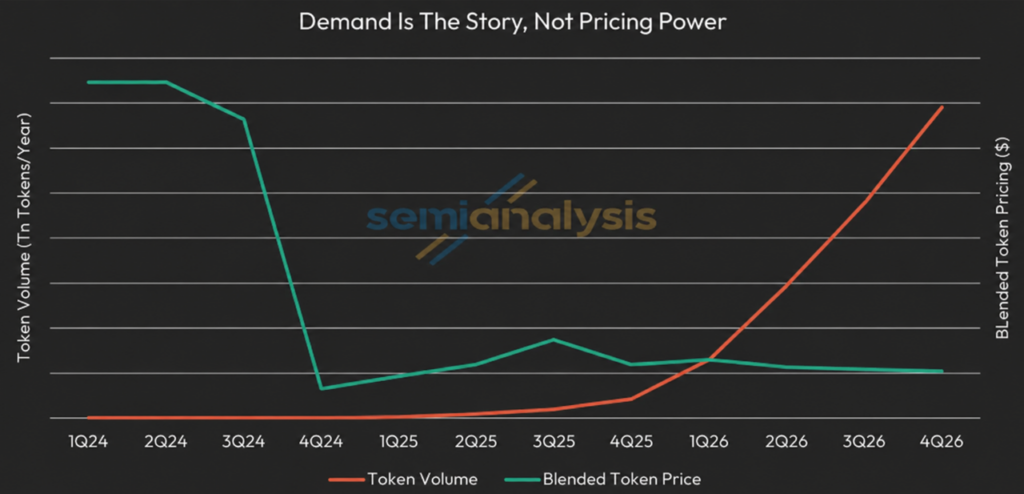
SemiAnalysis’s model argues that the key driver is not token price. It is token volume.
Average token pricing has fallen sharply since 2024. That makes sense. Inference systems get better, hardware gets faster, batching improves, and the same GPU cluster can generate more tokens. Unit cost falls.
But revenue can still grow if token consumption grows faster.
Traditional chat has a natural ceiling. A user asks a question, the model answers.
Agent workflows are different. They read files, search context, call tools, write code, run tests, inspect outputs, revise the plan, and start another pass. One agent task can consume many times more tokens than a normal chat session.
So the real formula is not:
Revenue = token price
It is:
Revenue = token price × token volume
Price can fall while volume explodes.
This is also why better hardware does not automatically hurt model companies. If GB300-class infrastructure or future systems lower the cost per token, that can unlock more use cases. The cheaper the token, the more workflows become economically viable.
Demand eats the new capacity.
- ARR Growth Has Not Clearly Slowed
Another key SemiAnalysis claim is that Anthropic’s net new ARR has not meaningfully slowed.
Its model shows roughly $3 billion of net new ARR in January, $7 billion in February, and $11 billion in March. The company’s monthly net new ARR is now modeled at more than $10 billion.
If that is close to reality, the “AI revenue growth is topping out” narrative does not fit Anthropic very well.
The next question is whether new models create new workloads.
SemiAnalysis treats Fable as the next growth catalyst. The logic is straightforward: a stronger model can justify higher pricing and handle tasks that were previously out of reach, especially in coding agents, security analysis, and high-value enterprise workflows.
That is also why government restrictions matter. If top-end models cannot be fully commercialized, revenue growth gets capped. If access opens back up, new workloads can push ARR higher.
This is not just a product launch issue. It is a revenue curve issue.
- B2B May Have Better Gross Margins Than Consumer AI
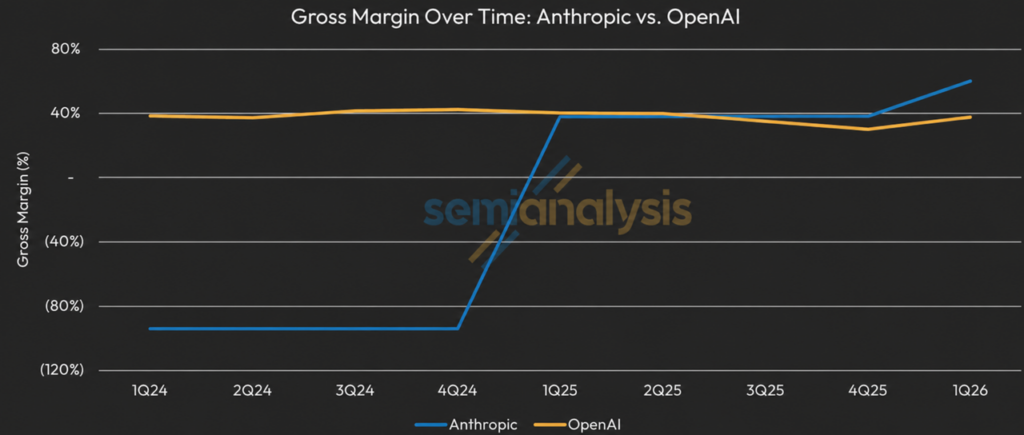
This is where the comparison with OpenAI gets more interesting.
OpenAI’s problem is not lack of demand. It is the cost of serving huge consumer volume. SemiAnalysis estimates that OpenAI supports more than 900 million free users, with monthly service cost around $0.70 per user.
That sounds small until you multiply it by 900 million.
Free users become a gross margin drag.
SemiAnalysis argues that if OpenAI and Anthropic both reached $100 billion of ARR, OpenAI could generate around $25 billion less gross profit than Anthropic because of the consumer cost burden.
That is a serious gap.
AI companies are not traditional software companies. A free user in software may cost bandwidth and storage. A free user in AI consumes inference compute.
This is why the subscription model is starting to look awkward. A Tom’s Guide piece summarizing SemiAnalysis’s work on AI subscription cost pressure made the same point: heavy users can consume far more compute than their monthly fee covers.
Anthropic’s B2B/API model is cleaner. Customers use more, they pay more. High-value workflows can support higher pricing. There is less free consumer traffic sitting on the P&L.
That matters because gross profit becomes fuel.
More gross profit means more money for next-generation training. Better models unlock new use cases. New use cases drive more usage. More usage funds more training.
That is the flywheel frontier model companies are trying to build.
- The ROI on Frontier Model Training May Be Better Than It Looks
Everyone knows training frontier models is expensive.
But SemiAnalysis frames the cost differently. From a venture return perspective, Anthropic’s training spend may have produced an extraordinary business.
Its estimate: since Q1 2024, Anthropic has spent around $8 billion in cumulative training cost and built a business with roughly $60 billion of ARR.
If that model is directionally right, the return on invested capital is remarkable.
This does not mean every company can spend $8 billion and become Anthropic. Most cannot. Most model companies will burn capital and fail to create a durable distribution or revenue base.
But for the few winners, training cost starts to look less like ordinary expense and more like capital investment.
Train the next model.
Unlock new tasks.
Sell into higher-value workflows.
Generate more token consumption.
Reinvest cash flow into the next model.
That is why a top model company cannot be valued exactly like a traditional SaaS company. It has pieces of software, cloud infrastructure, semiconductor economics, and platform business all mixed together.
Messy, yes. But potentially very powerful.
- Where the Next Growth Comes From
SemiAnalysis points to three main growth drivers.
First, existing customers continue to ramp usage in late 2026 and 2027.
This is the NDR story. New customers may start small, but once an agent workflow works, usage can expand quickly.
Second, cybersecurity could become a major market.
If Mythos or Fable-class models can reliably support security analysis, vulnerability discovery, threat detection, and code audit, the commercial value is obvious. Security teams already pay for high-value automation, and the work is complex enough to justify premium pricing.
Third, vertical industries expand the TAM.
Healthcare, finance, biotech, law, and scientific research all have expensive labor, complex workflows, and high-stakes analysis. If frontier models become good enough to enter core workflows, AI stops being a productivity toy and becomes part of production.
SemiAnalysis’s optimistic case is that Fable-driven pricing and new use cases could push Anthropic’s monthly net new ARR from more than $10 billion to around $15 billion.
If that happens, $300 billion of year-end ARR in 2027 becomes possible in the model.
From there, SemiAnalysis assumes long-term EBIT/free cash flow margins of 30% to 40%. That implies the possibility of roughly $100 billion in annual free cash flow by 2028.
That is how the $6 trillion valuation appears: $300 billion of 2027 expected ARR at 20× sales.
Aggressive? Absolutely.
But the point is not that Anthropic must be worth $6 trillion. The point is that if API revenue, agent workflows, very high net dollar retention, and strong gross margins all hold together, the valuation ceiling for model companies is much higher than many investors assumed.
The Real Takeaway

The most important part of the SemiAnalysis piece is not the $6 trillion number.
You can argue about the multiple. You can argue about the assumptions. You should definitely treat the figures as model estimates, not official company disclosures. Anthropic has not publicly released a full IPO filing.
But the bigger idea is hard to ignore:
AI monetization may not be about who has the most people chatting with a model. It may be about who gets the model embedded into enterprise workflows deeply enough that token consumption grows with business activity.
Consumer drives attention.
Enterprise drives revenue quality.
Agents drive token volume.
New models unlock new workloads.
That is why the market keeps grouping Anthropic, OpenAI, and SpaceX into the same IPO conversation. Investor’s Business Daily recently wrote about why the AI IPO path is getting more complicated. The core question is the same: will public markets keep paying for companies with explosive growth, massive capital needs, and a real shot at reshaping profit pools?
SemiAnalysis’s model is useful because it puts the pieces on one page: model capability, API usage, agent workflows, token demand, enterprise budgets, and long-term margin structure.
Even if you discount the valuation, the structure is worth paying attention to.
If the flywheel works, Anthropic is not just an app company. It is not just a cloud vendor either.
It starts to look like a new kind of infrastructure company.
Nvidia sells the shovels. Anthropic sells the labor replacement.
The race to $10 trillion may not be a joke.
Related posts:
Leave a Reply