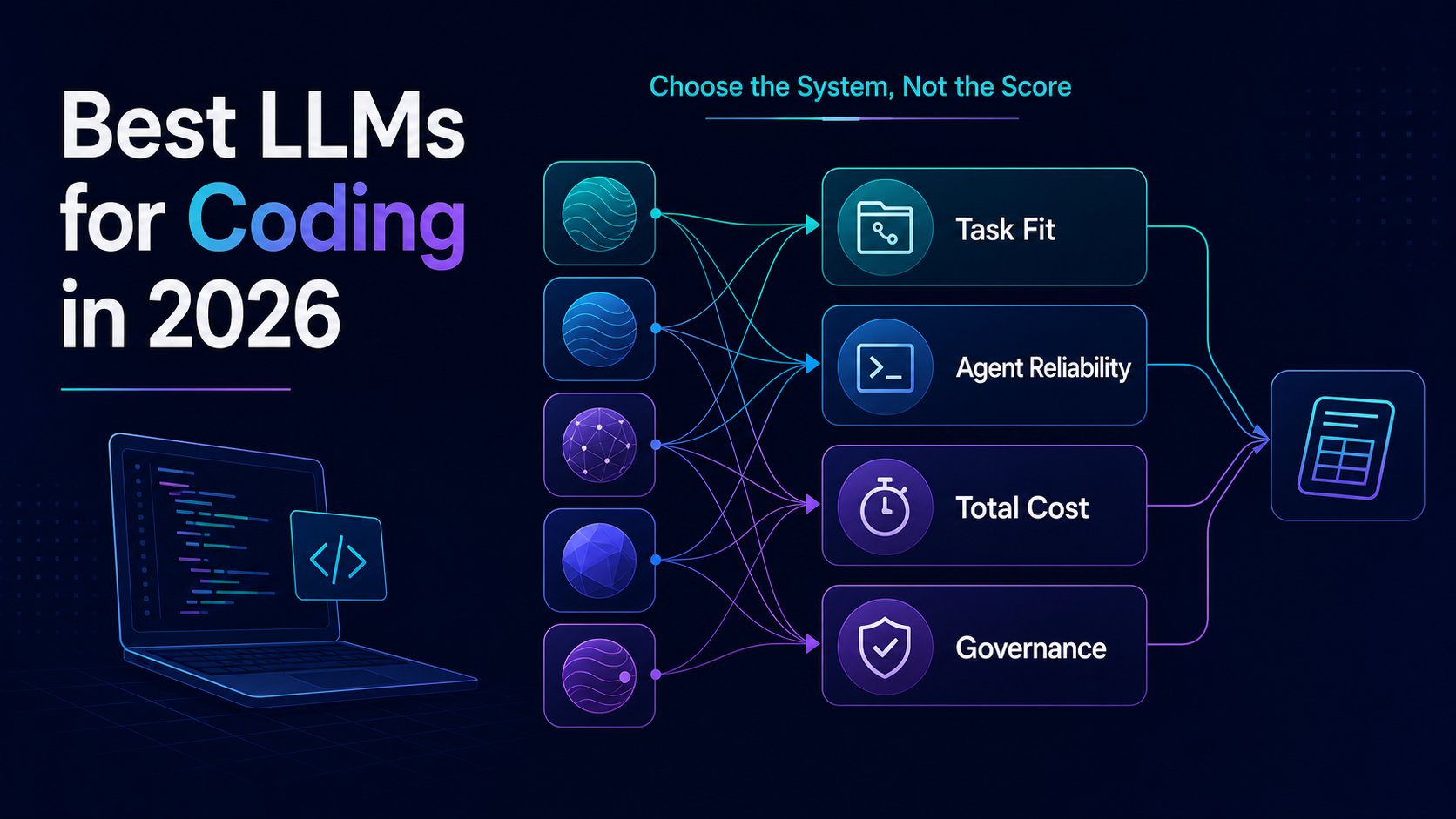
The best LLM for coding is not one permanent winner. Start with GPT-5.6 Sol or Claude Opus 4.8 for difficult, long-running changes; Claude Sonnet 5 for a balanced coding-agent default; Gemini 3.5 Flash for high-throughput, long-context work; and an open-weight model when deployment control matters more than turnkey convenience. Then test the shortlist on your own repositories.
This comparison covers model capability, context, API cost, deployment, and evidence—not editor features. Prices and availability were verified on July 15, 2026. Model aliases, previews, and introductory prices can change, so treat every figure as a dated snapshot.
Choose the complete coding system, not the largest isolated benchmark score.
What Makes an LLM Good at Coding
A good AI coding LLM does more than complete a function. It understands repository conventions, follows a multi-step plan, uses tools correctly, repairs failed attempts, and returns a patch a human can review. That makes five properties more useful than a single score:
- Task fit: algorithm writing, repository repair, frontend work, migration, or review require different strengths.
- Agent reliability: the model must select tools, interpret terminal output, preserve state, and recover from errors.
- Context discipline: a large window helps only when the model finds the right evidence and resists irrelevant code.
- Review quality: a passing test is not enough; the patch should be scoped, readable, secure, and maintainable.
- Operational fit: latency, total task cost, data policy, availability, and deployment options determine whether a model works in production.
The model and the agent are separate entities. The model reasons and generates actions. The agent supplies prompts, tools, permissions, memory, retries, and an execution environment. For product-level workflow choices, compare Graphify’s best AI coding agents in 2026 and best AI coding CLIs.
Benchmarks That Actually Matter
No coding benchmark measures the whole job. Use each benchmark for the question it can answer:
| Benchmark | What it measures | What it does not prove |
|---|---|---|
| LiveCodeBench | Fresh contest problems, code generation, execution, and output prediction | Repository navigation, PR quality, tool reliability, or migration skill |
| SWE-bench Verified | 500 human-validated GitHub issue tasks; a fixed scaffold can compare model behavior | A permanent frontier ranking or raw-model quality independent of the harness |
| SWE-Bench Pro | Longer, more complex repository tasks | A clean league table; a July 2026 OpenAI audit estimated about 30% of tasks were broken |
| Terminal-Bench | End-to-end terminal workflows with published model-and-agent combinations | The model’s contribution separated from the agent scaffold |
Benchmark metadata matters as much as the result. Record the task set and version, model snapshot, agent harness, tool policy, reasoning effort, attempt count, cost cap, and evaluation date. A vendor-reported run and an independent run should never share an unlabeled score column.
Quick Comparison Table
| Model | Best fit | Status / deployment | Context | API price per 1M tokens | Main caution |
|---|---|---|---|---|---|
| GPT-5.6 Sol | Difficult repository reasoning and long agent runs | Hosted frontier | 1.05M | $5 input / $30 output | Inputs above 272K trigger higher rates; alias and snapshot choice matter |
| Claude Opus 4.8 | Long-horizon, high-complexity agentic coding | Hosted frontier | 1M | $5 / $25 | Premium cost makes routine loops expensive |
| Claude Sonnet 5 | Balanced default for frequent coding-agent work | Hosted frontier | 1M | $3 / $15 standard | Introductory $2 / $10 price ends August 31, 2026 |
| Gemini 3.5 Flash | High-throughput agents and large-context analysis | Hosted, stable GA | 1,048,576 | $1.50 / $9 | Thinking tokens count toward output cost |
| DeepSeek V4 Pro | Low API cost and open-weight evaluation | Hosted Preview + weights | 1M | $0.435 cache miss / $0.87 output | Preview status and self-hosting complexity require a pilot |
| Mistral Medium 3.5 | Governed deployment with capable open weights | API + Modified MIT weights | 256K | $1.50 / $7.50 | 128B dense deployment still needs substantial infrastructure |
| Qwen3.6-35B-A3B | Efficient open-weight experimentation | Apache 2.0 weights | 262K native | Self-hosted cost varies | Extended context and coding quality depend on serving configuration |
Context is the advertised maximum, not a guarantee of equal accuracy across every token. Prices exclude cache behavior, tool output, retries, hosting, and engineering time.
The Best Coding LLMs in 2026
Frontier Models to Verify
GPT-5.6 Sol is the strongest OpenAI candidate to test for complex GPT coding workflows. OpenAI calls it the flagship for complex reasoning and coding, with a 1.05M-token window and 128K maximum output. Its main buying risk is economics: the model costs $5 per million input tokens and $30 per million output tokens, and very long inputs carry a surcharge. GPT-5.6 Terra and Luna are lower-cost family options worth adding when Sol quality is unnecessary.
Claude Opus 4.8 is the premium Claude coding candidate for long-horizon agent work. Anthropic positions Opus for complex reasoning and agentic coding, while Claude Sonnet 5 targets a better speed-and-intelligence balance. Sonnet is the more practical default for repeated edit-test loops; Opus belongs on the escalation path for the hardest tasks. Measure both under the same effort setting because more reasoning can raise quality, latency, and cost together.
Gemini 3.5 Flash is the stable Google candidate for sustained agent and coding workloads. It combines a 1M-token input window with lower list prices than the premium models above. Gemini 3.1 Pro remains Preview, so it can join an exploration track for harder reasoning but should not silently replace a production default.
These are shortlist recommendations, not claims that one model beats every other model. Vendor benchmark results can suggest candidates, but only a controlled internal trial supports a purchasing decision.
Open-Weight Models to Verify
Open-weight models help when a team needs deployment control, offline evaluation, data locality, or custom serving. They are not automatically open source, inexpensive, or laptop-friendly.
DeepSeek V4 Pro and Flash offer 1M-token context, tool use, reasoning modes, and unusually low hosted prices. Official materials still label the V4 release Preview and link the open weights. Teams should use the current V4 IDs rather than building new integrations on deepseek-chat or deepseek-reasoner, which DeepSeek says will retire on July 24, 2026.
Mistral Medium 3.5 provides Modified MIT weights, a 256K context window, and a 128B dense architecture. It is a credible governed-deployment candidate, but “open weights” does not remove GPU, observability, security, or upgrade work.
Qwen3.6-35B-A3B uses an Apache 2.0 license, 35B total parameters, and 3B active parameters. Its model card lists 262,144 native context with an extended configuration beyond 1M. Test the exact quantization and serving stack you plan to deploy; model-card capability does not establish your throughput or total ownership cost.
Cost and Context Trade-Offs
Token price is not task price. A cheaper model can cost more if it retries commands, reads unnecessary files, generates long reasoning traces, or creates review-heavy patches. A premium model can be economical when it finishes a difficult migration in one accepted run.
Track total cost per accepted patch: input, cached input, output and thinking tokens, tool calls, failed runs, GPU time, and human review minutes. Also test a compact context policy against a “send everything” policy. Retrieval quality and context discipline often matter more than the advertised window.
How to Pick a Coding Model for Agents
Run a controlled trial with 8–12 representative tasks. Include a small bug, multi-file feature, test repair, dependency upgrade, refactor, and one task that should be refused or escalated.
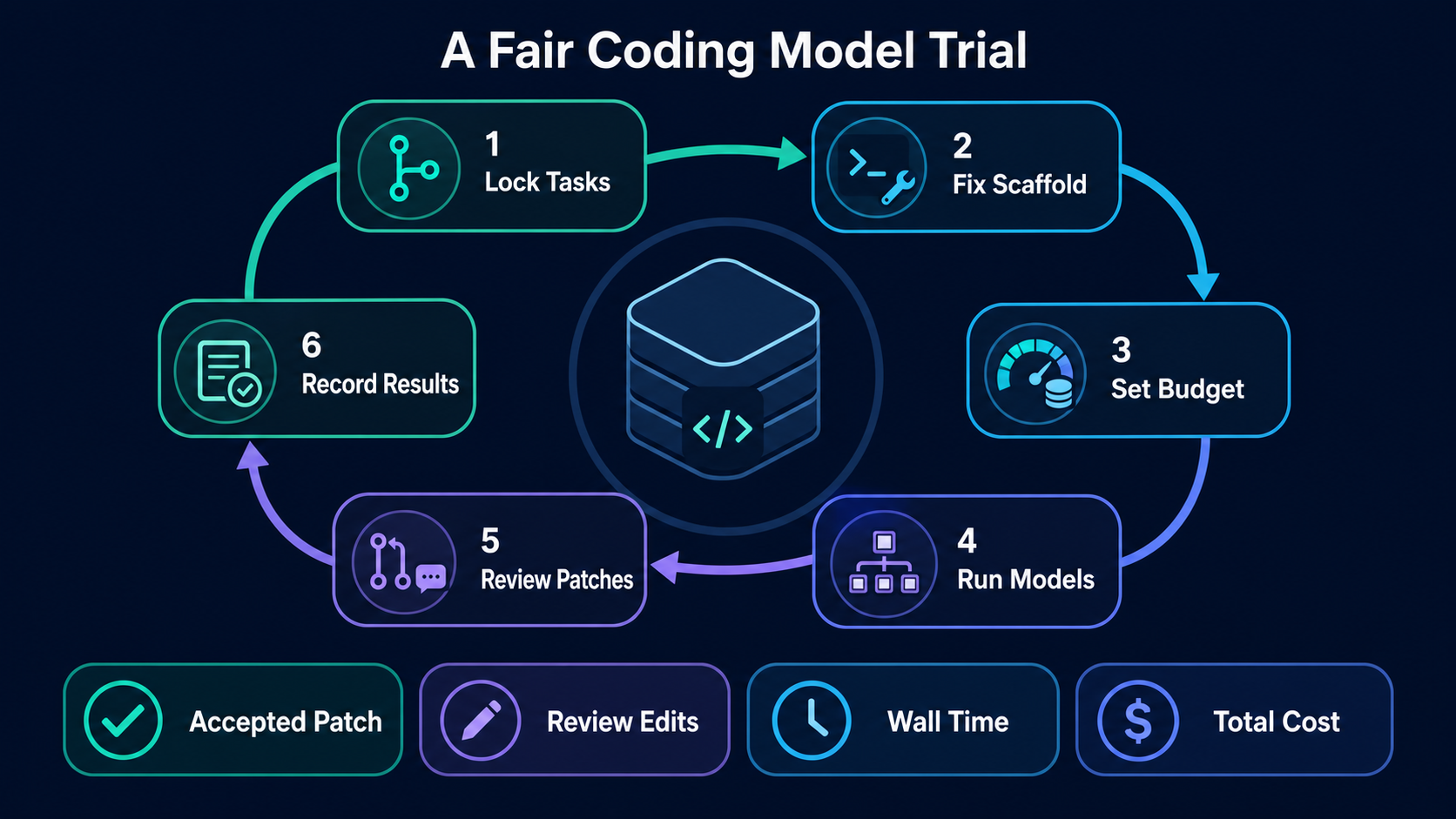
Use this protocol:
- Lock the same repository commit and acceptance tests for every model.
- Fix the agent scaffold, system prompt, tools, permissions, and network policy.
- Set the same reasoning level, retry limit, wall-time limit, and cost budget.
- Run every model without letting one receive extra hints.
- Review blinded patches for correctness, scope, security, clarity, and maintainability.
- Record accepted-patch rate, review edits, failed commands, wall time, total cost, and security events.
Choose a default, a cheaper fast path, and an escalation model instead of forcing one model onto every task. If you want to test OpenAI’s coding surface specifically, start with Graphify’s Codex guide. Graphify’s broader AI coding research and comparisons can help map model findings back to tools and workflows.
A practical routing policy can start with three rules. Send small, well-tested edits to the fast path. Escalate broad migrations, ambiguous failures, and architecture work to the strongest approved model. Route sensitive repositories only to models and endpoints that satisfy the project’s data policy. The agent should record why it selected a route, and a developer should be able to override that choice without rewriting the task.
Do not promote a model on aggregate acceptance alone. Split results by task family and inspect the tail failures. A model that solves nine simple issues but corrupts the one migration may be worse for that workflow than a slower candidate with eight clean patches. Set explicit thresholds for correctness, security events, review edits, and cost. When no candidate clears every guardrail, keep the current default and narrow the proposed use case rather than averaging a dangerous failure away.
Finally, repeat a small portion of the suite. One run cannot reveal variance. Two or three attempts on the highest-value tasks show whether success is stable or depends on a lucky trajectory. Keep attempt count equal across candidates and report pass-at-one separately from pass-with-retries, because retries consume both money and engineering time.
Version Volatility and Limits
Model conclusions decay quickly. A provider can change an alias, retire an ID, alter pricing, expand context, or ship a new snapshot after this article is published. Preview endpoints carry extra stability risk, and even pinned snapshots can behave differently when the surrounding agent changes.
Maintain a model registry with provider, exact model ID, snapshot, status, context limit, price source, evaluation date, approved use cases, and rollback target. Re-run the internal suite before changing the default model or agent scaffold. Do not interpret a 1M-token window as 1M tokens of uniform recall, and do not mix results from different benchmark versions.
FAQ
What internal tasks should teams use for model trials?
Use 8–12 recent, representative tasks with objective acceptance criteria. Cover bug repair, feature work, tests, refactoring, dependency changes, repository search, and an unsafe or ambiguous request. Remove secrets and freeze each task to the same commit so every model receives equal evidence.
Who should approve changing the default coding model?
The engineering owner should approve capability and developer-workflow changes. Security or platform owners should approve data handling, permissions, network access, and hosted-versus-self-hosted deployment. Procurement or finance should review material cost changes. Production rollout needs a named rollback owner.
What records help compare model runs later?
Keep the exact model ID and snapshot, provider, agent and harness version, prompts, repository commit, tool policy, reasoning setting, attempt count, token usage, wall time, cost, command log, test results, reviewer edits, and final acceptance decision. Preserve sensitive logs under the same access and retention policy as source code.
Conclusion
The best coding model 2026 shortlist depends on the job. Test GPT-5.6 Sol and Claude Opus 4.8 for hard long-horizon work, Claude Sonnet 5 for a balanced default, Gemini 3.5 Flash for throughput, and DeepSeek, Mistral, or Qwen when open-weight control matters. The durable advantage is not picking today’s loudest benchmark winner. It is building a fair evaluation loop that can select—and safely replace—the model behind your coding agents.
Leave a Reply