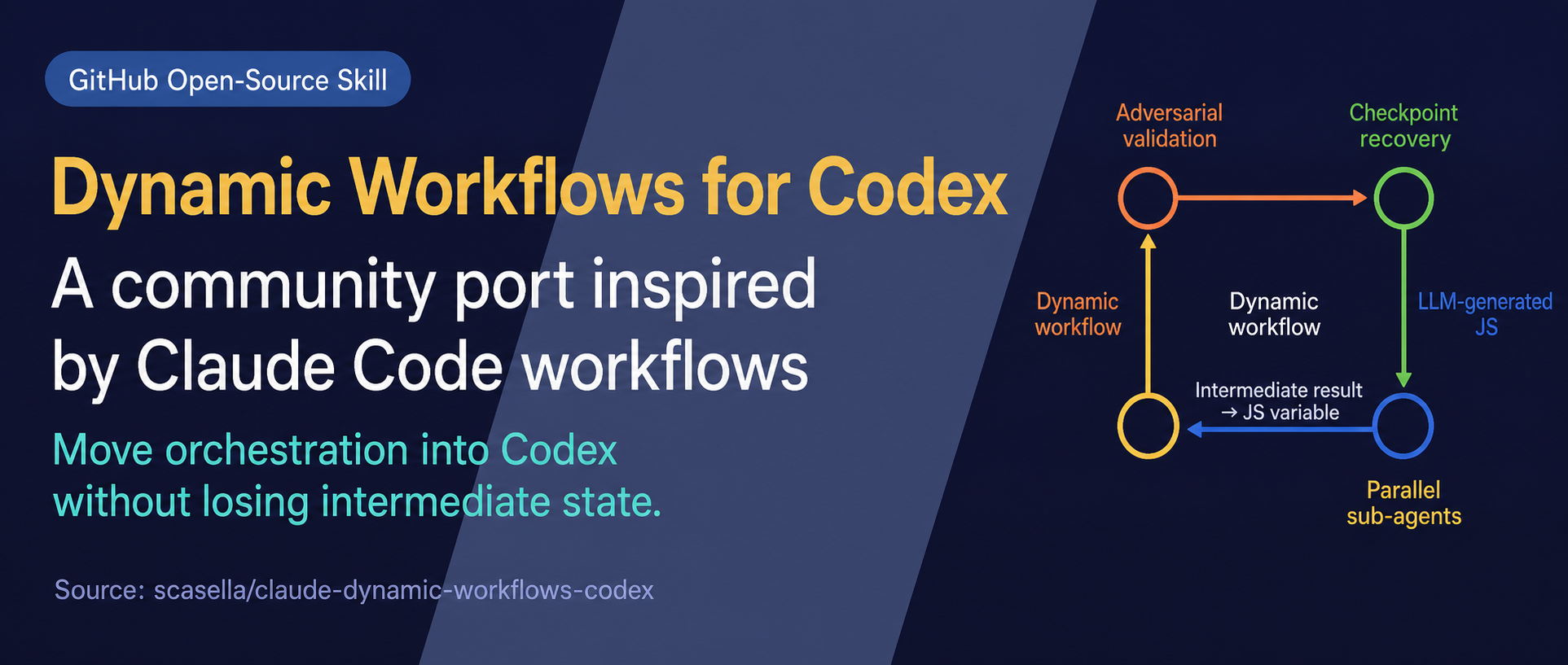
The open-source project claude-dynamic-workflows-codex connects two systems that are usually discussed separately: Claude Code writes a JavaScript orchestration workflow, while local Codex agents execute the work through Codex app-server. That distinction matters. This is not a native Codex /dynamic command, and it is not an official OpenAI or Anthropic integration. It is a community-built Claude Code plugin and standalone runner that uses Codex as its agent backend.
A Chinese WeChat article from Ai 这个时代 introduced the project as a way to reduce context pressure in multi-agent work. The underlying idea is sound, but the current repository differs from several operational details in that account. The repository’s documented command is /codex-workflows, installation happens from Claude Code’s plugin marketplace or a Claude skills directory, and the project explicitly describes itself as unofficial.
The architecture: orchestration in code, execution in Codex

Dynamic workflows move coordination logic out of the conversational loop and into a JavaScript program. The script can express parallel phases, pipelines, budgets, races, review gates, and stopping conditions. Intermediate results can remain in runtime variables rather than being pasted wholesale into the top-level conversation.
In this project, Claude Code turns a rough request into that workflow script. The runner then connects to the local codex app-server, starts Codex threads, streams events, records progress in a journal, and renders the run as either a terminal map or an interactive browser view. OpenAI’s documentation describes app-server as the interface for deep client integrations that need authentication, conversation history, approvals, and streamed agent events. The community project is therefore building on a real, documented Codex integration surface rather than scraping a terminal UI.
The practical result is a separation of responsibilities:
- Claude Code acts as the workflow author and operator.
- JavaScript holds the execution graph, branching, and intermediate state.
- Codex app-server supplies the agent threads and streamed execution events.
- A journal supports replay, inspection, and resuming unfinished work.
- The viewer exposes phases, workers, token counts, timing, and final results.
This is more than a cosmetic wrapper around subagents. The repository adds sessionful workers that can receive follow-up instructions on an existing thread, races that cancel losing approaches, human gates, run summaries, and a multi-workflow fleet mode. Those features are implemented by this repository; they should not be mistaken for guarantees attached to every Codex client.
What problem does it solve?
Standard subagent delegation is useful when several bounded tasks can run independently. Current Codex documentation says subagents can keep noisy exploration and test output away from the main thread, but it also warns that every worker performs its own model and tool work, so multi-agent runs generally consume more tokens than comparable single-agent work.
A scripted workflow becomes attractive when the coordination pattern itself needs to be durable. Examples include:
- scanning many independent areas and then adversarially verifying the findings;
- racing several root-cause hypotheses and stopping the losing workers;
- loading a large corpus once and asking repeated questions on the same warm thread;
- pausing at a human decision before a risky phase;
- resuming a long run without repeating every completed step;
- comparing structured run journals over time.
The benefit is not simply “more agents.” It is the ability to make fan-out, review, cancellation, and convergence explicit and repeatable. For a one-off question or a small edit, that machinery is unnecessary overhead.
The token claim needs a narrower reading

The source article says the port uses fewer tokens than Claude Code’s native dynamic workflow. The repository does publish evidence, but it supports a more limited conclusion.
Its warm-versus-cold benchmark used Codex 0.137.0, GPT-5.5 at medium effort, a roughly 3,300-line corpus, and three follow-up questions. A warm worker spent 329,000 tokens on initial ingestion and about 69,000 tokens per follow-up. Fresh workers that reread the corpus used about 219,000 tokens per question. Across all three questions, the warm arm reported 535,000 tokens versus 656,000 for the cold arm, with substantially lower marginal latency.
That is useful evidence for repeated interrogation of the same material. It is not a general comparison between this project and every native Claude Code workflow. The repository itself notes that the warm approach loses for a single question because the initial ingestion dominates. Results will also vary with corpus size, model, cache behavior, effort, prompt design, and the workflow graph. Anyone making cost decisions should rerun the included benchmark on their own workload and compare total billed cost, not token count alone.
Accurate setup and a low-risk first test
The repository currently requires Node.js 18 or newer and a logged-in codex CLI on the local path. Its recommended Claude Code installation is:
/plugin marketplace add scasella/claude-dynamic-workflows-codex
/plugin install codex-workflows@codex-workflows
After installation, a task is invoked from Claude Code with a command such as:
/codex-workflows Audit every route under src/ for missing authorization, read-onlyBefore spending model tokens, the repository also includes an offline viewer demo:
git clone https://github.com/scasella/claude-dynamic-workflows-codex
cd claude-dynamic-workflows-codex
node runner/bin/view-run.js examples/incident-demo --open
That demo is the safest way to inspect the execution map without launching agents. For a live first run, use a small read-only task, inspect the generated workflow script, set a hard budget, and confirm that the Codex version and permissions match the repository’s expectations.
Where it fits—and where it does not
This project is a credible option for developers who already use Claude Code as their control surface but want Codex agents underneath a repeatable orchestration layer. It is especially interesting for research, large audits, migrations, incident analysis, and workloads where the same warm context will answer several questions.
It is a weaker fit when:
- one capable agent can finish the task directly;
- the work is dominated by a single sequential dependency;
- concurrent edits would create merge conflicts;
- the organization cannot accept a community integration spanning two vendors’ tools;
- reproducibility, audit, and version pinning have not been established;
- a CI job would be better served by OpenAI’s supported SDK or GitHub Action.
There are also operational costs. More agents can mean more token usage, more local processes, more permission decisions, and a larger failure surface. The generated script is executable orchestration and deserves review. Sandboxing should reflect the task, secrets should stay out of prompts and journals, and model or protocol changes can break an unofficial integration even when both underlying products continue to work independently.
Bottom line
claude-dynamic-workflows-codex is best understood as an experimental orchestration bridge: Claude Code authors the plan, a JavaScript runtime manages it, and Codex app-server executes agent threads. Its strongest contribution is not a universal promise of cheaper agents. It is a concrete, inspectable way to encode multi-agent control flow, preserve run state, and reuse warm workers.
That can materially improve the economics of the right repeated-context workload. It does not remove the need to size the workflow, review permissions, validate outputs, and measure the actual bill. Start with the offline demo, then a small read-only run, and promote the pattern only after its journal shows that the extra orchestration is buying something a simpler approach cannot.
Leave a Reply