Tag: Agent Skills

Guides, tutorials, templates, and best practices for building and using reusable agent skills that extend what AI coding agents can do.

  • Comet 0.4 Guide: Classic Spec Workflows, /comet-any and Skill Evaluation

    Comet 0.4 Guide: Classic Spec Workflows, /comet-any and Skill Evaluation

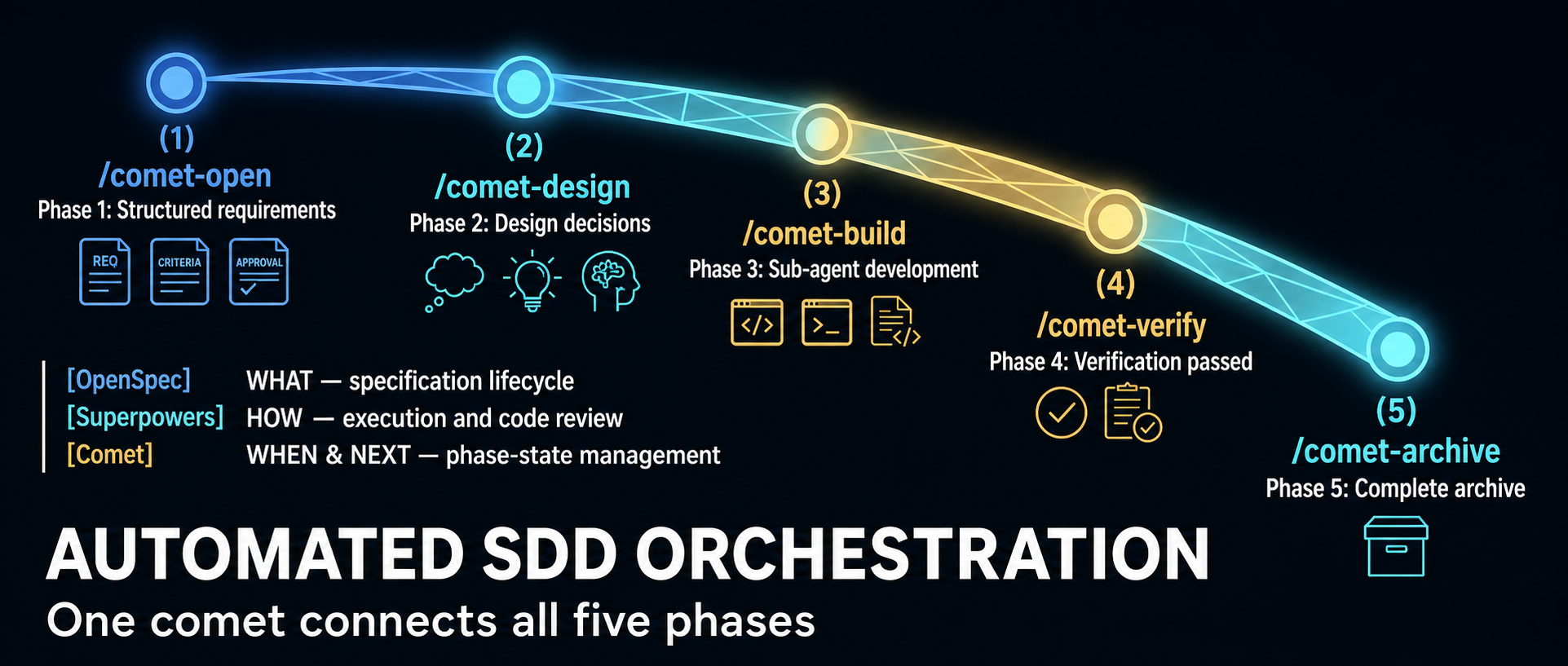
    Comet began as an orchestration layer for combining OpenSpec’s specification lifecycle with Superpowers-style planning and execution. The project now describes itself more broadly: a resumable workflow and Skill platform for coding. That shift matters because current Comet has three distinct jobs, not one:

    1. /comet runs a guarded software-change workflow.
    2. /comet-any turns existing Skills into a reusable workflow package.
    3. comet eval tests whether a Skill behaves reliably enough to advance toward publication.

    A June 2026 WeChat article from 职场向上生长力 explains the original five-phase design well. It is now a historical snapshot of the 0.3.x line: its central state-machine model remains relevant, but several counts, scripts and product boundaries changed in the 0.4 beta series. This guide uses the current official rpamis/comet repository and release metadata as the authority.

    Version reality: current does not mean stable

    Release channel map distinguishing Comet 0.3.9 from the current 0.4 beta and the stable Classic core
    Classic is the established architectural core, but the current npm default remains a semantic prerelease; pin the exact package version.

    As of July 16, 2026, npm’s latest tag for @rpamis/comet points to 0.4.0-beta.4, published July 12. It is the current default install, but the beta identifier still makes it a semantic prerelease. The last version without a prerelease suffix is 0.3.9, published June 18.

    Choice What it means Best fit
    @rpamis/comet@0.3.9 Last non-beta release; mature Classic workflow built around the 0.3 architecture Teams prioritizing a fixed, non-prerelease baseline
    @rpamis/comet@0.4.0-beta.4 Current npm default; pure Node runtime plus the expanded Skill and eval platform Evaluation, new integrations and teams willing to absorb beta changes
    Unpinned @rpamis/comet Currently resolves to beta.4 because npm latest points there Only when your update policy intentionally follows the current channel

    The repository calls Classic Spec “the stable core for long-running tasks.” Read that as a product-architecture claim: the five-phase lifecycle is the established center of Comet. It does not turn the 0.4.0-beta.4 package into a generally available 0.4 release. Likewise, beta.4’s release notes call several top-level commands “Stable Classic commands”; that describes their supported interface inside the beta, not the maturity label of the entire package.

    Pin the version in team setup documentation and automation. Otherwise, the same installation command can resolve to a materially different runtime over time.

    What changed in the 0.4 beta line

    The most visible engineering change is a pure Node runtime. The 0.4 README says Comet no longer depends on Bash or WSL; the package declares Node.js 20 or newer. This is especially meaningful for Windows users and for cross-platform workflow bundles, because state and guard logic no longer depend on a shell environment that behaves differently across machines.

    The product surface also expanded:

    • Classic Spec remains the requirements-to-archive workflow.
    • /comet-any authors composed Skill Bundles with workflow nodes, schemas, guards and handoffs.
    • comet eval supplies local or LangSmith-connected evaluation evidence.
    • comet dashboard provides a read-only browser view of active changes and archive history.

    Beta.4 adds or hardens ambient resume, a registry of project-scope installations, direct comet state, comet guard, comet handoff and comet archive commands, custom build evidence, multi-change guards, archive confirmation and Codex Skill discovery. Those details come from the official 0.4.0-beta.4 release, not from the older WeChat walkthrough.

    Surface 1: Classic Spec with /comet

    Classic Spec is for a software change that should move through a controlled lifecycle. Its conceptual phases remain:

    1. Open — turn an idea into an OpenSpec change and obtain human agreement on scope.
    2. Design — record architectural decisions and resolve ambiguity before implementation.
    3. Build — create an execution plan, choose isolation and implement under review rules.
    4. Verify — collect test, task and design-conformance evidence.
    5. Archive — synchronize the accepted delta into the main specification and close the change.

    The important mechanism is not the command sequence. It is durable external state. Each managed change stores workflow facts in .comet.yaml: phase, mode, artifact references, verification outcome and archive status. /comet can inspect that state and recommend the next legal action after a terminal restart or context reset.

    Guards are equally important. A useful workflow must reject illegal transitions, not merely remind the agent what it should do. Comet’s Classic runtime checks prerequisites before phase advancement and can restrict source writes while a change is still in requirements or design. Beta.4 also requires final archive confirmation to be represented in machine-owned state, so calling an internal path cannot silently bypass the human decision.

    A practical Classic setup

    Requirements are Node.js 20+, npm or npx, and Git. Choose a version deliberately:

    # Last non-beta release
    npm install -g @rpamis/comet@0.3.9
    
    # Current beta evaluated in this guide
    npm install -g @rpamis/comet@0.4.0-beta.4
    

    Then initialize inside the target repository:

    cd your-project
    comet init
    comet doctor --json
    comet status --json
    

    Use /comet from the supported coding agent to start or resume a change. Do not begin with automatic transitions enabled on a high-risk repository. First learn which points request scope, isolation, review and archive decisions. After the team trusts its checks, automation can reduce ceremony without hiding governance.

    Surface 2: /comet-any for workflow authoring

    /comet-any addresses a different problem: turning Skills into a distributable workflow rather than implementing a product feature. The current Skill defines a workflow contract in terms of:

    • Workflow Nodes that own resumable responsibilities;
    • Skill Bindings and required Skill calls;
    • Output Schemas attached to specific nodes;
    • Guardrails that permit or block advancement;
    • Handoffs containing cross-node or subagent evidence;
    • a workflow-protocol.json source of truth.

    This is more rigorous than placing several Skill names in a prompt. A bound Skill does not automatically replace a workflow node, and a schema declared globally does not enforce anything until it is attached to a concrete node. The authoring flow requires a proposal and human confirmation before generation, then creates scripts, rules, hooks, references and an eval manifest.

    There are two broad modes. A comet-five-phase-overlay customizes parts of Classic Spec while preserving .comet.yaml semantics and protected control nodes. A workflow-kernel is for a genuinely different lifecycle with its own state model and guard design. If a team wants to replace fundamental control nodes such as open, execute, verify or archive, it should treat that as a new kernel rather than quietly weakening Classic’s guarantees.

    Use /comet-any when the deliverable is a reusable workflow package. Use /comet when the deliverable is a software change. Mixing those intents produces confusing state and weak acceptance criteria.

    Surface 3: comet eval as evidence

    Comet product map linking guarded development, reusable workflow composition, and skill evaluation
    Comet separates guarded software changes, reusable workflow bundles, and evaluation evidence into three connected surfaces.

    comet eval asks whether a Skill can be discovered, executed and scored on defined tasks. For a bundle generated by /comet-any, the recommended sequence is:

    comet eval ./generated-skill/comet/eval.yaml --collect
    comet eval ./generated-skill/comet/eval.yaml --html
    

    --collect is a low-cost preflight: it checks the manifest, task discovery and dependency paths without starting the expensive evaluation. --html performs the run and creates a browsable report. The official documentation distinguishes raw runs from the clean analysis set and attributes failures to harness, workflow, task, model or environment instead of folding every infrastructure error into a Skill-quality score.

    For an early local Skill without an eval manifest, comet eval ./my-skill --quick --html is a smoke test. It is not final release evidence. Publish readiness expects evaluation tied to the current draft hash; failed, missing or stale-hash evidence blocks progression.

    The README discusses Rubric, Pass@k and Pass^k scoring and shows repository-generated benchmark charts. Treat those results as project evidence for its published tasks and treatments, not proof that every team’s custom workflow will improve by the same amount. Your tasks, model, environment and validators determine whether the measurement transfers.

    Choosing the right Comet path

    Start with the outcome:

    • For a feature, bug fix or refactor that needs traceable requirements and verification, use Classic /comet.
    • For a repeatable organizational process assembled from multiple Skills, use /comet-any.
    • For evidence that a Skill works across runs, use comet eval.
    • For a conservative rollout, pin 0.3.9 and test the beta in a separate repository.
    • For 0.4 capabilities, pin beta.4, record the version in artifacts and rerun evaluation when upgrading.

    Comet’s most valuable idea is not that an agent can execute five commands. It is that workflow control can be represented as files, state transitions, deterministic checks and review evidence. That architecture survives a context window. The 0.4 beta extends the same principle from one software-development workflow to a broader platform for composing and evaluating Skills.

    Sources

  • Trellis Agent Harness Guide: Specs, Tasks, Memory, and the Four-Phase Loop

    Trellis Agent Harness Guide: Specs, Tasks, Memory, and the Four-Phase Loop

    AI coding agents are fast at local execution and unreliable at remembering why a project works the way it does. Trellis addresses that gap by putting durable engineering context inside the repository: scoped specifications, task artifacts, per-developer journals, workflow state, and platform-specific agent configuration.

    That makes Trellis less like a model or code generator and more like an agent harness. It does not replace Claude Code, Codex, Cursor, or another coding agent. It gives those agents a shared project layer and a repeatable delivery loop.

    At the time of this review, the mindfold-ai/Trellis repository had roughly 12.7k GitHub stars—12,662 when checked—and the npm package was version 0.6.7. The project uses the AGPL-3.0-only license. Its current prerequisites are Node.js 18.17 or newer for the CLI and Python 3.9 or newer for the scripts and hooks.

    What Trellis stores in the repository

    Trellis repository map showing specifications, task artifacts, developer journals, workflow state, and host-specific integrations
    The .trellis/ directory holds the stable project context; generated skills, hooks, and host entry files adapt that core to each coding environment.

    The .trellis/ directory is the stable core across supported coding tools. Four areas matter most:

    • spec/ stores team conventions: directory structure, error handling, testing, component patterns, and other rules that should survive a chat session.
    • tasks/ stores active and archived work, including a PRD and separate context manifests for implementation and review.
    • workspace/ stores per-developer journals so a later session can recover what happened without reconstructing the entire conversation.
    • workflow.md and runtime state tell the agent which phase is active and what evidence it should produce next.

    Trellis also generates platform-specific skills, subagent definitions, commands, hooks, and entry files such as AGENTS.md. The core artifacts stay the same, but their delivery varies by host. Claude Code, Cursor, and OpenCode expose richer hook and subagent integration; other tools may rely on pull-based context, a prompt file, or an inline main-agent path.

    This distinction is important. “Supports 17 platforms” means Trellis ships configurators for 17 environments. It does not mean every environment provides identical session-start events, pre-tool hooks, slash commands, or subagent context injection. The official capability matrix should be reviewed for the exact tools a team uses.

    The current four-phase loop

    Trellis four-phase loop from planning and implementation through verification, archival, and project memory
    Plan selects context, Implement produces the change, Verify collects evidence, and Finish archives the task while promoting durable lessons.

    The current Trellis README describes a four-phase workflow:

    1. Plantrellis-brainstorm clarifies the task one question at a time and writes prd.md. Research-heavy questions can be delegated to trellis-research. The plan curates which specs and research artifacts belong in implement.jsonl and check.jsonl.
    2. Implementtrellis-implement works from the PRD and the selected implementation context. It is instructed not to commit the change.
    3. Verifytrellis-check reviews the diff against the task and specs, then runs the relevant lint, type-check, and test commands. It can self-fix small mechanical issues.
    4. Finish — a final check runs, trellis-update-spec promotes durable lessons into the spec library, and finishing the work archives the task and updates the developer journal.

    An older source described spec update as a separate third stage and finish as a fourth. The current documentation folds spec promotion into Finish, after Plan, Implement, and Verify. That is more than naming: the knowledge update is part of closure, not an optional cleanup step detached from verification.

    Specs are bootstrapped, then curated

    The most consequential correction to older Trellis reviews concerns specification authoring. Trellis no longer expects every team to fill every placeholder entirely by hand. The official README says many teams let AI draft specifications from the existing codebase, then tighten important rules manually. The quick-start documentation also includes a bundled spec-bootstrap skill and an optional template marketplace.

    The right mental model is AI draft, team curate:

    • Use the codebase to produce a first-pass description of actual patterns.
    • Delete generic advice that does not constrain a decision.
    • Add concrete examples and counterexamples from the repository.
    • Review high-impact rules—security, migrations, API compatibility, testing, error handling—like code.
    • Keep the specs versioned and update them when a verified task establishes a better convention.

    AI-generated specs are not automatically trustworthy. A model can faithfully document an accidental pattern, copy an anti-pattern that happens to be common, or turn preferences into false absolutes. Trellis provides the structure and update path; the team remains responsible for the standard.

    Why context manifests are useful

    Large instruction files often fail in two ways: they consume context on every turn, and unrelated rules distract the agent from the current task. Trellis instead uses task-specific JSONL context manifests.

    The planning phase selects the relevant material for implementation and checking. An implementation worker might need API conventions, database rules, and the PRD. A reviewer may need those plus testing and error-handling guidance. The two manifests can differ, which helps keep each agent’s context bounded and makes the selection inspectable.

    This mechanism does not guarantee lower total token use. Hooks, planning, subagents, checks, and spec updates all cost time and model work. Its value is context precision and repeatability, not free context. Teams should compare end-to-end latency and usage against their current workflow on representative tasks.

    Project memory without one giant chat history

    Trellis journals record what a developer completed, while task state records what remains active. On hook-backed platforms, session startup can inject identity, Git status, active tasks, spec indexes, and recent journal context. On tools without the same hook surface, an entry skill or generated prelude supplies a fallback.

    This is durable memory in the engineering sense: versioned project knowledge plus developer-specific work summaries. It is not a claim that every past conversation is automatically correct or that journal context should override the repository. The current code, tests, and reviewed specs remain the source of truth.

    Per-developer workspace directories reduce journal conflicts, while shared specs and tasks remain reviewable through normal pull requests. Teams should still define ownership for spec changes; otherwise, the knowledge base can accumulate contradictions as quickly as a monolithic AGENTS.md file.

    Installation and a safe first pilot

    Install the current CLI and initialize only the platforms you actually use:

    npm install -g @mindfoldhq/trellis@0.6.7
    trellis init -u your-name --claude --codex

    The generic trellis init -u your-name flow can auto-detect installed platforms. Pinning the npm version makes a team trial reproducible; @latest is convenient for exploration but can change generated templates between machines.

    For an existing codebase, use this pilot sequence:

    1. Initialize Trellis on a disposable branch.
    2. Let the bootstrap workflow draft a narrow set of specs from real code.
    3. Have maintainers review and reduce those specs to high-signal rules.
    4. Choose one medium-sized, reversible feature with clear acceptance criteria.
    5. Run the complete Plan → Implement → Verify → Finish loop.
    6. Inspect which files each JSONL manifest selected.
    7. Intentionally violate one rule and confirm the review phase catches it.
    8. Start a new session and verify that task and journal recovery are accurate.
    9. Measure repository footprint, merge noise, runtime, and model usage before expanding adoption.

    Codex users need an additional platform check. Current Trellis documentation says Codex uses an AGENTS.md prelude, skills and agent files, and a UserPromptSubmit hook; hook support must be enabled and reviewed in compatible Codex releases. Subagent context injection is not identical to Claude Code’s PreToolUse path, so parity should be tested rather than assumed.

    Trade-offs teams should evaluate

    Repository weight

    Trellis generates more than a single instruction file. Exact file counts vary by version and selected platforms, so an old “152 files” result should not be treated as a fixed product property. The meaningful question is whether those generated files stay stable, reviewable, and useful enough to justify their maintenance cost.

    Platform variance

    The same .trellis/ core can be shared broadly, but automation depth varies. Some platforms have full session and subagent hooks; others use skills or inline execution. A mixed-tool team should test its least-capable required platform first.

    Spec quality and governance

    Poor specs scale poor decisions. Teams need reviewers, ownership, deprecation rules, and a way to resolve conflicts between written standards and working code.

    Workflow overhead

    Planning, isolated implementation, independent checking, and spec promotion are valuable for consequential work. They can be excessive for a one-line fix or disposable prototype. Trellis’s current quick-start says small inline tasks do not have to become Trellis tasks; use that escape hatch deliberately.

    License

    Trellis is licensed AGPL-3.0-only, not MIT or Apache-2.0. Organizations with distribution, modification, hosted-service, or proprietary integration concerns should have the intended use reviewed against the license before standardizing the tool. This is a governance check, not a reason to avoid the project automatically.

    Who should adopt Trellis?

    Trellis is most compelling for a long-lived repository where multiple people or coding agents repeatedly need the same architectural knowledge. It is particularly relevant when the team has already outgrown one large AGENTS.md or CLAUDE.md, when task context needs to be reviewable, or when sessions frequently lose the reasoning behind local conventions.

    It is less compelling for a small prototype, a one-person script, or a repository whose conventions are still changing faster than anyone can curate them. In those cases, a concise instruction file plus normal tests may be the simpler and more reliable harness.

    The core Trellis proposition is not “AI remembers everything.” It is “the repository carries the right memory forward.” That proposition succeeds only when specs are curated, tasks are closed honestly, checks are meaningful, and each platform’s integration is verified in practice.

    Sources

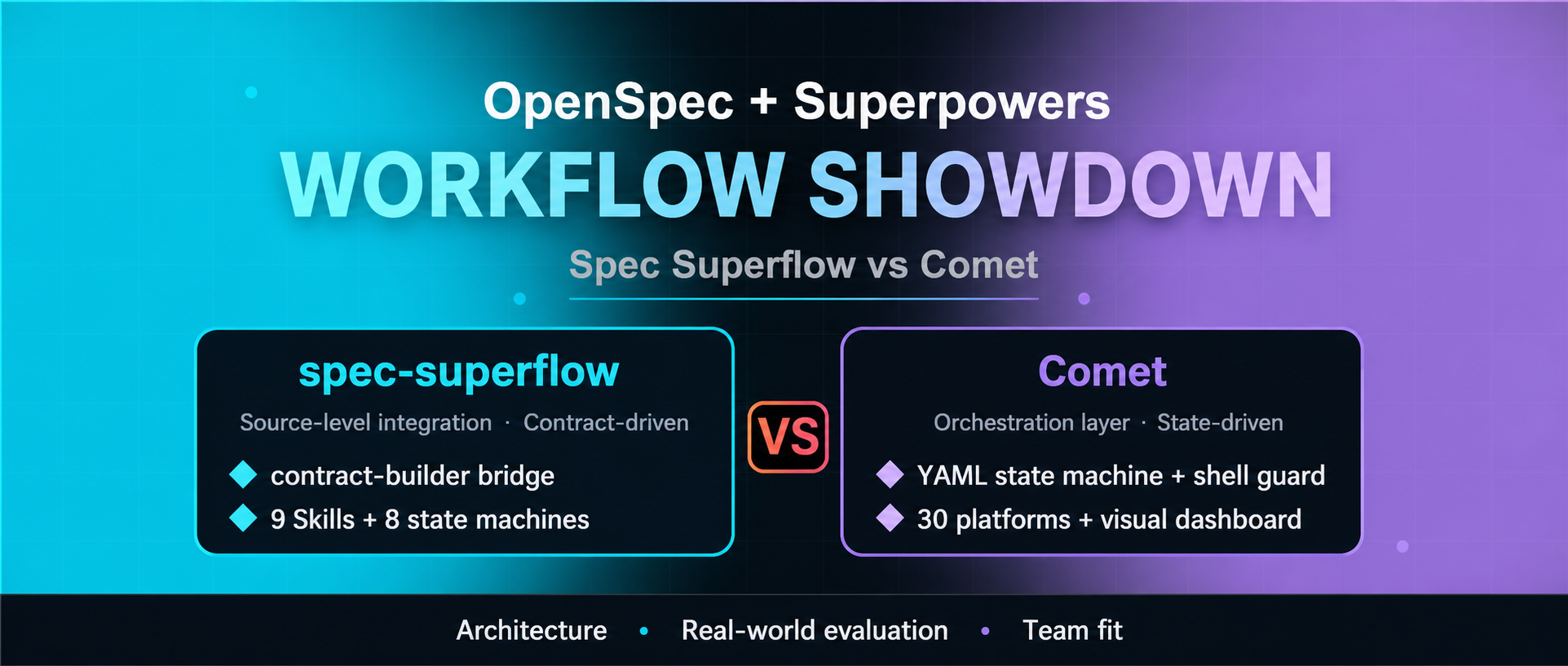
  • Spec Superflow vs Comet: Which OpenSpec–Superpowers Workflow Fits Your Team?

    Spec Superflow vs Comet: Which OpenSpec–Superpowers Workflow Fits Your Team?

    OpenSpec and Superpowers solve different parts of AI-assisted software delivery. OpenSpec emphasizes explicit change artifacts and a maintained specification lifecycle; Superpowers emphasizes disciplined implementation practices such as design, testing, review, and verification. Spec Superflow and Comet both try to connect those layers—but the two projects now serve noticeably different buyers.

    This comparison updates a Chinese WeChat article that examined earlier releases. As of July 16, 2026, the current published versions are Spec Superflow v0.9.1 and Comet 0.4.0-beta.4. That matters because the source compared v0.8.10 with v0.3.9. Since then, Spec Superflow has expanded its portable runtime and execution controls, while Comet has moved its Classic workflow from shell scripts to Node.js and broadened into skill composition and evaluation.

    The short answer: choose Spec Superflow when you want a self-contained, prescriptive spec-to-execution contract. Choose Comet when you want a broader workflow platform with cross-tool installation, a dashboard, reusable skill composition, and evaluation. Neither is automatically the right answer for a small change that one agent can safely complete and verify.

    Current comparison at a glance

    Decision matrix comparing Spec Superflow and Comet across integration, state, lifecycle, platform breadth, evaluation, and adoption cost
    A concise decision matrix for the two projects’ current architectural trade-offs.
    Dimension Spec Superflow v0.9.1 Comet 0.4.0-beta.4
    Primary design Self-contained spec-first workflow Cross-platform skill harness with a Classic spec workflow
    OpenSpec/Superpowers relationship Incorporates their planning and execution ideas without requiring either at runtime Connects OpenSpec artifacts, Superpowers methods, and Comet’s own runtime
    Core control model Eight-state flow, execution contract, decision points, guards, execution plan and review receipts Five-phase Classic flow, .comet.yaml, Node guard/state/handoff tools, configurable review/TDD
    Installed skills Nine core skills Nine English skills plus matching Chinese variants in the release tree, including comet-any
    Platform support claimed by project 17 platforms 33 platforms
    Runtime Node.js 20+; self-contained package Node.js 20+; pure Node runtime; OpenSpec is a package dependency
    Visibility CLI validation, doctor, audit, state and execution-plan commands CLI status/doctor plus a local read-only web dashboard
    Extension path Fixed workflow with controlled execution modes and handoffs /comet-any, skill creation/publishing, local and LangSmith-oriented evaluation
    Release posture v0.9.1 0.4.0 beta series

    The platform and skill counts above are project claims, not independent compatibility certifications. A listed installer does not guarantee that every host exposes identical hooks, subagents, permissions, or skill-discovery behavior.

    Spec Superflow: make the handoff a contract

    Spec Superflow’s defining choice is to make planning-to-implementation handoff explicit and difficult to bypass. Its nine skills cover discovery, specification, contract building, execution, debugging, review, release, and spec merging. A workflow starts by inspecting the content of existing artifacts, rather than relying only on timestamps, and routes the change through an eight-state model.

    The centerpiece is execution-contract.md. The contract condenses the planning artifacts into an implementation boundary, with an intent lock, constraints, and freshness checks. Guards can refuse implementation when the contract is absent, stale, or unapproved. The workflow also enforces TDD, review, and spec synchronization in its full path.

    Version 0.9.1 goes beyond the older “nine skills and a guard” summary. For full and hotfix changes, it can generate a guarded execution recommendation, ask the user to confirm an execution mode, persist an execution plan, and require passing review receipts for each wave. The available modes include inline work, serial batch-inline work, and subagent-driven development. A plan can be upgraded to a more structured mode, but the tooling intentionally prevents silent downgrade of an approved plan.

    This design favors auditability and constraint retention. It also creates ceremony. A team must be willing to maintain the artifacts, honor decision points, and understand why a guard blocked progress. Spec Superflow includes hotfix and tweak routes, but its core value appears when a change is important enough to justify a durable contract.

    Spec Superflow is the stronger fit when

    • you want one self-contained package instead of runtime coordination across separately installed frameworks;
    • the planning-to-build boundary is the main source of risk;
    • TDD, review receipts, and spec synchronization should be enforced rather than suggested;
    • a controlled set of execution modes is preferable to an open-ended workflow platform;
    • CLI audit evidence matters more than a graphical dashboard;
    • Chinese-first workflow instructions are useful to the team.

    Comet: make the workflow a platform

    Comet still offers a five-phase Classic workflow—open, design, build, verify, archive—but the current project is broader than the “YAML plus shell glue” description in the older source. Beginning with the 0.4 beta line, its runtime is pure Node.js. The installed Classic skills use JavaScript modules such as comet-guard.mjs, comet-state.mjs, and comet-handoff.mjs, while .comet.yaml remains the per-change state record.

    That state file allows the main /comet entry point to determine the active phase and resume work. The 0.4.0-beta.4 release also adds an ambient resume probe, stable top-level state/guard/handoff/archive commands, stronger evidence handling for custom builds, and archive-confirmation enforcement. The dashboard provides a read-only browser view of active changes, phase status, task progress, artifacts, and archive history.

    Comet’s larger strategic difference is /comet-any and its evaluation tooling. The project now positions itself as a harness for composing arbitrary skills into distributable workflows, then measuring them with rubrics and Pass@k/Pass^k-style experiments. comet eval can run local checks and produce HTML reports; the repository also documents a LangSmith path for teams that want centrally inspectable evaluation traces.

    This breadth increases the number of moving parts. Comet declares OpenSpec as a package dependency and its initializer manages OpenSpec, Superpowers, Comet skills, platform-specific directories, language variants, updates, and uninstall behavior. Its published release is still named 0.4.0-beta.4, so teams should treat version pinning and upgrade tests as part of adoption, even though GitHub marks the release itself as non-prerelease metadata.

    Comet is the stronger fit when

    • the team already uses OpenSpec or Superpowers and wants an orchestration layer around them;
    • one workflow must be installed across a heterogeneous set of coding tools;
    • a visual status dashboard will help reviewers or project leads;
    • TDD and review strictness need to be configurable by project;
    • the organization wants to create, package, evaluate, and distribute skills beyond the Classic spec workflow;
    • resumability and cross-device recovery are higher priorities than minimizing the framework surface.

    The real trade-off: controlled depth versus platform breadth

    It is tempting to reduce the choice to “discipline versus flexibility,” but that misses the engineering boundary.

    Spec Superflow internalizes more of the workflow contract. Its guards, decision points, execution plans, and review receipts form one opinionated control system. That reduces runtime dependency on upstream frameworks and makes the intended path easier to audit. The cost is tighter coupling to Spec Superflow’s own artifact model and release cadence.

    Comet externalizes and composes more capabilities. Its Classic mode coordinates OpenSpec and Superpowers concepts, while the wider platform adds installation adapters, a dashboard, skill creation, and evaluations. That provides more extension points, but each extension point is another compatibility surface to test.

    Neither architecture guarantees better code. Both can enforce that evidence exists; neither can ensure that a generated test is meaningful, that a review caught the right risk, or that a specification captured the user’s actual intent. Human approval remains most valuable at irreversible decisions: scope, architecture, data migration, security boundaries, and release.

    A practical pilot before standardizing either tool

    Two-branch pilot scorecard for evaluating Spec Superflow and Comet on the same software change
    Use the same change and score both branches on repeatability, evidence quality, recovery, review effort, overhead, and exit cost.

    Run the same medium-sized change through both systems in disposable branches. Avoid using a tiny edit, because both workflows will look artificially expensive, and avoid a mission-critical migration, because a first trial should be reversible.

    Score each run on evidence rather than impressions:

    1. Setup repeatability: Can a second developer install the pinned release and reproduce the environment?
    2. Artifact quality: Do proposal, design, tasks, contract/state, verification, and archive records agree?
    3. Guard behavior: Does an intentionally missing approval, stale artifact, or failing test actually stop progression?
    4. Resume behavior: Can a new session recover the correct change and next action without guessing?
    5. Review usefulness: Do review receipts or reports contain actionable evidence rather than a ceremonial “pass”?
    6. Change overhead: How much time and model usage go to coordination compared with implementation?
    7. Portability: Do the specific coding tools your team uses support the required hooks, skills, and permissions?
    8. Exit cost: Can you uninstall or stop using the framework while preserving useful specifications and history?

    Pin exact versions during the pilot. Both repositories are young and actively changing: Spec Superflow was created in late June 2026, and Comet in May 2026. Release notes, not old tutorials, should be the first stop before every upgrade.

    Recommendation

    For a team whose main failure mode is “the implementation drifted away from an approved design,” start with Spec Superflow v0.9.1. Its contract-builder, guarded execution plan, and review receipts directly target that boundary.

    For a team whose main problem is “we need one resumable workflow and skill platform across many coding environments,” start with Comet 0.4.0-beta.4. Its installer breadth, dashboard, skill composition, and evaluation surface are the differentiators—not merely its five-phase Classic flow.

    If the work is a one-file fix, a configuration adjustment, or a question that does not need a durable spec, start with neither. The best workflow is the smallest one that preserves the evidence and control the change actually requires.

    Sources

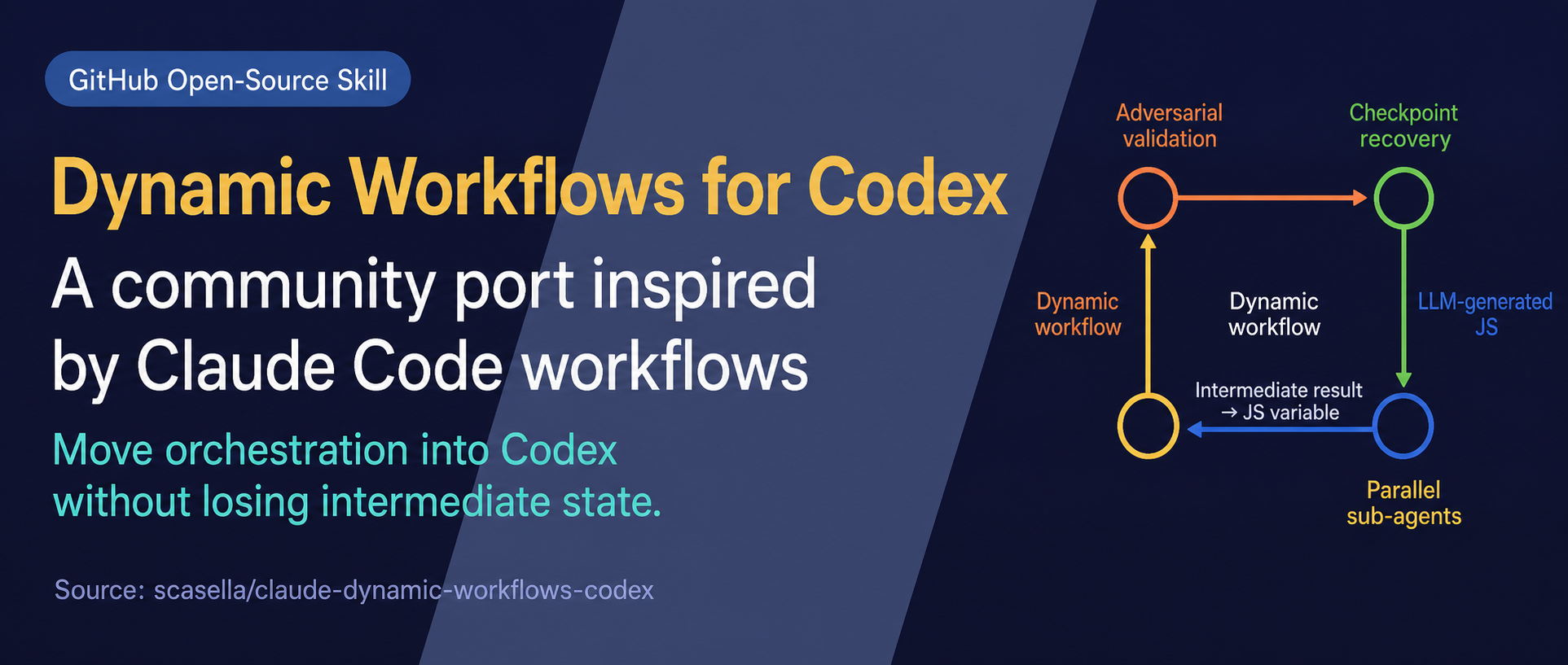
  • Claude Dynamic Workflows on Codex: What This Community Project Actually Does

    Claude Dynamic Workflows on Codex: What This Community Project Actually Does

    The open-source project claude-dynamic-workflows-codex connects two systems that are usually discussed separately: Claude Code writes a JavaScript orchestration workflow, while local Codex agents execute the work through Codex app-server. That distinction matters. This is not a native Codex /dynamic command, and it is not an official OpenAI or Anthropic integration. It is a community-built Claude Code plugin and standalone runner that uses Codex as its agent backend.

    A Chinese WeChat article from Ai 这个时代 introduced the project as a way to reduce context pressure in multi-agent work. The underlying idea is sound, but the current repository differs from several operational details in that account. The repository’s documented command is /codex-workflows, installation happens from Claude Code’s plugin marketplace or a Claude skills directory, and the project explicitly describes itself as unofficial.

    The architecture: orchestration in code, execution in Codex

    Architecture diagram showing a Claude-inspired workflow definition orchestrating Codex execution and reusable state
    The community plugin routes a generated workflow through Codex app-server and stores reusable workflow state; it is not a Codex-native skill.

    Dynamic workflows move coordination logic out of the conversational loop and into a JavaScript program. The script can express parallel phases, pipelines, budgets, races, review gates, and stopping conditions. Intermediate results can remain in runtime variables rather than being pasted wholesale into the top-level conversation.

    In this project, Claude Code turns a rough request into that workflow script. The runner then connects to the local codex app-server, starts Codex threads, streams events, records progress in a journal, and renders the run as either a terminal map or an interactive browser view. OpenAI’s documentation describes app-server as the interface for deep client integrations that need authentication, conversation history, approvals, and streamed agent events. The community project is therefore building on a real, documented Codex integration surface rather than scraping a terminal UI.

    The practical result is a separation of responsibilities:

    • Claude Code acts as the workflow author and operator.
    • JavaScript holds the execution graph, branching, and intermediate state.
    • Codex app-server supplies the agent threads and streamed execution events.
    • A journal supports replay, inspection, and resuming unfinished work.
    • The viewer exposes phases, workers, token counts, timing, and final results.

    This is more than a cosmetic wrapper around subagents. The repository adds sessionful workers that can receive follow-up instructions on an existing thread, races that cancel losing approaches, human gates, run summaries, and a multi-workflow fleet mode. Those features are implemented by this repository; they should not be mistaken for guarantees attached to every Codex client.

    What problem does it solve?

    Standard subagent delegation is useful when several bounded tasks can run independently. Current Codex documentation says subagents can keep noisy exploration and test output away from the main thread, but it also warns that every worker performs its own model and tool work, so multi-agent runs generally consume more tokens than comparable single-agent work.

    A scripted workflow becomes attractive when the coordination pattern itself needs to be durable. Examples include:

    • scanning many independent areas and then adversarially verifying the findings;
    • racing several root-cause hypotheses and stopping the losing workers;
    • loading a large corpus once and asking repeated questions on the same warm thread;
    • pausing at a human decision before a risky phase;
    • resuming a long run without repeating every completed step;
    • comparing structured run journals over time.

    The benefit is not simply “more agents.” It is the ability to make fan-out, review, cancellation, and convergence explicit and repeatable. For a one-off question or a small edit, that machinery is unnecessary overhead.

    The token claim needs a narrower reading

    Evidence boundary for the repository's warm-versus-cold workflow benchmark
    The repository benchmark is directional evidence for one repeated-context workload, not proof of universal savings or production reliability.

    The source article says the port uses fewer tokens than Claude Code’s native dynamic workflow. The repository does publish evidence, but it supports a more limited conclusion.

    Its warm-versus-cold benchmark used Codex 0.137.0, GPT-5.5 at medium effort, a roughly 3,300-line corpus, and three follow-up questions. A warm worker spent 329,000 tokens on initial ingestion and about 69,000 tokens per follow-up. Fresh workers that reread the corpus used about 219,000 tokens per question. Across all three questions, the warm arm reported 535,000 tokens versus 656,000 for the cold arm, with substantially lower marginal latency.

    That is useful evidence for repeated interrogation of the same material. It is not a general comparison between this project and every native Claude Code workflow. The repository itself notes that the warm approach loses for a single question because the initial ingestion dominates. Results will also vary with corpus size, model, cache behavior, effort, prompt design, and the workflow graph. Anyone making cost decisions should rerun the included benchmark on their own workload and compare total billed cost, not token count alone.

    Accurate setup and a low-risk first test

    The repository currently requires Node.js 18 or newer and a logged-in codex CLI on the local path. Its recommended Claude Code installation is:

    /plugin marketplace add scasella/claude-dynamic-workflows-codex
    /plugin install codex-workflows@codex-workflows

    After installation, a task is invoked from Claude Code with a command such as:

    /codex-workflows Audit every route under src/ for missing authorization, read-only

    Before spending model tokens, the repository also includes an offline viewer demo:

    git clone https://github.com/scasella/claude-dynamic-workflows-codex
    cd claude-dynamic-workflows-codex
    node runner/bin/view-run.js examples/incident-demo --open

    That demo is the safest way to inspect the execution map without launching agents. For a live first run, use a small read-only task, inspect the generated workflow script, set a hard budget, and confirm that the Codex version and permissions match the repository’s expectations.

    Where it fits—and where it does not

    This project is a credible option for developers who already use Claude Code as their control surface but want Codex agents underneath a repeatable orchestration layer. It is especially interesting for research, large audits, migrations, incident analysis, and workloads where the same warm context will answer several questions.

    It is a weaker fit when:

    • one capable agent can finish the task directly;
    • the work is dominated by a single sequential dependency;
    • concurrent edits would create merge conflicts;
    • the organization cannot accept a community integration spanning two vendors’ tools;
    • reproducibility, audit, and version pinning have not been established;
    • a CI job would be better served by OpenAI’s supported SDK or GitHub Action.

    There are also operational costs. More agents can mean more token usage, more local processes, more permission decisions, and a larger failure surface. The generated script is executable orchestration and deserves review. Sandboxing should reflect the task, secrets should stay out of prompts and journals, and model or protocol changes can break an unofficial integration even when both underlying products continue to work independently.

    Bottom line

    claude-dynamic-workflows-codex is best understood as an experimental orchestration bridge: Claude Code authors the plan, a JavaScript runtime manages it, and Codex app-server executes agent threads. Its strongest contribution is not a universal promise of cheaper agents. It is a concrete, inspectable way to encode multi-agent control flow, preserve run state, and reuse warm workers.

    That can materially improve the economics of the right repeated-context workload. It does not remove the need to size the workflow, review permissions, validate outputs, and measure the actual bill. Start with the offline demo, then a small read-only run, and promote the pattern only after its journal shows that the extra orchestration is buying something a simpler approach cannot.

    Sources

  • Who Gets to Decide? Designing an Authority Control Plane for AI Coding Agents

    Who Gets to Decide? Designing an Authority Control Plane for AI Coding Agents

    Imagine asking a coding agent to “make failed payments more reliable.” It finds the background-job system, adds three automatic retries, writes passing tests, and produces a clean pull request. The implementation is technically competent. It may also violate customer-support policy, create duplicate-payment risk, and change the product experience without anyone authorising those choices.

    This is not primarily a hallucination problem. The agent may understand the code perfectly. The failure is authority leakage: a system designed to execute work silently becomes the owner of a decision that belongs to a product, security, legal, or operations role.

    A recent update to Matt Pocock’s open-source grilling workflow, reached through the small grill-me wrapper, makes two useful ideas explicit. The agent should investigate facts that already exist, and it should wait when the answer depends on a human choice. A confirmation gate then checks shared understanding before execution.

    Those rules are a good starting point. Production agent systems need a broader operating model: one that connects conversational confirmation to tool permissions, sandbox boundaries, network policy, audit records, rollback, and measurable reliability. In other words, an agent needs an authority control plane, not just a polite prompt.

    Authority is different from capability

    Models are increasingly capable of proposing product rules, migration strategies, security controls, and operational responses. Capability answers, “Can the system produce a plausible solution?” Authority answers, “Who is entitled to choose this outcome, and under which constraints?”

    The distinction matters because a repository contains several different kinds of information:

    Information class Typical source Correct agent response
    Retrievable fact Code, tests, configuration, logs, documentation, authorised tools Investigate and cite the evidence
    Non-negotiable constraint Regulation, contract, compatibility guarantee, budget, explicit project rule Preserve it and flag conflicts
    Owned preference Product intent, risk tolerance, policy, design direction, new trade-off Present options and wait for the responsible owner
    Testable hypothesis Prediction about users, performance, adoption, or an uncertain technical approach Design a prototype, measurement, or reversible experiment

    The fourth category prevents a subtle mistake. If no internal caller uses an API, that does not prove an external customer is not using it. Repository search cannot settle the question, but neither can a manager’s preference. The answer may require telemetry, a deprecation window, or a controlled experiment.

    This expanded classification produces a better division of labour:

    • Agents retrieve evidence.
    • Systems enforce constraints.
    • Accountable people make choices.
    • Experiments resolve hypotheses.

    NIST’s AI Risk Management Framework supports this organisational view. Its core asks organisations to define human and AI roles, document system knowledge limits, specify how outputs are overseen, and assign responsibility for AI risk. Oversight is therefore a designed operating process, not a generic “human in the loop” label.

    Replace binary approval with four action modes

    Not every tool call deserves the same interruption. A useful control plane assigns each proposed action to one of four modes.

    1. Observe

    Read-only inspection of code, documentation, logs, schemas, or authorised dashboards. These actions should usually proceed automatically when access is already in scope. The agent records what it inspected and does not mutate state.

    2. Prepare

    The agent creates a draft, diff, plan, migration preview, query, or message without applying it to the live target. Preparation is valuable because it converts an abstract request into something a reviewer can inspect. A prepared database migration is not the same as running it; a drafted email is not the same as sending it.

    3. Execute with guardrails

    The agent performs a bounded, reversible mutation inside a defined environment. Examples include editing files in a worktree, running tests in a sandbox, or changing a feature flag for a small canary. The control plane limits tools, credentials, network destinations, scope, and runtime.

    4. Explicit approval

    The action affects an external system, uses privileged credentials, creates a material commitment, changes customer-visible policy, destroys data, or is difficult to reverse. The agent pauses and presents an approval packet tied to the exact action.

    This model is stricter than “ask before every write” and more useful than “let the agent decide.” It allows low-risk work to move quickly while concentrating attention on authority transitions.

    English grill-me update banner reading “The missing piece is finally in place” and “Major update,” beside a glowing puzzle piece and illustrated character.

    English redraw of an illustration from the original Chinese report. The translated headline announces a major grill-me workflow update.

    Use an authority budget, not a vague risk label

    “High risk” is too imprecise to drive tooling. A more actionable approach evaluates five dimensions:

    1. Impact: what happens if the action is wrong?
    2. Irreversibility: can the previous state be restored completely and quickly?
    3. Scope: how many users, records, services, or repositories are affected?
    4. Uncertainty: how strong is the evidence that the proposed action is correct?
    5. Novelty: is this a familiar, tested pattern or a new path with weak operational history?

    This is an editorial synthesis of NIST risk management, OWASP least-agency guidance, and release-engineering practice—not a published standard. Its value is operational: increasing any dimension should reduce the agent’s autonomy or increase the strength of the control.

    The same idea can be expressed as an authority budget:

    • Which tools may the agent invoke?
    • Which data and resources may those tools reach?
    • How large a side effect may one action create?
    • How long may the agent continue before a checkpoint?

    A local formatting change may have a generous budget. A production schema deletion should have almost none.

    OWASP’s guidance on excessive agency identifies excessive functionality, permissions, and autonomy as distinct root causes. That separation is important. Even a well-instructed model remains dangerous if its tool can execute arbitrary shell commands with a production administrator credential. Conversely, a narrowly scoped tool operating under the current user’s identity can make a model error much less damaging.

    A confirmation packet should be parameter-bound

    The least useful approval prompt is “Continue?” It hides the information the reviewer needs and encourages reflexive acceptance.

    A serious approval packet should contain:

    • Outcome: the user-visible or operational result.
    • Exact action: tool, target, parameters, command, request, or proposed diff.
    • Affected resources: files, services, records, users, and external systems.
    • Effective identity: whose credential and which scopes will be used.
    • Evidence: tests, repository facts, policies, and primary documentation.
    • Decisions: choices already made and their accountable owner.
    • Residual uncertainty: assumptions and unverified inferences.
    • Blast radius: plausible worst-case impact.
    • Recovery: rollback, restore, cancellation, or containment path.
    • Reason for escalation: the boundary that requires approval.

    The OpenAI Agents SDK human-approval flow illustrates several implementation details. Approval can be attached to specific tools, execution can pause with the tool name and arguments visible, state can be serialised, and the original run can resume after approval or rejection. Decisions can be scoped to one call instead of becoming vague permission for everything that follows.

    That last point is critical. “Yes, send this email” should not become “Yes, send any future email.” Sticky approval can be convenient within a bounded run, but it should be explicit, time-limited, and tied to a known tool and scope.

    Separate the decision plane from the execution plane

    The same model that proposes an action should not be the only mechanism deciding whether the action is permitted. Prompts express policy intent; enforcement belongs in the surrounding system.

    A bounded-autonomy architecture uses at least six control surfaces:

    Tool surface

    Expose only necessary operations. Prefer read_invoice and schedule_retry over a general shell or unrestricted HTTP client. Validate structured arguments before execution.

    Identity surface

    Run actions in the requesting user’s context where possible. Use short-lived credentials, narrow OAuth scopes, least-privilege database roles, and separate read from write identities.

    Filesystem and process surface

    Place code execution in an isolated workspace. Anthropic’s Claude Code sandboxing report describes filesystem and network isolation as complementary boundaries and reports that sandboxing reduced internal permission prompts by 84%. A filesystem boundary alone does not stop exfiltration; a network boundary alone does not stop local secret access.

    Network surface

    Default-deny outbound access for sensitive workflows, then allowlist required destinations. Log allowed and denied requests. Do not treat a URL fetched from untrusted content as implicitly authorised.

    Approval surface

    Pause before boundary-crossing actions and show the parameter-bound packet. Keep the approval mechanism outside the agent’s natural-language reasoning loop.

    Trace surface

    Record model and policy version, user goal, selected tool, exact arguments or diff, target, effective identity and scope, approval identity and time, result, and rollback pointer. NIST SP 800-53 provides implementation-grade least-privilege and audit principles: processes should receive only the privileges required, privileged functions should be audited, and audit records should capture who did what, where, when, and with what result.

    OpenAI’s description of running Codex safely follows the same layered logic: sandbox policy constrains writes and network access, approvals govern boundary crossings, and telemetry captures security-relevant activity. The design lesson is more important than any vendor implementation: safety emerges from layers that fail independently.

    Approval fatigue is a safety defect

    Requiring confirmation for every action sounds conservative. In practice it can train reviewers to click through.

    A controlled USENIX SOUPS study on warning habituation found that repeated non-security notifications reduced attention and adherence even for a new security warning, especially when the interfaces looked similar. The study was not about coding agents, so applying it here is an informed analogy. The implication is still useful: uniform approval dialogs can make exceptional risk look routine.

    Approval design should therefore be tiered:

    • Do not interrupt for authorised read-only investigation.
    • Batch related low-risk prepared changes into one reviewable diff.
    • Use distinct visual treatment for privileged, destructive, or externally visible actions.
    • Explain why the action escalated.
    • Show the exact side effect, not only the agent’s rationale.
    • Measure approval volume, rejection rate, and time-to-decision.
    • Remove approval prompts that never affect the outcome.

    The goal is not zero friction. It is high-information friction at the moment responsibility changes hands.

    Checkpoint, validate, and promote

    Conversation-level approval is only one checkpoint. A stronger workflow separates preparation from promotion:

    1. Snapshot: create a commit, worktree, database snapshot, or versioned configuration before mutation.
    2. Act in isolation: let the agent modify a sandbox or staging target.
    3. Validate: run deterministic tests, static analysis, policy checks, security scans, and task-specific graders.
    4. Review evidence: present the diff, results, residual risk, and rollback pointer.
    5. Promote atomically: merge, deploy, publish, or switch traffic only after the required approval.
    6. Observe: monitor defined success and failure signals.
    7. Rollback or expand: restore the previous state when thresholds fail, or progressively increase scope when evidence remains healthy.

    This pattern imports proven release-engineering ideas into agent workflows. Google SRE’s canarying guidance recommends small, self-contained changes because they are easier and cheaper to reverse. A canary exposes only a limited population while the system compares outcomes and decides whether to continue.

    For coding agents, the equivalent may be a local worktree, draft pull request, shadow query, dry run, feature flag, or limited rollout. Autonomy can increase as reversibility increases.

    Worked example: redesigning payment retries

    Return to the failed-payment request.

    Observe

    The agent inspects the queue, payment-provider integration, idempotency-key handling, error taxonomy, customer notifications, dashboards, and existing tests. It records factual findings and links them to files or documentation.

    Map constraints

    The agent identifies provider limits, contractual commitments, compliance requirements, and existing support procedures. If those sources conflict, it flags the conflict instead of selecting the most convenient interpretation.

    Isolate owned choices

    The team must decide which errors qualify for retry, maximum delay, customer-visible state, notification timing, and ownership of a final failure. The agent presents options and consequences.

    Identify hypotheses

    Whether retries improve recovery without increasing duplicates is an empirical question. The plan may require a small canary, a shadow calculation, or historical replay before changing live behaviour.

    Produce the approval packet

    The packet might propose one retry for a narrow transient-error class, preserve the existing idempotency key, exclude declined cards, add an operator metric, limit rollout to 5%, and automatically disable the flag when duplicate-attempt or error thresholds are exceeded.

    Execute and observe

    The agent implements the bounded change in a worktree, runs tests, opens a reviewable diff, and waits before production promotion. After approval, the system deploys gradually and records overrides, failures, and rollback decisions.

    Most work remains agent-owned. Human attention is reserved for customer policy, financial risk, and production authority.

    Evaluate both outcomes and trajectories

    An agent saying “done” is not evidence. The final environment state must prove the claim.

    Anthropic’s guide to agent evaluations distinguishes the outcome from the trajectory. The outcome is what changed in the environment; the trajectory is the sequence of model turns, tool calls, and intermediate actions. Both matter:

    • A correct patch produced through an unauthorised production action is not a safe success.
    • A perfectly compliant trajectory that fails to solve the task is not a useful success.

    Use deterministic graders where possible: tests, schema validation, file assertions, permission checks, and state comparison. Use model-based grading for qualities that resist exact rules, then calibrate those graders periodically against human experts.

    Evaluation should also separate:

    • Capability suites: difficult tasks that reveal what the agent may be able to do.
    • Regression suites: established behaviours expected to pass consistently.
    • First-try usefulness: often expressed as pass@1.
    • Consistency: the probability of succeeding across repeated trials, often expressed as pass^k.

    Benchmarks such as SWE-bench are valuable because they apply generated patches to real repositories and run tests in controlled environments. They do not replace organisation-specific evaluation. Production authority failures may never appear in a repository issue benchmark.

    Infrastructure can distort results too. Anthropic reported in its analysis of evaluation infrastructure noise that resource configuration alone moved Terminal-Bench 2.0 scores by six percentage points in one study. Small leaderboard differences should not drive autonomy policy unless the environments are comparable.

    For long-running work, task duration matters. METR’s task-completion time horizon asks how long a task would take a human expert at a specified agent success probability. An operational inference follows: as the expected task horizon grows, checkpoints, state persistence, evidence review, and recovery mechanisms should become stronger.

    Metrics for the authority control plane

    Track technical performance and oversight quality together:

    • Task success rate after environment verification.
    • First-try success and repeated-trial consistency.
    • Approval requests per completed task.
    • Approval acceptance, rejection, and override rates.
    • False-positive escalations: the agent asked for a decision that evidence could answer.
    • False-negative escalations: the agent acted where approval was required.
    • Time to escalation and time waiting for a decision.
    • Post-approval failure rate.
    • Rollback frequency and mean time to recovery.
    • Tool errors, retry loops, and policy violations.
    • Blast radius of failed actions.
    • Human overrides by action class.
    • Cost and token use per verified outcome.

    The target is not fewer approvals at any cost. It is better allocation: fewer interruptions for facts, more reliable escalation for real authority changes, and stronger evidence before irreversible actions.

    Confirmation belongs inside a lifecycle

    NIST’s Generative AI Profile places governance, testing, monitoring, incident response, recovery, and deactivation in one lifecycle. Relevant practices include sending pre-deployment test evidence to release authorities, recording human overrides, defining escalation routes, maintaining fallback procedures, and establishing criteria for deactivation.

    That suggests a continuous control loop:

    Test → authorise → observe → override → learn → rollback or deactivate

    A confirmation gate handles the authorise step. It cannot compensate for missing monitoring, an unusable rollback path, or a system that never learns from rejected approvals.

    A practical rollout sequence

    Teams do not need to build the entire control plane at once.

    First: inventory side effects

    List every tool and classify whether it reads, prepares, mutates locally, affects an external system, uses privileged identity, or performs an irreversible action.

    Second: narrow the execution surface

    Remove unused tools, split broad functions, reduce credential scopes, and run code in isolated workspaces. Enforce limits outside the prompt.

    Third: define escalation policy

    Assign action modes, authority owners, and the evidence required for promotion. Make rules parameter-bound and test them on both positive and negative examples.

    Fourth: make recovery real

    Add snapshots, dry runs, feature flags, limited rollouts, cancellation, and rollback. Test recovery rather than documenting an unverified command.

    Fifth: trace and evaluate

    Record trajectories and final state. Seed an evaluation suite with actual failures, including cases where the agent should proceed and cases where it must stop.

    Sixth: tune the human experience

    Measure approval burden and remove low-value interruptions. Preserve prominent, information-rich prompts for high-impact actions.

    What this model cannot guarantee

    An authority control plane does not make an agent correct. A reviewer can approve a harmful action. A sandbox can be misconfigured. A tool can hide side effects. A rollback can fail after data has propagated. A model can produce a persuasive but false rationale.

    The design therefore assumes failure and limits its consequences. Prompts express intent; permissions bound capability. Tests provide evidence; traces support investigation. Human approval allocates responsibility; staged execution and rollback preserve operator control.

    The most mature agent is not the one given unlimited freedom. It is the one embedded in a system that knows the difference between evidence, experimentation, and authority—and can prove what happened after the decision.

    References
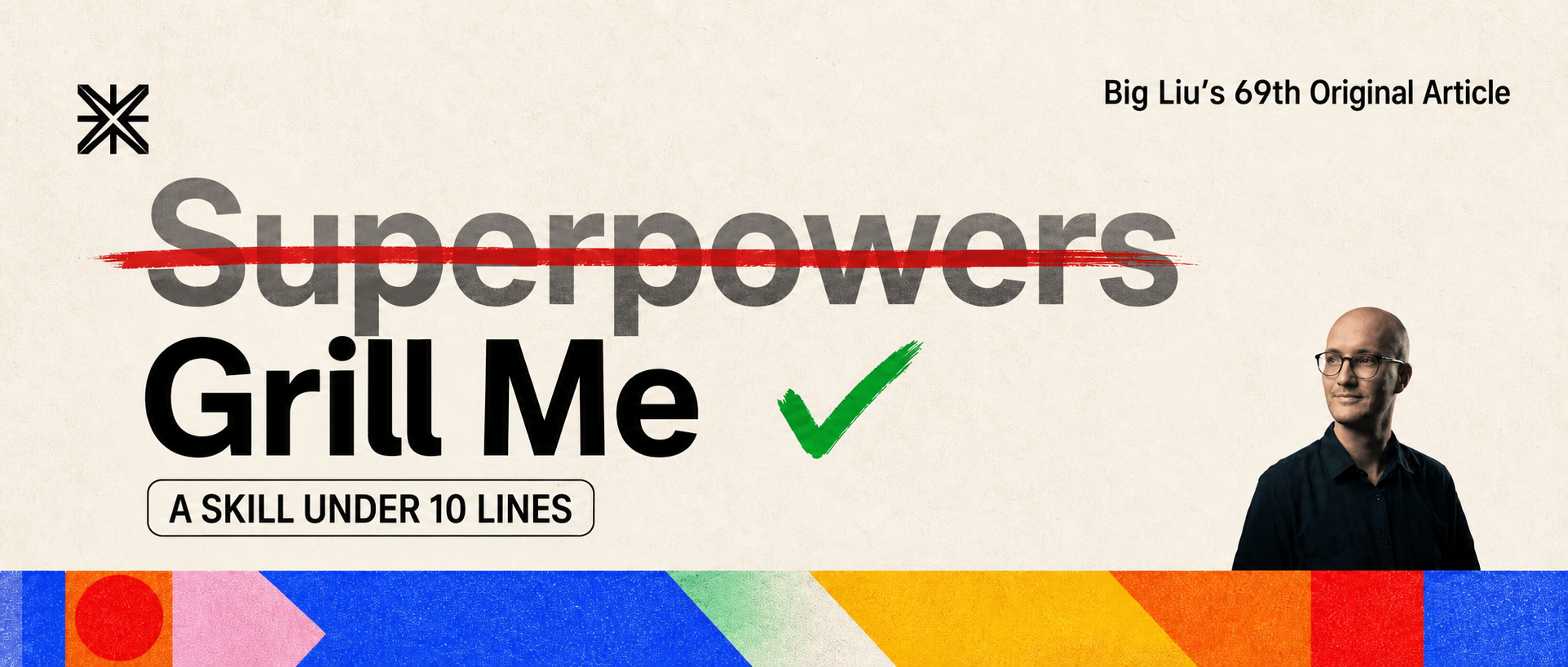
  • Superpowers vs. Grill Me: Match AI Planning to the Cost of Being Wrong

    Superpowers vs. Grill Me: Match AI Planning to the Cost of Being Wrong

    A substantially expanded English analysis of a Chinese article by 大刘 (AI大刘), updated with current project documentation, official coding-agent guidance, and empirical research on clarification and planning.

    AI coding is rarely limited by how fast a model can produce code. The expensive failure mode is building a plausible solution to the wrong problem, then discovering the mismatch after code, tests, and assumptions have accumulated. That is why planning skills have become popular. But “more planning” is not a universal answer, and “more questions” is not a quality metric.

    This article responds to 大刘’s original WeChat article, which contrasts the comprehensive Superpowers workflow with Matt Pocock’s compact Grill Me skill. Its central intuition is useful: the tools allocate decision-making differently. Current documentation and newer research sharpen that claim. The practical question is not “Which tool wins?” It is “Which uncertainty are we reducing, and how costly would a wrong answer be?”

    English banner introducing a practical comparison of Superpowers and Grill Me
    A practical comparison of Superpowers and Grill Me. English-localized derivative based on the original visual by 大刘 / AI大刘.

    Clarification, planning, and verification do different jobs

    Many discussions collapse three activities into “thinking before coding.” That hides their different purposes:

    • Clarification reduces uncertainty about what should be built. It resolves intent, constraints, ownership, acceptable trade-offs, and observable success.
    • Planning manages dependencies in how it will be built. It orders changes, identifies interfaces, assigns verification, and exposes coordination risks.
    • Verification produces evidence that the result is acceptable. Tests, logs, type checks, screenshots, diffs, and human review answer a different question from either clarification or planning.

    Claude Code’s official Plan mode illustrates the distinction. It is primarily a research-and-approval boundary: the agent can inspect the project and propose changes, but edits remain blocked until the plan is approved. That is valuable, yet it does not guarantee that the agent asked the product owner the one question that changes the feature’s meaning. A plan can be detailed and still encode the wrong requirement.

    The reverse is also true. A thorough interview can establish intent without producing a safe migration sequence, a test strategy, or a reviewable implementation contract. The three layers complement one another; substituting one for all three is the mistake.

    English graphic framing the friction of turning vague requirements into agent work
    Vague requirements create friction when an agent must turn them into work. English-localized derivative based on the original visual by 大刘 / AI大刘.

    The 2026 comparison is stack versus primitive

    The most important correction to a simple Superpowers-versus-Grill-Me framing is that these are not equivalent products at different sizes.

    As checked on 14 July 2026, grill-me itself is a tiny user-invoked wrapper: it starts the underlying grilling skill. The current instructions say to walk a decision tree one question at a time, recommend an answer with each question, investigate facts available in the environment, leave decisions to the user, and wait for shared understanding before acting.

    Matt Pocock’s broader repository now routes different situations to different skills. Its current ask-matt guidance directs greenfield, stateless discussion toward Grill Me; existing-codebase work that needs durable context toward grill-with-docs; and larger work through specification, ticketing, implementation, and review steps. Grill Me is therefore one entry point in a growing workflow stack, not a complete one-file replacement for design records, execution, testing, and review.

    Superpowers is explicitly a full software-development methodology. Its latest formal release at the time of checking was v6.1.1, published 2 July 2026. The repository contained 14 top-level skills, and its documented chain runs from brainstorming through worktree isolation, detailed planning, subagent or sequential execution, test-driven development, review, verification, and branch completion.

    English graphic contrasting two repositories with different scopes
    The two repositories operate at different levels of scope. English-localized derivative based on the original visual by 大刘 / AI大刘.

    This changes the comparison. The real alternatives are closer to these:

    Layer Matt Pocock workflow Superpowers workflow Primary output
    Intent discovery grill-me, grilling, or grill-with-docs brainstorming Agreed decisions and constraints
    Durable design Context and decision records, then spec when needed Written design spec with review gates Reviewable design artifact
    Decomposition Spec and tickets for larger work writing-plans with small verified tasks Ordered implementation contract
    Execution implement and related engineering skills Subagent-driven or plan execution Code changes in bounded steps
    Quality control TDD and final review in the broader stack TDD, task review, branch review, completion verification Evidence, review findings, release choice

    The fair conclusion is not that Grill Me replaces Superpowers. It is that a compact clarification primitive can be useful before, inside, or instead of a larger methodology depending on the task’s risk and coordination needs.

    Superpowers has also become more deliberate about user decisions

    The current Superpowers brainstorming instructions do not simply let the agent decide everything. They tell the agent to inspect the project first, ask questions one at a time, propose two or three approaches with trade-offs, present the design in sections, obtain approval, write a design document, self-review it, and obtain review of the written specification before moving to planning.

    That overlap matters. Both approaches separate facts the agent can discover from decisions the owner must make. Their main difference is what happens around and after the interview. Superpowers persists design artifacts and connects them to a mandatory engineering chain. Grilling can stop at shared understanding or hand off to other skills selected for the job.

    English graphic presenting Superpowers as an end-to-end workflow
    Superpowers is an end-to-end development methodology. English-localized derivative based on the original visual by 大刘 / AI大刘.
    English screenshot illustrating the mandatory instruction style discussed in the source
    The source article discusses mandatory workflow instructions. This describes a workflow style, not a guarantee that every model and installation will comply identically. English-localized derivative based on the original visual by 大刘 / AI大刘.

    Superpowers’ current writing-plans skill also reaches beyond a prose outline. It asks for exact files, interfaces, concrete code or commands, small actions, test-first RED/GREEN steps, and commits. That is expensive compared with a three-bullet plan, but it creates a portable execution artifact. The cost is justified when another agent or engineer must resume the work, when multiple components change in dependency order, or when reviewers need to detect divergence before merge.

    English graphic illustrating a longer planning document
    A longer planning artifact can make assumptions and dependencies reviewable, but it also creates reading and approval work. English-localized derivative based on the original visual by 大刘 / AI大刘.

    The project is not static. Superpowers’ v6.0.0 release consolidated review steps, added branch-level review and plan checks, and revised interfaces and global constraints. Its v6.1 line reduced bootstrap overhead and improved Codex integration. It is therefore misleading to treat “Superpowers overhead” as a fixed property measured by one older run. Workflow cost depends on release, harness, model, codebase, and configuration.

    Grill Me protects decision ownership—but should not ask everything

    Grilling’s most useful rule is not “ask many questions.” It is “research facts; ask the user for decisions.” A repository can usually answer which framework is installed, how neighboring endpoints authorize requests, which commands run tests, and whether a migration helper already exists. Asking a user for those facts wastes attention and invites stale answers.

    The user is needed for questions that the environment cannot settle: whether backward compatibility matters more than cleanup, which failure mode is acceptable, whether a data migration may be irreversible, who can view a new field, or what business event counts as success.

    English graphic introducing Grill Me as an interview-style skill
    Grill Me is an interview-style skill and one entry point in a broader workflow. English-localized derivative based on the original visual by 大刘 / AI大刘.
    English graphic summarizing Grill Me’s one-question-at-a-time workflow
    The approach asks one question at a time, recommends an answer, checks the environment for discoverable facts, and waits for agreement. English-localized derivative based on the original visual by 大刘 / AI大刘.

    That division makes human attention a scarce engineering resource. Approval prompts can become theater when they appear at every minor action. The better control points are boundaries with real consequence: freezing the requirement, accepting the plan, crossing a sandbox or network boundary, applying an irreversible migration, merging, or publishing. Low-risk, local, reversible steps can proceed inside an agreed boundary and return evidence afterward.

    English graphic illustrating shared understanding before implementation
    The desired outcome is shared understanding before implementation begins. English-localized derivative based on the original visual by 大刘 / AI大刘.

    Research supports targeted clarification, not maximum interrogation

    The empirical literature gives stronger support to clarification than the original single-run comparison, but it also warns against overgeneralization.

    The 2024 FSE paper ClarifyGPT detected ambiguous requirements, generated targeted questions, refined the request from the answers, and then generated code. In its small human study, GPT-4 Pass@1 on MBPP-sanitized rose from 70.96% to 80.80%. Across four automated benchmark evaluations, average GPT-4 performance rose from 68.02% to 75.75%, while ChatGPT rose from 58.55% to 67.22%. Those are meaningful results, but the human study had ten participants, the tasks were mainly function-level Python problems, and the larger evaluation relied on simulated user feedback. It supports the mechanism—not a claim that every large repository needs a long interview.

    A newer 2026 study, Ask or Assume?, tested clarification on underspecified variants of SWE-bench Verified. Its uncertainty-aware multi-agent setup resolved 69.4% of tasks versus 61.2% for a standard single-agent setup. The agent also conserved questions on easier tasks. Again, the missing information and user interaction were experimentally constructed, so the result is evidence for uncertainty-aware clarification rather than a production guarantee.

    Most directly relevant to Grill Me’s “37 questions” story, Asking What Matters found that increasing question count did not consistently improve task success; performance plateaued while the share of answerable questions declined. Its trained clarification module matched GPT-5’s resolution rate on the study’s underspecified issues with 41% fewer questions. The authors identify two useful criteria: task relevance—does the missing information predict success?—and user answerability—can the user realistically supply it?

    That yields a better question test:

    1. Can the agent find the answer in code, documentation, logs, tests, or a small experiment? If yes, investigate instead of asking.
    2. Could different answers materially change the interface, data model, permission boundary, compatibility promise, or acceptance criteria? If no, defer or choose a reversible default.
    3. Is the person being asked actually able and authorized to decide? If no, identify the owner or state the unresolved risk.
    4. Will the answer be converted into a constraint or observable check? If no, the question may create conversation without reducing implementation risk.

    The important unit is information gain per interruption, not questions per session.

    Planning evidence is strongest when dependencies matter

    Clarification is not the only intervention with empirical support. The 2024 TOSEM paper Self-Planning Code Generation reported relative Pass@1 improvements of up to 25.4% over direct generation by having models generate concise implementation steps first. The tasks were primarily algorithmic and function-level, so the exact gain should not be projected onto production repositories.

    Repository-scale evidence is more relevant to Superpowers’ value proposition. Microsoft Research’s CodePlan used dependency-aware multi-step planning on repository migrations and temporal edits touching between 2 and 97 files. It passed build and correctness checks in five of seven repositories; a context-matched baseline without planning passed none. The sample was small and the task types were structured, but the result captures where planning earns its keep: later edits depend on earlier ones, and local correctness does not imply repository-level correctness.

    Conversely, bounded work with a strong evaluator can benefit from a simpler loop. Agentless used a fixed localization–repair–validation pipeline rather than a highly autonomous workflow and solved 96 of 300 SWE-bench Lite issues in its reported evaluation. That historical benchmark does not settle today’s tool choice, but it illustrates a durable point: when the scope is narrow and the verifier is reliable, disciplined direct execution can outperform extra ceremony.

    Treat the 0 / 6 / 37 comparison as a case study

    The original article cites Alex Rusin’s comparison of three approaches on one API feature. In that reported run, Plan Mode asked no questions and produced a plan in roughly ten minutes; Superpowers asked six focused questions and took more than 31 minutes before stalling; Grill Me asked 37 questions.

    Those figures are useful as a trace of how one configuration allocated decisions. They are not a benchmark. One feature, operator, model configuration, repository, and run cannot establish general speed or correctness. The projects have also changed since the test. Superpowers now has newer planning and review behavior; Grilling’s July 2026 releases added an explicit confirmation gate and a clearer facts-versus-decisions split.

    English graphic: one tool governs process while the other asks the user to clarify intent
    One tool governs a larger process; the other concentrates on clarification. English-localized derivative based on the original visual by 大刘 / AI大刘.
    English chart comparing Plan Mode, Superpowers, and Grill Me
    Alex Rusin’s cited case compares Plan Mode (0 questions, about 10 minutes), Superpowers (6 questions, 31+ minutes), and Grill Me (37 questions). It is an illustrative single run, not a general performance study. English-localized derivative based on the original visual by 大刘 / AI大刘.

    A risk-weighted decision matrix

    Choose the smallest workflow that covers the costly uncertainty—not the smallest workflow in absolute terms.

    Situation Useful default What must be true before execution
    Vague greenfield idea; domain owner available Grill Me High-impact choices are explicit and the user confirms shared understanding
    Existing codebase; decisions need a durable record Grill With Docs or equivalent Context, terminology, and architectural decisions are written down
    Multi-file or multi-component change with dependency order Superpowers or another structured planning stack Design is approved, interfaces are named, steps have verification and rollback boundaries
    Small local change following a stable pattern Lightweight plan and direct execution Scope is reversible and a reliable test or observable check exists
    Production write, security boundary, destructive migration, or external side effect Structured workflow plus explicit approval Blast radius, recovery path, owner, and final approval are unambiguous
    Large, multi-session problem whose shape is still unclear Discovery/decomposition workflow before implementation The problem is split into independently reviewable scopes

    A useful qualitative risk score is:

    planning intensity ≈ probability of a wrong assumption × cost of reversal × coordination surface

    This is not a numeric formula. It is a prompt to examine three independent reasons for more structure. High ambiguity raises the chance of choosing the wrong target. Irreversible or customer-visible effects raise the cost of being wrong. Many files, systems, sessions, or contributors raise the chance that a correct local change fails as a whole.

    The strongest workflow is a sequence

    For consequential work, the best combination is usually:

    1. Inspect before asking. Read project instructions, neighboring code, tests, logs, schemas, and recent decisions. Separate facts from owner-only choices.
    2. Grill only high-impact decisions. Ask one answerable question at a time, explain the recommended default, and record the decision as a constraint or acceptance criterion.
    3. Freeze a decision brief. Capture goal, non-goals, external behavior, interfaces, compatibility, data and permission boundaries, acceptance criteria, and actions that require renewed approval.
    4. Generate a dependency-aware plan. Map files and interfaces, sequence dependent changes, define RED/GREEN or equivalent checks, and place rollback or human gates at high-blast-radius steps.
    5. Execute in verifiable increments. Keep changes small enough that failures have a clear cause. Use independent review where the cost warrants it.
    6. Return evidence, not confidence. Show the diff, tests, logs, screenshots, citations, migration results, and unresolved risks before merge or publication.

    This sequence matches broader official guidance. Anthropic describes an agent loop of gathering context, taking action, and verifying results, and recommends giving Claude something concrete to verify against. OpenAI’s original Codex description likewise emphasizes isolated environments and iterative tests. The tools differ, but the control principle is stable: approval governs authority; verification governs trust.

    Stop grilling when

    • every decision that would change scope, architecture, external behavior, data, or permissions has an owner-approved answer;
    • goals, non-goals, and acceptance criteria are observable;
    • discoverable facts have been investigated instead of delegated back to the user;
    • remaining unknowns are local, reversible, or cheaply testable; and
    • it is clear which later actions require renewed approval.

    Start implementation when

    • each plan step has a concrete artifact or observable result;
    • verification commands and expected outcomes are present, not merely a list of files to edit;
    • high-risk steps have rollback or approval boundaries;
    • repository instructions contain current build, lint, test, and validation commands; and
    • a reviewer can tell from the plan what “done” means.

    What the evidence still cannot tell us

    No cited study directly compares current Superpowers, Grill Me, Grill With Docs, Claude Plan mode, and a lightweight baseline across the same production repositories and human teams. Function-level benchmarks underrepresent coordination and maintenance. Simulated users may answer more consistently than real stakeholders. SWE-bench variants emphasize issue resolution rather than product discovery. Project release notes report maintainers’ intentions and internal evaluations, not independent universal outcomes.

    That uncertainty should change how teams adopt these methods. Measure rework, elapsed time, human attention, escaped defects, review findings, and recovery cost on your own task mix. Do not use repository stars, plan length, token count, or question count as a substitute for outcome evidence.

    The most defensible conclusion is narrower and more useful: clarification reduces uncertainty about what should be built; planning manages dependencies in how it will be built; verification determines whether the result is acceptable. Match the depth of each layer to the cost of being wrong.

    Sources and attribution