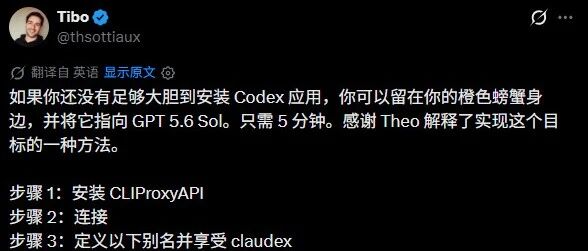
GPT-5.6 Sol can now sit inside a Claude Code workflow—but “inside” hides two very different architectures. One replaces the model behind Claude Code through a compatibility gateway. The other, OpenAI’s official codex-plugin-cc, keeps Claude Code intact and delegates selected work to a local Codex process.
That distinction matters. The two paths have different credentials, failure modes, support boundaries, and user experiences. A viral five-minute setup may prove that agent interfaces and models are becoming more modular, but it does not make every combination equally supported or safe to operate.
What the viral setup actually demonstrated
A Chinese WeChat report from 智猩猩AI collected a short exchange between developer Theo and OpenAI product leader Thibault Sottiaux. Theo said GPT-5.6 Sol felt better in Claude Code than in Codex for his use case. Sottiaux then shared a compact setup built around CLIProxyAPI and a claudex alias.
That is an interesting practitioner report, not a controlled comparison. It tells us that one developer preferred a particular model-and-harness pairing; it does not establish that Claude Code is universally a better host for GPT-5.6 Sol or that a proxy preserves every Codex capability.

The key distinction: model replacement versus task delegation
An agentic coding product has at least three layers:
- The model generates reasoning and tool requests.
- The harness manages context, permissions, tools, subagents, and the terminal interface.
- The provider adapter translates the harness’s requests into the upstream model API and converts responses back.
The community proxy setup keeps Claude Code as the harness but changes the provider path. Claude Code sends Anthropic-format requests to a local or remote compatibility layer; that layer translates them for OpenAI and routes them to GPT-5.6 Sol.
The official OpenAI plugin uses a different boundary. Claude Code remains connected to its normal model, while plugin commands launch or communicate with the local Codex CLI/app server for a review, rescue, handoff, or background task. The plugin is an interoperability bridge between two agents, not a main-model replacement switch.
Path one: running GPT-5.6 Sol through a compatibility gateway
The screenshots show a shell alias that starts Claude Code with gpt-5.6-sol as the requested model and several implementation-specific environment variables. A second screenshot makes the hidden prerequisite explicit: the alias only works when Claude Code is already pointed at an Anthropic-compatible proxy.

claudex alias. Several variables shown are specific to this setup; they should not be assumed to be stable Claude Code configuration keys.
Anthropic officially documents ANTHROPIC_BASE_URL and gateway credentials for routing Claude Code through an organization-operated LLM gateway. Its documentation also states two important limitations: Anthropic does not endorse or audit third-party gateways, and it does not support routing Claude Code to non-Claude models through a gateway.
That does not mean a compatibility proxy cannot work. It means the operator owns the integration risk. A translator must preserve more than plain text. It may need to map system prompts, tool schemas, streaming events, reasoning controls, usage accounting, error objects, image inputs, prompt caching, and evolving beta headers. A basic conversation can succeed while a subagent, tool call, or long-running session fails later.
The proxy route is therefore best treated as an experiment for developers who can inspect traffic and recover from breakage—not as a zero-maintenance product feature.

claudex alias. It is evidence of the shared experiment, not an official support guarantee for model substitution.Credential policy is separate from technical compatibility
The easiest mistake is to assume that any credential already stored by either CLI can safely be reused by a bridge. Technical access and permitted access are different questions.
Anthropic’s current legal-and-compliance documentation says subscription OAuth is intended for ordinary use in Claude Code and other native Anthropic applications. It prohibits third-party developers from offering Claude.ai login or routing requests through Free, Pro, or Max plan credentials on behalf of users. For products and services, Anthropic directs developers to API keys or supported cloud providers.
For a gateway experiment, use credentials deliberately issued for the traffic being sent. Do not copy consumer OAuth tokens out of credential stores, expose them to an unreviewed proxy, or assume a saved Claude subscription becomes an OpenAI entitlement. On the OpenAI side, use the authentication method documented for Codex or the API, and keep provider keys server-side when a gateway is shared.
There is also a data boundary to review. A gateway can observe prompts, source snippets, tool results, and metadata unless designed otherwise. Before using one with proprietary code, verify its source, deployment location, logging defaults, update path, access controls, and retention policy.
CLIProxyAPI deserves an additional network check before use. Its example configuration documents an empty bind host as listening on all IPv4 and IPv6 interfaces and leaves TLS disabled by default. A local experiment should be bound to loopback, protected with a strong proxy key, and kept off untrusted networks. The same example also exposes options described as Claude “cloak” and identity-confuse; avoid any identity-obscuring mode unless the relevant providers explicitly permit it.

Path two: OpenAI’s official Codex plugin for Claude Code
OpenAI’s official codex-plugin-cc offers the lower-risk route when the real goal is to use Codex capabilities without abandoning a Claude Code workflow. The project’s documented installation is:
/plugin marketplace add openai/codex-plugin-cc
/plugin install codex@openai-codex
/reload-plugins
/codex:setup
The plugin then exposes commands such as /codex:review, /codex:adversarial-review, /codex:rescue, /codex:status, and /codex:result. It uses the globally installed Codex binary, the Codex app server, existing Codex configuration, and local Codex authentication.
This architecture has a clean trust boundary: Claude Code orchestrates the current interaction, and Codex performs explicitly delegated work. It also makes provenance easier to understand. A Codex review is a Codex task with Codex usage limits and configuration; it is not Claude Code secretly running on an OpenAI model.
The trade-off is experience. If you want every Claude Code turn to be generated by GPT-5.6 Sol, the official plugin does not provide that. If you want to stay in Claude Code while sending selected reviews or difficult tasks to Codex, it is the purpose-built option.
Side-by-side decision guide
| Question | Compatibility gateway | Official Codex plugin |
|---|---|---|
| What changes? | The model/provider path behind Claude Code | Selected tasks are delegated to Codex |
| Main interface | Claude Code for the whole session | Claude Code plus /codex:* commands |
| Authentication | Gateway credential plus upstream provider credential | Existing local Codex login or OpenAI API key |
| Official support | Anthropic does not support non-Claude models through gateways | Maintained by OpenAI for Codex delegation |
| Main risk | Protocol drift, credential mistakes, incomplete feature translation | Added orchestration complexity and separate usage limits |
| Best fit | Controlled interoperability experiments | Reviews, rescues, and background Codex tasks from Claude Code |
What GPT-5.6 Sol contributes
OpenAI describes GPT-5.6 Sol as the flagship GPT-5.6 model for complex professional work. The current model page lists a 1,050,000-token context window, up to 128,000 output tokens, and support for tools including web search, file search, hosted shell, computer use, MCP, and tool search. The gpt-5.6 alias routes to Sol. API pricing is listed at $5 per million input tokens and $30 per million output tokens, with separate cache and long-context rules.
Those specifications explain the interest in pairing Sol with a familiar harness, but they do not predict end-to-end agent quality. The harness determines what context reaches the model, how tools are described, when permission is requested, how failures are retried, and how long sessions are compressed. A strong model can underperform through a lossy adapter; a well-integrated model can feel better even when raw benchmark differences are small.
A practical recommendation
Choose the official plugin if your objective is “use Codex from Claude Code.” It has a documented install path, keeps authentication scoped to Codex, and makes delegation explicit.
Consider a compatibility gateway only if your objective is specifically “evaluate GPT-5.6 Sol as Claude Code’s main model” and you can accept an unsupported combination. Use a disposable test repository first. Pin versions, use purpose-issued credentials, disable gateway logging where possible, test tool calls and cancellation—not just chat—and keep a direct Codex baseline for comparison.
The larger lesson is real: models and agent harnesses are becoming more composable. But composability is a spectrum. A working demo proves that protocol translation is possible; production readiness requires supported authentication, faithful tool semantics, predictable upgrades, and clear ownership when something breaks.
Leave a Reply