Category: AI Coding News

News and analysis covering product releases, model updates, acquisitions, funding, policy changes, open-source projects, and ecosystem developments affecting AI-assisted software development.

  • GPT-5.6 Sol in Claude Code: Proxy Hack vs. OpenAI’s Official Plugin

    GPT-5.6 Sol in Claude Code: Proxy Hack vs. OpenAI’s Official Plugin

    GPT-5.6 Sol can now sit inside a Claude Code workflow—but “inside” hides two very different architectures. One replaces the model behind Claude Code through a compatibility gateway. The other, OpenAI’s official codex-plugin-cc, keeps Claude Code intact and delegates selected work to a local Codex process.

    That distinction matters. The two paths have different credentials, failure modes, support boundaries, and user experiences. A viral five-minute setup may prove that agent interfaces and models are becoming more modular, but it does not make every combination equally supported or safe to operate.

    What the viral setup actually demonstrated

    A Chinese WeChat report from 智猩猩AI collected a short exchange between developer Theo and OpenAI product leader Thibault Sottiaux. Theo said GPT-5.6 Sol felt better in Claude Code than in Codex for his use case. Sottiaux then shared a compact setup built around CLIProxyAPI and a claudex alias.

    That is an interesting practitioner report, not a controlled comparison. It tells us that one developer preferred a particular model-and-harness pairing; it does not establish that Claude Code is universally a better host for GPT-5.6 Sol or that a proxy preserves every Codex capability.

    Chinese-localized social post in which Theo says GPT-5.6 Sol felt better in Claude Code than in Codex
    The source screenshot translates Theo’s claim that GPT-5.6 Sol performed “meaningfully better” for him in Claude Code. Treat this as an anecdotal workflow preference, not a benchmark.

    The key distinction: model replacement versus task delegation

    An agentic coding product has at least three layers:

    1. The model generates reasoning and tool requests.
    2. The harness manages context, permissions, tools, subagents, and the terminal interface.
    3. The provider adapter translates the harness’s requests into the upstream model API and converts responses back.

    The community proxy setup keeps Claude Code as the harness but changes the provider path. Claude Code sends Anthropic-format requests to a local or remote compatibility layer; that layer translates them for OpenAI and routes them to GPT-5.6 Sol.

    The official OpenAI plugin uses a different boundary. Claude Code remains connected to its normal model, while plugin commands launch or communicate with the local Codex CLI/app server for a review, rescue, handoff, or background task. The plugin is an interoperability bridge between two agents, not a main-model replacement switch.

    Path one: running GPT-5.6 Sol through a compatibility gateway

    The screenshots show a shell alias that starts Claude Code with gpt-5.6-sol as the requested model and several implementation-specific environment variables. A second screenshot makes the hidden prerequisite explicit: the alias only works when Claude Code is already pointed at an Anthropic-compatible proxy.

    Claude Code terminal explaining a claudex alias and its model and tool-control variables
    The first setup screenshot explains the claudex alias. Several variables shown are specific to this setup; they should not be assumed to be stable Claude Code configuration keys.
    Claude Code terminal showing that the alias also requires an Anthropic-compatible proxy base URL and gateway token
    The follow-up screenshot adds the missing architecture: Claude Code must connect to a gateway that accepts Anthropic-format traffic and routes the requested model to the correct provider. Copying the alias alone is insufficient.

    Anthropic officially documents ANTHROPIC_BASE_URL and gateway credentials for routing Claude Code through an organization-operated LLM gateway. Its documentation also states two important limitations: Anthropic does not endorse or audit third-party gateways, and it does not support routing Claude Code to non-Claude models through a gateway.

    That does not mean a compatibility proxy cannot work. It means the operator owns the integration risk. A translator must preserve more than plain text. It may need to map system prompts, tool schemas, streaming events, reasoning controls, usage accounting, error objects, image inputs, prompt caching, and evolving beta headers. A basic conversation can succeed while a subagent, tool call, or long-running session fails later.

    The proxy route is therefore best treated as an experiment for developers who can inspect traffic and recover from breakage—not as a zero-maintenance product feature.

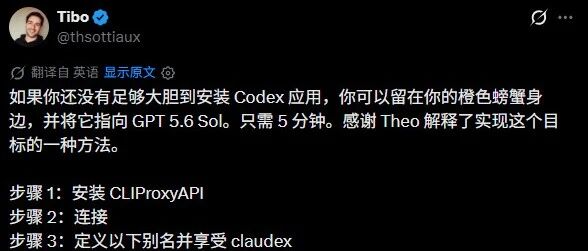
    Chinese-localized post from Thibault Sottiaux describing CLIProxyAPI, connecting Claude Code, and defining a claudex alias
    The source screenshot summarizes three steps in Chinese: install CLIProxyAPI, connect it to Claude Code, and define a claudex alias. It is evidence of the shared experiment, not an official support guarantee for model substitution.

    Credential policy is separate from technical compatibility

    The easiest mistake is to assume that any credential already stored by either CLI can safely be reused by a bridge. Technical access and permitted access are different questions.

    Anthropic’s current legal-and-compliance documentation says subscription OAuth is intended for ordinary use in Claude Code and other native Anthropic applications. It prohibits third-party developers from offering Claude.ai login or routing requests through Free, Pro, or Max plan credentials on behalf of users. For products and services, Anthropic directs developers to API keys or supported cloud providers.

    For a gateway experiment, use credentials deliberately issued for the traffic being sent. Do not copy consumer OAuth tokens out of credential stores, expose them to an unreviewed proxy, or assume a saved Claude subscription becomes an OpenAI entitlement. On the OpenAI side, use the authentication method documented for Codex or the API, and keep provider keys server-side when a gateway is shared.

    There is also a data boundary to review. A gateway can observe prompts, source snippets, tool results, and metadata unless designed otherwise. Before using one with proprietary code, verify its source, deployment location, logging defaults, update path, access controls, and retention policy.

    CLIProxyAPI deserves an additional network check before use. Its example configuration documents an empty bind host as listening on all IPv4 and IPv6 interfaces and leaves TLS disabled by default. A local experiment should be bound to loopback, protected with a strong proxy key, and kept off untrusted networks. The same example also exposes options described as Claude “cloak” and identity-confuse; avoid any identity-obscuring mode unless the relevant providers explicitly permit it.

    Screenshot of an article titled How I Got GPT-5.6 Sol Working Inside Claude Code with the phrase One harness. Any model
    This source screenshot promotes the “one harness, any model” idea. The useful caveat is that protocol compatibility, provider terms, and credential handling must each be evaluated separately.

    Path two: OpenAI’s official Codex plugin for Claude Code

    OpenAI’s official codex-plugin-cc offers the lower-risk route when the real goal is to use Codex capabilities without abandoning a Claude Code workflow. The project’s documented installation is:

    /plugin marketplace add openai/codex-plugin-cc
    /plugin install codex@openai-codex
    /reload-plugins
    /codex:setup

    The plugin then exposes commands such as /codex:review, /codex:adversarial-review, /codex:rescue, /codex:status, and /codex:result. It uses the globally installed Codex binary, the Codex app server, existing Codex configuration, and local Codex authentication.

    This architecture has a clean trust boundary: Claude Code orchestrates the current interaction, and Codex performs explicitly delegated work. It also makes provenance easier to understand. A Codex review is a Codex task with Codex usage limits and configuration; it is not Claude Code secretly running on an OpenAI model.

    The trade-off is experience. If you want every Claude Code turn to be generated by GPT-5.6 Sol, the official plugin does not provide that. If you want to stay in Claude Code while sending selected reviews or difficult tasks to Codex, it is the purpose-built option.

    Side-by-side decision guide

    Question Compatibility gateway Official Codex plugin
    What changes? The model/provider path behind Claude Code Selected tasks are delegated to Codex
    Main interface Claude Code for the whole session Claude Code plus /codex:* commands
    Authentication Gateway credential plus upstream provider credential Existing local Codex login or OpenAI API key
    Official support Anthropic does not support non-Claude models through gateways Maintained by OpenAI for Codex delegation
    Main risk Protocol drift, credential mistakes, incomplete feature translation Added orchestration complexity and separate usage limits
    Best fit Controlled interoperability experiments Reviews, rescues, and background Codex tasks from Claude Code

    What GPT-5.6 Sol contributes

    OpenAI describes GPT-5.6 Sol as the flagship GPT-5.6 model for complex professional work. The current model page lists a 1,050,000-token context window, up to 128,000 output tokens, and support for tools including web search, file search, hosted shell, computer use, MCP, and tool search. The gpt-5.6 alias routes to Sol. API pricing is listed at $5 per million input tokens and $30 per million output tokens, with separate cache and long-context rules.

    Those specifications explain the interest in pairing Sol with a familiar harness, but they do not predict end-to-end agent quality. The harness determines what context reaches the model, how tools are described, when permission is requested, how failures are retried, and how long sessions are compressed. A strong model can underperform through a lossy adapter; a well-integrated model can feel better even when raw benchmark differences are small.

    A practical recommendation

    Choose the official plugin if your objective is “use Codex from Claude Code.” It has a documented install path, keeps authentication scoped to Codex, and makes delegation explicit.

    Consider a compatibility gateway only if your objective is specifically “evaluate GPT-5.6 Sol as Claude Code’s main model” and you can accept an unsupported combination. Use a disposable test repository first. Pin versions, use purpose-issued credentials, disable gateway logging where possible, test tool calls and cancellation—not just chat—and keep a direct Codex baseline for comparison.

    The larger lesson is real: models and agent harnesses are becoming more composable. But composability is a spectrum. A working demo proves that protocol translation is possible; production readiness requires supported authentication, faithful tool semantics, predictable upgrades, and clear ownership when something breaks.
    Sources

  • AI News Roundup: Claude, DeepSeek V4, Gemini and More

    AI News Roundup: Claude, DeepSeek V4, Gemini and More

    1-Minute Briefing

    01 | Claude Code accused of hidden China-user detection; Alibaba bans Claude

    A reverse-engineering report claimed Claude Code had used timezone checks, proxy-domain matching, and Unicode-based prompt markers to identify suspected China-based users. Anthropic said the mechanism was an anti-abuse experiment aimed at resale and distillation risks, and that the code was removed in a July 2 update. Alibaba later classified Claude products as high-risk software and ordered employees to uninstall them from work environments starting July 10.

    02 | DeepSeek V4 set for mid-July release, with peak-hour API pricingDeepSeek V4 is moving out of preview and is expected to launch officially in mid-July. The new pricing model doubles API prices during weekday peak hours in Beijing time: 9:00-12:00 and 14:00-18:00. Off-peak pricing remains unchanged. The older deepseek-chat and deepseek-reasoner endpoints are scheduled to shut down on July 24.

    03 | Meituan releases LongCat-2.0, a trillion-parameter model trained on domestic chips

    LongCat-2.0 has 1.6T total parameters, around 48B active parameters on average, a dynamic activation range of 33B to 56B, and native 1M-token context support. Meituan says the model was pretrained from scratch on a 50,000-card domestic accelerator cluster, making it a large-scale test of China’s local AI compute stack. Independent third-party benchmarks are still limited.

    04 | Claude Sonnet 5 launches, beating Opus 4.8 on Terminal-Bench

    Anthropic released Claude Sonnet 5, positioning it as the strongest agentic model in the Sonnet line. It scored 80.4% on Terminal-Bench 2.1, ahead of Claude Opus 4.8 at 74.6%, while reaching 63.2% on SWE-bench Pro. The limited-time API price is $2 per million input tokens and $10 per million output tokens, rising to $3 and $15 after August 31.

    05 | Fable 5 returns globally, then moves from subscription to usage billing

    After the U.S. Commerce Department lifted restrictions on June 30, Claude Fable 5 returned to global availability on July 1. Three days later, Anthropic announced that Fable 5 would be removed from Pro-style subscriptions and moved to separate usage credits from July 7. Pricing is $10 per million input tokens and $50 per million output tokens.

    06 | Anthropic launches Claude Science for labs and pharma teams

    Claude Science is Anthropic’s new research workbench for scientific users. It is designed to support literature review, experimental planning, data analysis, chart generation, and manuscript iteration inside longer research workflows. The initial target customers are academic labs and pharmaceutical R&D teams.

    07 | Gemini Spark lands on Mac as Google rolls out new image and video models

    Gemini Spark is now available on Mac, with integrations across Google Tasks, Keep, Canva, Dropbox, and other apps. Google also launched Nano Banana 2 Lite and Gemini Omni Flash for developers. Nano Banana 2 Lite focuses on fast, low-cost image generation, while Omni Flash supports mixed text, image, and video inputs for video generation.

    08 | Cursor and OpenClaw both move onto mobile

    Cursor Mobile lets users manage cloud coding agents from a phone and stay in sync with desktop sessions. OpenClaw launched native iOS and Android apps that connect to a self-hosted OpenClaw Gateway, allowing users to approve actions and expose selected device capabilities to agents.


    01 | Claude Code Accused of Hidden Detection Logic; Alibaba Bans Claude

    A developer reverse-engineering Claude Code found hidden logic that had not appeared in the changelog. According to the public analysis, the code had been present since version 2.1.91 on April 2 and checked whether the system timezone matched Asia/Shanghai or Asia/Urumqi when proxy use was detected.

    The more sensitive part was domain matching. The report said Claude Code contained a 147-entry domain list covering Chinese companies such as Baidu, Alibaba, ByteDance, Moonshot AI, MiniMax, and StepFun, as well as Claude resale and mirror services. The detection result was allegedly encoded through subtle formatting changes: switching slashes and hyphens in dates, and replacing apostrophes with visually identical Unicode characters.

    Anthropic engineer Thariq Shihipar said the mechanism was an experimental anti-abuse measure introduced in March to prevent unauthorized resale and model distillation. The company said the code was removed in a July 2 update. The dispute was later covered in broader reports on the Claude Code security controversy. Alibaba responded by adding Claude products to its high-risk software list, banning workplace use of Claude Sonnet 5, Claude Opus 4.8, Claude Fable 5, Claude Code, and related agent tools from July 10.

    02 | DeepSeek V4 Targets Mid-July Release, Peak-Hour API Prices Double

    DeepSeek announced on June 29 that DeepSeek V4 is expected to launch officially in mid-July, graduating from preview. The production version is expected to bring additional performance and feature updates, but the bigger operational change is pricing.

    Under the new model, weekday peak hours in Beijing time, from 9:00 to 12:00 and 14:00 to 18:00, will cost 2x the base API price. Evening and weekend usage stays at the preview-period rate. For teams that call DeepSeek heavily during Chinese business hours, this directly raises daytime costs; teams with batch or async workloads can shift jobs to off-peak windows to avoid the premium. DeepSeek’s public API pricing documentation is now worth watching more closely than the model card itself.

    The older deepseek-chat and deepseek-reasoner endpoints will be retired on July 24 and will stop accepting requests after that date. Any production system still using the old endpoints needs to migrate before then.

    03 | Meituan Releases LongCat-2.0, a Trillion-Parameter Model on Domestic Compute

    Meituan released LongCat-2.0 on June 30. The model has 1.6T total parameters, around 48B active parameters on average, and a dynamic activation range between 33B and 56B. It also supports a native 1M-token context window.

    The model uses an ultra-sparse MoE architecture, activating different parameter ranges depending on the task. Meituan says the model was pretrained from scratch on a 50,000-card domestic AI accelerator cluster and describes it as the first trillion-parameter model to complete both training and inference fully on Chinese-made chips. External coverage of Meituan’s LongCat-2.0 release frames it as an infrastructure milestone as much as a model launch.

    Independent evaluation is still thin, so capability claims need more testing. But from a systems point of view, the important part is that a domestic compute cluster at this scale appears to have supported full pretraining, inference, and long-context service.

    04 | Claude Sonnet 5 Launches, Passing Opus 4.8 on Terminal-Bench

    Anthropic released Claude Sonnet 5 on June 30, positioning it as the strongest agentic model in the Sonnet family. On Terminal-Bench 2.1, it scored 80.4%, ahead of Claude Opus 4.8 at 74.6%. On SWE-bench Pro, it reached 63.2%, close to Opus 4.8’s 69.2%, and it scored 84.7% in BrowseComp single-agent search evaluation.

    Claude Sonnet 5 supports a native 1M-token context window and up to 128K tokens of output in a single response. The limited-time API price is $2 per million input tokens and $10 per million output tokens. After August 31, pricing returns to $3 input and $15 output. Sonnet 5 is now the default model for Claude Code as well as free and Pro Claude users.

    Anthropic staff also said Claude Code’s system prompt has been cut by roughly 80%. The message is interesting: newer models seem to need less handholding, and too many examples or constraints may start to limit performance instead of improving it.

    05 | Fable 5 Returns Globally, Then Moves to Usage Billing

    Claude Fable 5’s export-control episode lasted almost three weeks. The U.S. Commerce Department notified Anthropic on June 30 that the restrictions had been lifted, and Fable 5 returned to global availability on July 1. Before that, the model had been pulled globally on June 12, with Claude Mythos 5 partially restored to around 100 organizations on June 26.

    Access came back with new safety controls. Anthropic introduced an updated safety classifier and worked with partners including Amazon, Microsoft, and Google on jailbreak severity evaluation. Reports on Fable 5 access being restored also noted that the free-access window would be brief.

    On July 7, Fable 5 was removed from Pro-style subscription plans and moved to a separate usage-credit system. Pricing is $10 per million input tokens and $50 per million output tokens, five times the limited-time Sonnet 5 price. Anthropic says this is not permanent and that Fable may return to subscriptions when server capacity allows, but heavy users will feel the cost change immediately.

    06 | Anthropic Launches Claude Science for Labs and Pharma

    Anthropic also introduced Claude Science, a research workbench aimed at scientists. It supports literature review, experimental planning, data analysis, chart generation, and manuscript drafting inside longer research workflows, so users do not need to keep moving between separate tools for every step.

    The initial audience is academic labs and pharmaceutical R&D teams. Anthropic wants scientists to spend more time on judgment and creative research, and less time formatting, moving data, and repeating analysis steps. The launch has been described as an AI workbench for scientific research, with life sciences and scientific computing as early focus areas.

    This also shows how Anthropic is splitting the Claude product line. Sonnet 5 pushes coding and agents, Fable 5 moves toward high-end usage billing, and Claude Science goes after vertical research workflows.

    07 | Gemini Spark Comes to Mac, Alongside New Image and Video Models

    Gemini Spark launched on Mac on July 1. It integrates with Google Tasks, Google Keep, Canva, Dropbox, and other third-party apps, and can handle multi-step tasks such as ordering, shopping, design, and real-time topic tracking. Compared with a normal chat assistant, Spark is closer to a desktop agent that can operate across files and apps.

    On the same day, Google released Nano Banana 2 Lite and Gemini Omni Flash for developers. Nano Banana 2 Lite is built for low-cost, high-speed image generation, producing an image in around four seconds at a reported cost of $0.034 per thousand images. Gemini Omni Flash supports mixed text, image, and video inputs for video generation, with natural-language editing after generation.

    The direction is clear: Gemini is moving from answering questions toward operating apps, tracking context, and generating media across modalities.

    08 | Cursor and OpenClaw Both Launch Mobile Apps

    Cursor released Cursor Mobile on June 30. Users can talk to cloud coding agents from their phones, check generation progress, and stay synced with the desktop app. Cursor’s bet is that developers are shifting from writing every line of code themselves to managing code-generation agents, and mobile access makes that management layer more continuous.

    OpenClaw launched native iOS and Android apps the day before. Unlike a standalone chatbot, the mobile app acts as a control node. It connects to a self-hosted OpenClaw Gateway, which then routes requests to backend AI agents. Users can authorize access to device capabilities such as camera, screen, location, contacts, and calendar.

    The two launches point in the same direction. AI coding tools are moving beyond “sit at a computer and type prompts.” The next interface is about monitoring, approving, and taking over agent work from wherever you are.


    Related posts: