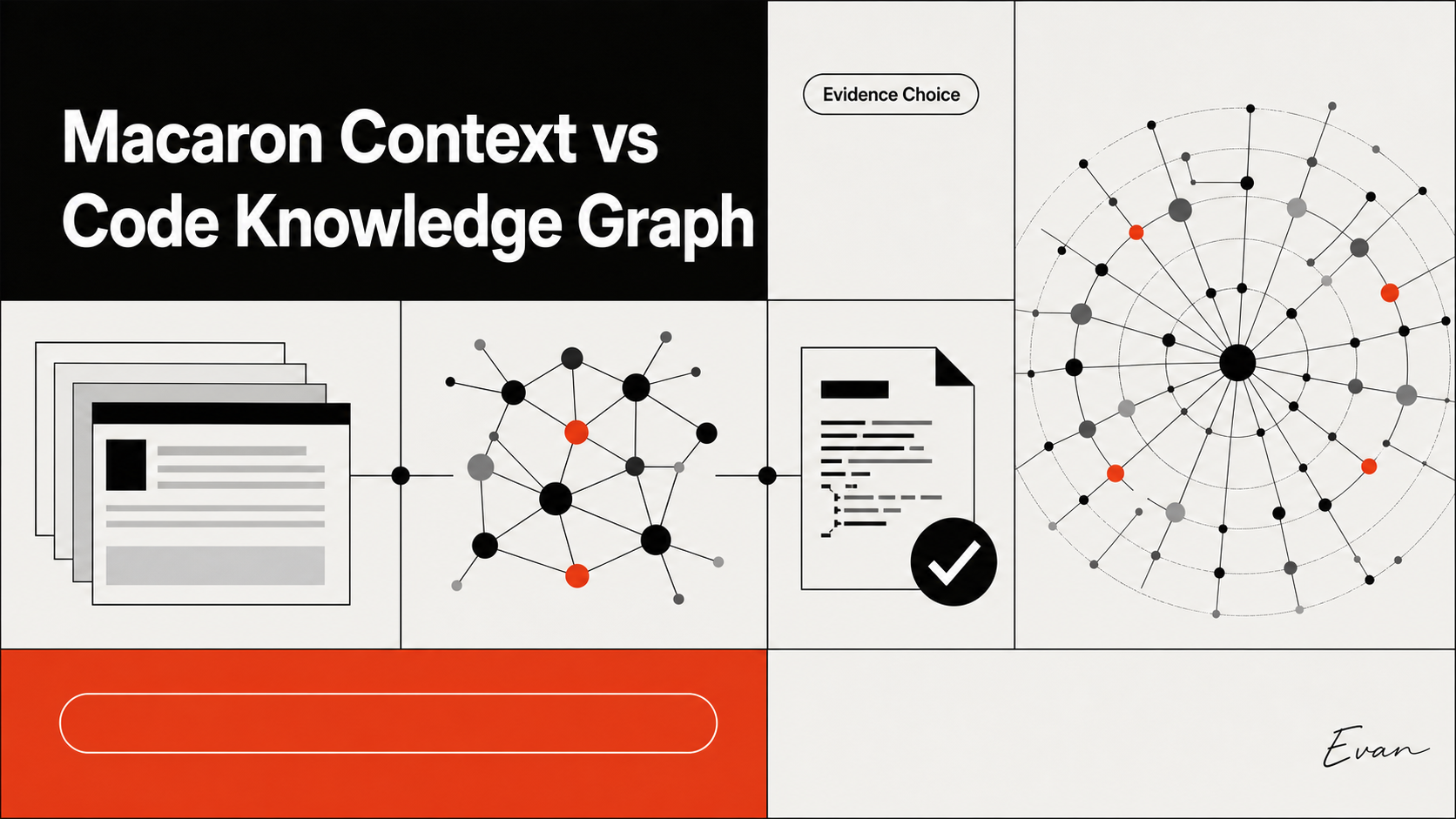
Macaron long context lets a coding workflow place more repository evidence in one model request; a code knowledge graph makes relationships such as calls, imports, ownership, and test coverage queryable. Use the window to reason over a bounded, known evidence set. Use a graph to discover and connect evidence when the task crosses modules. Use current source and tests to verify both.
The fact boundary matters. Macaron-V1-Coding-Venti lists a 1M context length in its MindLab Research model card and a 1,048,576-position configuration. The official MoL harness reference profiles use 262K context at launch. The frequently repeated 2M figure belongs to MindLab’s LongStraw reinforcement-learning training infrastructure, not to a Macaron-V1 inference guarantee. Treat capacity as a dated deployment setting, not a replacement for repository structure.
Quick Verdict
Use long context when a task already has a small, well-justified set of source files, tests, specifications, and decisions to compare. Use a code graph when you first need to answer which files, callers, consumers, tests, or owners are relevant. Use both for a risky multi-module change: graph-select the evidence, read it in context, then verify the result.
| Method | Primary question | Best fit | What it cannot establish |
|---|---|---|---|
| Macaron context window | How much evidence can be present together? | A known subsystem, diff review, distributed contract and test reading | That all relevant evidence was included or used correctly |
| Lexical or semantic retrieval | Which chunks match this query? | Symbols, errors, exact terms, and concept search | A complete dependency or authority path |
| Code knowledge graph | Which repository entities relate, and through which typed path? | Impact tracing, callers, imports, schemas, tests, ownership | Dynamic behavior, perfect freshness, or policy decisions |
| Source and tests | Is the claimed behavior supported now? | Any high-impact plan or change | Nothing can replace current evidence and verification |
The broader 1M Context vs Knowledge Graph guide compares this pattern across model families. This page applies it to Macaron-V1’s official 1M model specification and its documented serving caveat.
What Long Context Helps With
Long context is valuable after evidence selection. A coding agent can keep a larger coherent slice of the task together: interface contract, implementation, callers, tests, architecture decision, migration plan, logs, and current diff. This reduces the need to compress every source file into summaries that lose important constraints.
With Macaron-V1, a useful long-context request might contain a pinned commit’s authentication middleware, session model, policy configuration, contract tests, recent incident note, and a targeted acceptance criterion. The agent can compare the materials in one working view and explain contradictions without repeatedly reloading fragments.
Long context also helps with:
- reviewing a known migration path across schema, generated client, consumers, and release notes;
- comparing a proposed patch against multiple invariants and test suites;
- retaining a bounded tool trajectory while synthesizing a plan;
- reading a subsystem where the relevant files and documents have already been identified;
- checking whether a diagnosis accounts for both implementation and operational evidence.
The model card’s 1M context value should be read narrowly. It describes the checkpoint configuration. The MoL harness’s documented 262K launch setting describes a provided self-hosted profile. Hosted service behavior may differ again. A team trial should record the exact model, endpoint or harness, context setting, system instructions, tool configuration, prompt size, cache behavior, and repository commit. Without this, “Macaron handled our large codebase” is not reproducible.
Long prompts are not automatically better prompts. Unneeded files, duplicate definitions, stale documents, generated code, vendor code, and tool descriptions can dilute the evidence that matters. A larger window can reduce some retrieval pressure, but it cannot determine authority or make the model notice every important relation.
What Code Knowledge Graphs Add
A code knowledge graph preserves explicit repository structure. It turns questions such as “who consumes this API?” or “which tests reach this schema?” into traversals over named entities and typed relationships.
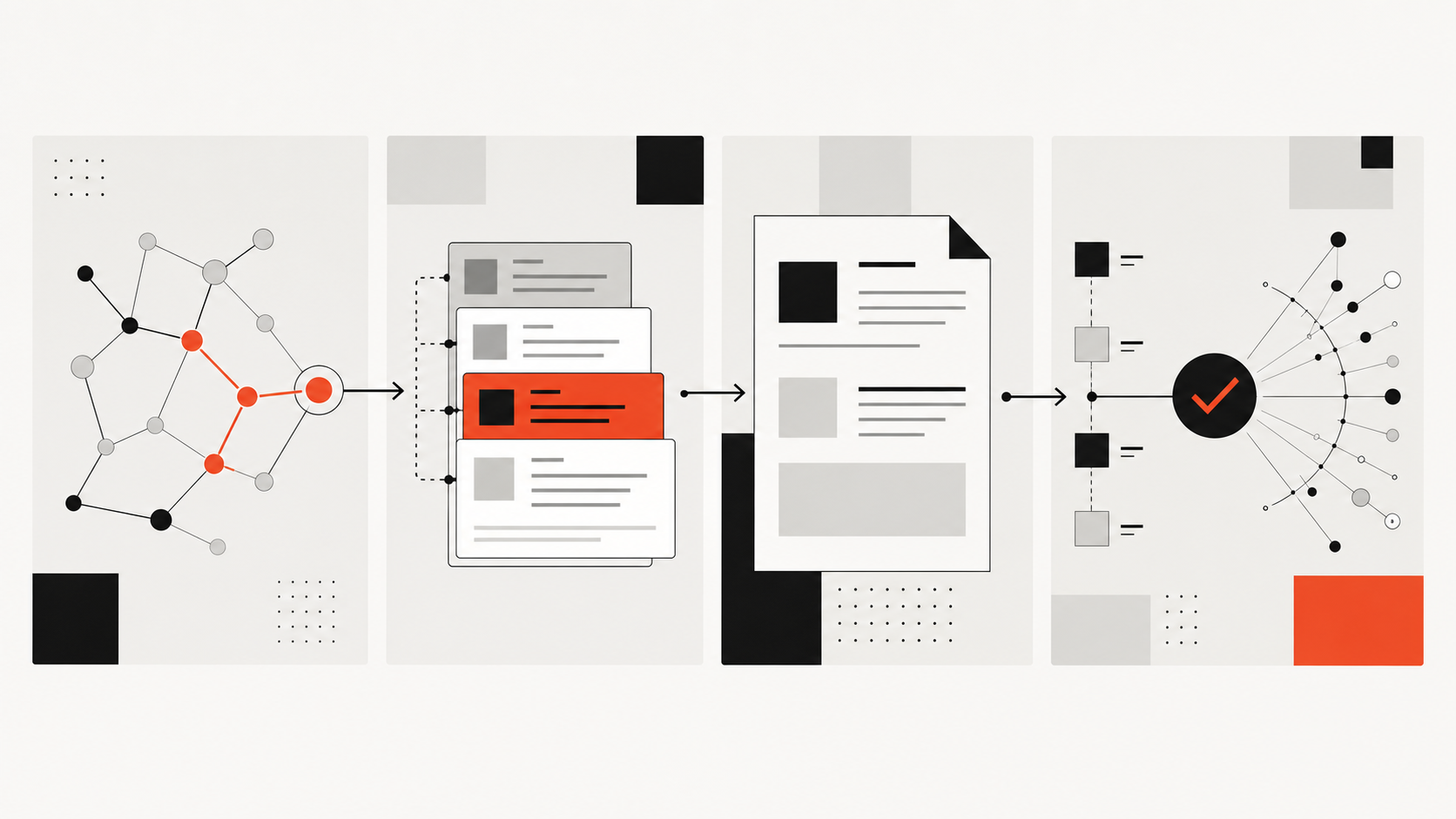
Useful nodes include packages, files, symbols, routes, APIs, schemas, configuration, tests, owners, and design documents. Useful edges include imports, calls, implementations, generated-from, covers, owned-by, and rationale-for. The result is not merely a ranked set of chunks; it is a candidate explanation of why the evidence belongs together.
That matters when a query is structural rather than textual. Searching for a field name may find its declaration and many incidental mentions. A graph can show that the field is serialized by one adapter, consumed by three clients, validated by a contract suite, and covered by a deployment flag. The agent can then read those primary files together in its context window.
Graphs add three controls that large prompts lack by default:
- Relationship visibility. An impact path can be inspected and challenged rather than inferred from a pile of files.
- Provenance and freshness. Important graph results can name the source locations, repository revision, extraction method, and refresh date.
- Repeatable selection. Different agents or model providers can query the same maintained evidence layer instead of starting discovery from scratch.
Graphify is an optional external implementation of this pattern. It can generate code and document graph artifacts that guide an agent toward structural evidence. It is not a claim that Macaron or a separately configured HCP SDK includes a native code graph. An external graph must be refreshed and its important edges verified against current source.
Repository Tasks That Need Structure
Structure matters when the consequence of a change lies outside the first file the model opens.
| Task | Candidate relationship path | Why a graph helps |
|---|---|---|
| Remove a public field | schema → serializers → generated clients → consumers → examples → contract tests | Surface matching alone can miss generated or downstream users |
| Change an authorization rule | entry point → middleware → policy → session store → error tests → audit owner | The behavior spans code, configuration, and responsibility boundaries |
| Split a package | exports → imports → build graph → package owners → release artifacts | The task is about dependency direction, not one code snippet |
| Diagnose a delayed job | schedule → queue → worker → retry policy → state write → telemetry | Runtime behavior often crosses vocabulary and modules |
| Modernize a database call | query helper → transaction boundary → callers → migration → integration tests | Local edits can change ordering, consistency, or rollback behavior |
For each path, the graph gives a starting hypothesis. Dynamic registration, reflection, runtime configuration, feature flags, generated code, and external integrations may still be omitted. The model should mark uncertain edges and request the source or owner evidence needed to resolve them.
This is a better test of repository understanding than asking whether a model can summarize a large directory. A useful response identifies the expected path, distinguishes confirmed and inferred relationships, and proposes the tests that can falsify its plan.
How to Combine Context Windows and Graphs
Use the two layers in sequence rather than forcing a false choice.
- Pin the task. Record objective, acceptance criteria, base commit, allowed write paths, and reviewers.
- Select the evidence neighborhood. Search and graph-traverse direct dependencies, multi-hop consumers, tests, owners, configuration, and relevant decisions.
- Verify the path. Open raw source behind high-impact graph edges. Note stale, dynamic, or unconfirmed behavior.
- Build the context packet. Include only the current files and documents that explain the task, plus an explicit unknowns list.
- Reason with Macaron. Ask for a minimal plan, cited evidence, change risks, test rationale, and a boundary between fact and inference.
- Edit under control. Restrict writes to approved scope, review the diff, run focused and broader checks, and obtain owner approval.
- Refresh after structure changes. Update the graph after accepted refactors, symbol moves, generated-artifact changes, or dependency rewiring. Do not turn temporary task notes into permanent graph facts.
MindLab’s separately published HCP SDK can standardize configuration inputs such as Skills, resources, MCP, hooks, workspace staging, and provider settings. Its public documentation describes a wrapper around other runtime components, not a Macaron checkpoint feature, agent, or repository-memory database. Use that configuration role to make a workflow repeatable, while keeping repository intelligence in source-controlled artifacts and an independently maintained graph.
The combined workflow yields a practical division of labor: the graph reduces repeated discovery, the context window holds the selected evidence for synthesis, and current source plus tests constrain the outcome. This is more reliable than assuming a long prompt or a graph query is self-validating.
FAQ
What 2M context claims should be verified?
First verify what the number measures. For Macaron-V1-Coding-Venti, the official model card and configuration support a 1M model-context specification. MindLab’s LongStraw materials describe 2M-plus reinforcement-learning training infrastructure. They do not establish a 2M production inference window for Macaron-V1. Also verify the actual endpoint or self-hosted harness setting; MindLab’s reference MoL profiles use 262K.
Can graph retrieval miss important files?
Yes. A graph can miss dynamic behavior, unsupported language features, generated files, stale documentation, external services, or an incorrectly inferred edge. Treat traversal as evidence selection, record provenance and revision, inspect high-impact source, and sample the graph against known changes. Retrieval failure is an engineering risk to measure, not a reason to discard structure entirely.
When should teams use both approaches?
Use both when a task spans multiple packages or artifacts and the selected evidence still fits comfortably inside the actual deployment context budget. A graph is most useful before the model knows the relevant neighborhood; long context is most useful after the neighborhood is justified. For a small, known, single-file change, direct source reading and focused tests are usually cheaper.
Conclusion
Macaron context vs knowledge graph is not a contest between a large model window and repository structure. A 1M Macaron-V1 specification can make it easier to synthesize a known body of evidence. A graph can make relationship paths, provenance, and repeated discovery more explicit. Neither proves a patch is correct.
Use a graph to select and explain structural evidence, Macaron to reason over the selected current material, and source inspection, tests, and responsible reviewers to validate the change. Keep the 2M LongStraw training claim separate from the Macaron-V1 inference question.
For the model-specific repository trial, use the Macaron-V1 large-codebase test plan. For constructing and maintaining the bounded evidence packet, continue with Macaron context engineering.
Leave a Reply