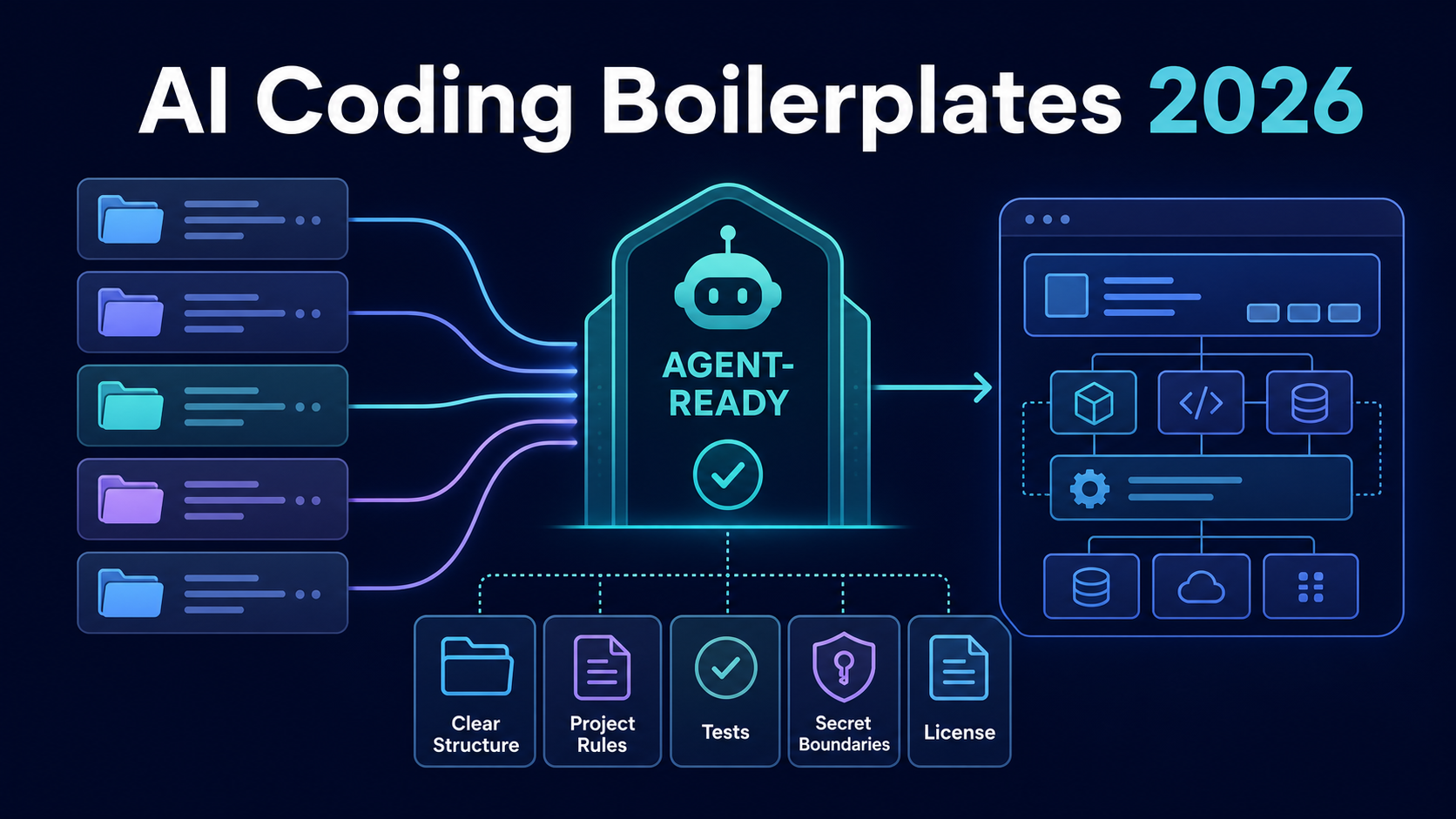
The best AI coding boilerplate is not the template with the longest feature list. It is the smallest maintained starter whose structure, project rules, tests, secrets, license, and upgrade path an agent can understand without guessing. Start with Vercel Chat SDK for an AI chat product, Next.js SaaS Starter for a readable SaaS reference, Open SaaS for explicit agent guidance, create-t3-app for a configurable foundation, or SaaS Boilerplate by ixartz for a broader free application shell.
This is an agent-readiness comparison, not a generic Next.js theme ranking. Repository state and licenses were checked on July 15, 2026. Fork a candidate and audit the exact commit before using it in production.
What Makes a Boilerplate AI-Coding Friendly
An AI coding-friendly boilerplate reduces ambiguity for both the model and the reviewer. It exposes where code belongs, how to run checks, which generated files should stay untouched, and what “done” means. A large codebase can still be agent-friendly; an undocumented small one can be hostile.
Use six tests:
- Clear boundaries: application, database, authentication, billing, tests, and infrastructure have predictable homes.
- Project instructions:
AGENTS.md,CLAUDE.md, editor rules, or concise contributor docs name real commands and restrictions. - Deterministic verification: lockfiles, migrations, type checks, linting, tests, and CI reproduce locally.
- Secret hygiene:
.env.exampledocuments names without shipping credentials or unsafe defaults. - Replaceable integrations: provider-specific code is isolated behind adapters instead of spread across the repository.
- Usable license: the exact template version permits your commercial and distribution model.
Agent rules do not rescue poor architecture. They should describe the repository, not compensate for circular dependencies or hidden runtime behavior. Graphify’s AI coding agent comparison explains why the surrounding execution and review system matters as much as the model.
How We Ranked the Starter Kits
We reviewed current official repositories and vendor documentation, then scored fit by evidence rather than stars. The comparison considers structure, documented commands, automated checks, agent-specific guidance, dependency surface, license clarity, maintenance activity, and exit cost.
No common private build was run across every template, so this article does not publish a fabricated numerical winner. A starter qualifies for the shortlist only when a developer can inspect its source or documentation and run a bounded pilot. Paid kits appear as items to verify, not as sponsored recommendations.
The deciding metric is reviewable change throughput: can an agent implement one representative feature while preserving architecture, passing tests, and producing a small understandable diff? Time-to-first-screen alone rewards templates that postpone security and migration work.
We also treat deletion as a first-class score. Every unused authentication provider, payment path, background job and deployment adapter gives an agent another plausible but wrong place to make a change. During the pilot, count how many files survive after removing features you do not need and whether the remaining tests still describe the product. A smaller retained surface is often more valuable than a larger advertised feature count.
Maintenance evidence needs a date. Check the latest commit, releases, open security reports, supported framework versions and migration notes, but do not confuse a same-day commit with stability. Inspect what changed and whether maintainers document breaking upgrades. For commercial kits, ask to see a changelog and sample repository before purchase; screenshots cannot reveal dependency age, test coverage or architectural coupling.
Quick Comparison Table
| Starter | Best fit | Stack and structure | Agent-ready evidence | License / access | Main caution |
|---|---|---|---|---|---|
| Vercel Chat SDK | AI chat and tool-enabled product prototypes | Next.js, AI SDK, Auth.js, Postgres, Blob, Playwright | .cursor/rules, tests, typed app/lib boundaries |
Apache 2.0 repository license | Strongly opinionated around Vercel services and chat use cases |
| Next.js SaaS Starter | Learning or extending a compact SaaS foundation | Next.js, Postgres, Drizzle, cookie-based JWT authentication, Stripe, shadcn/ui | Small readable modules, migrations, seed scripts and explicit route/action guards | MIT | It has no automated test command; the teams/billing shell still needs product-specific hardening |
| Open SaaS | Full-stack SaaS with explicit agent support | Wasp, React, Node, Prisma, payments, jobs, Playwright | AGENTS.md, skills, agent docs, CI and E2E tests |
MIT | Wasp conventions are an intentional framework commitment |
| create-t3-app | A clean configurable Next.js base | Next.js with selectable TypeScript, tRPC, auth and database choices | Generated stack stays small; official usage docs | MIT | It is a foundation, not prebuilt billing or product logic |
| SaaS Boilerplate | A feature-rich free Next.js shell | Next.js, TypeScript, auth, teams, RBAC, i18n, logging, tests | Test/CI surface and explicit modules | MIT | More features increase deletion and upgrade work |
| Makerkit | Teams evaluating a paid, guided multi-tenant starter | Next.js options, auth, billing and multi-tenant documentation | Vendor documents agent rules across packages | Commercial tiers; terms vary | Verify the selected kit, price, license, update rights and generated code before purchase |
“Free” describes acquisition, not ownership cost. A free starter can demand weeks of integration; a paid starter can still create lock-in or unused code.
Best AI Coding Boilerplates in 2026
Next.js and SaaS Starter Kits
Next.js SaaS Starter is the strongest free reference when you want a compact conventional SaaS codebase rather than every possible feature. Its official repository combines Postgres, Drizzle, cookie-based JWT authentication, Stripe and shadcn/ui under an MIT license. The limited surface helps an agent trace a request through route, data and billing layers. Its current package.json has database setup, seed and migration scripts but no automated test command, so add behavior and authorization tests before treating it as a production baseline.
SaaS Boilerplate by ixartz fits teams that prefer more scaffolding: multi-tenancy, roles, permissions, internationalization, logging and tests. Those features create helpful examples, but they also enlarge the context and upgrade surface. Delete unused modules early, before agents form dependencies on them.
Makerkit is a paid candidate for teams that value extensive multi-tenant documentation and agent rules. Commercial access changes the evaluation: confirm the current price, permitted projects, redistribution restrictions, support period and update entitlement in the actual license you receive. A marketing comparison is not a legal review.
Agent-Friendly Project Structures
Open SaaS makes agent support an explicit product property. Its current repository includes AGENTS.md, skills and agent-oriented documentation alongside CI and Playwright tests. That is useful evidence because the instructions live near executable code. The trade-off is Wasp: its declarative full-stack model can reduce plumbing, but your team and agent must learn the framework’s conventions.
create-t3-app takes the opposite approach. It generates a smaller type-safe foundation from selected components instead of shipping a finished SaaS. That can be ideal for experienced teams: fewer unused abstractions mean less context and less deletion. You must still add your own billing, authorization, deployment and project rules.
A good project structure gives the agent progressive context. Root instructions define shared commands and safety rules. Package-level instructions explain local boundaries. Tests encode behavior. Architecture records explain decisions that code alone cannot reveal. This is the same context discipline behind Graphify: relationships and evidence are more useful than a flat pile of files.
Templates to Verify Before Use
Vercel Chat SDK is the most specialized pick. It is a working AI chat application with model-provider routing, persistence, authentication, file storage and tests. Choose it when chat is close to the product’s core loop. Do not force a marketplace, analytics product or conventional CRUD SaaS into a chatbot architecture merely because the demo launches quickly.
Also verify any new “AI-native” commercial starter before adding it to the shortlist. Look for a public changelog, exact stack versions, a sample repository, test commands, license text, refund terms, security guidance and a documented removal path. Claims such as “works with every agent” or “production-ready” are not acceptance tests.
How to Choose Without Lock-In
Clone the candidate into a throwaway organization and run an exit test before committing your product to it. If the starter connects agents to external systems, audit each integration with the same least-privilege checks used in Graphify's MCP server guide. If it began as a prompt-led prototype, use the vibe coding promotion boundary before moving it toward production.
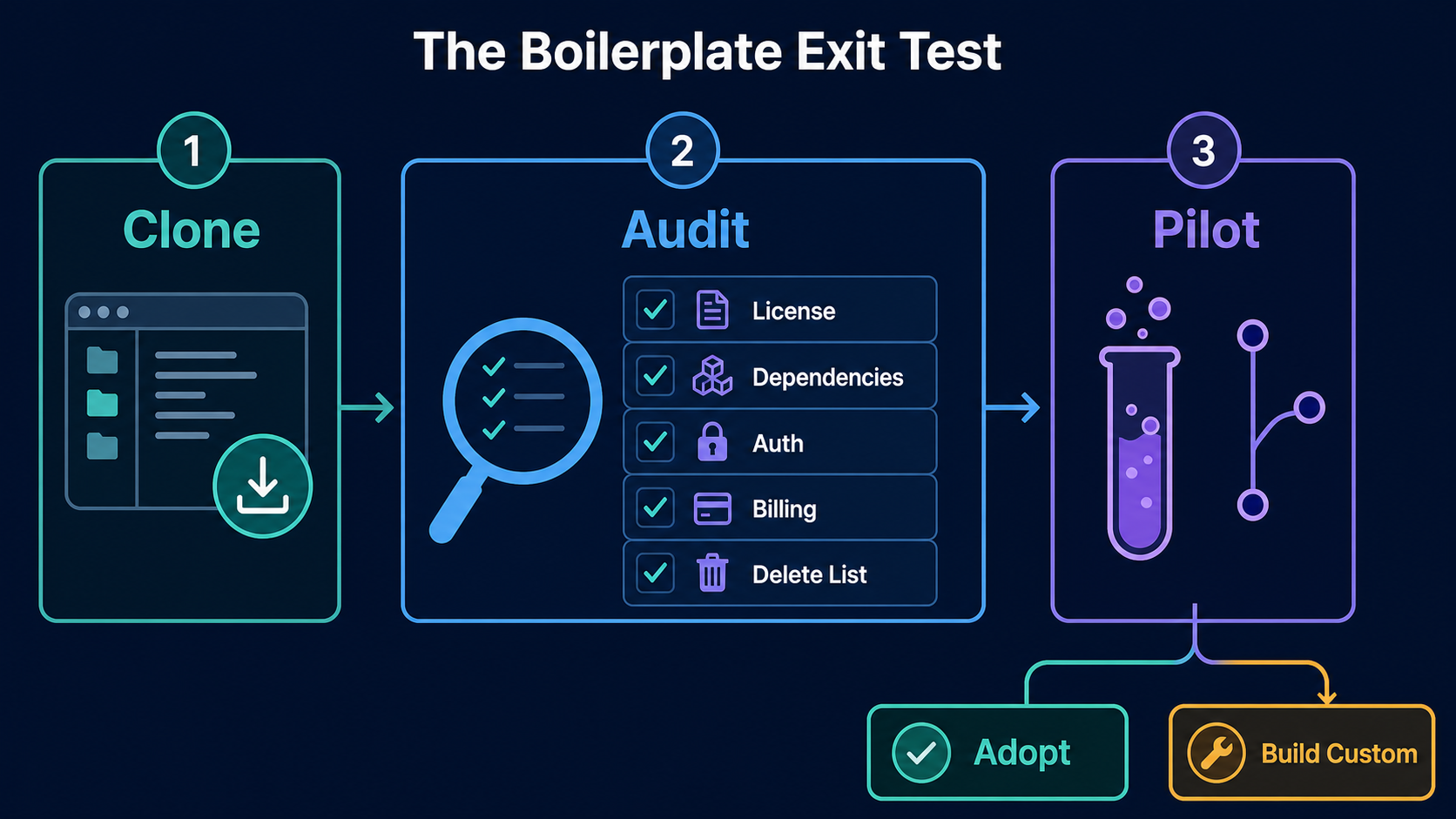
- Freeze evidence: record the repository URL, commit, license, package lock and documentation date.
- Create a delete list: mark demo users, sample content, analytics, providers, jobs and UI that your product does not need.
- Map the seams: identify how to replace authentication, billing, email, storage, database and hosting.
- Run one real feature: give the coding agent a representative change plus acceptance tests and a time budget.
- Exercise failure: rotate a secret, replay a webhook, roll back a migration and remove one provider.
- Measure review: record accepted-patch rate, human edits, failed commands, test time and unexplained generated files.
Adopt only if the team can explain the critical request paths and remove an integration without rewriting unrelated modules. Maintain a clean upstream-diff strategy, but do not blindly merge template updates into production. Review them as third-party code.
Finally, create your own baseline after adoption. Pin the approved commit, replace vendor demo instructions with project-specific rules, document owners for authentication and billing, and add architecture decisions for intentional deviations. Future agents should optimize for your product, not keep recreating the template author’s demo. This handoff is the point where a starter stops being an external example and becomes maintained internal software.
FAQ
Who should review template licenses before launch?
The engineering owner should identify every repository, package and asset license. Legal or a designated business owner should approve commercial, redistribution, attribution and seat/project restrictions. Record the exact license text and commit or purchased version; a directory’s license badge is not enough.
What files should teams remove before production?
Remove demo accounts, sample data, unused providers, placeholder API routes, test keys, default admin paths, example webhooks, analytics you did not approve, deployment samples you will not maintain and generated assets without clear rights. Then regenerate the lockfile, rerun migrations and scan the final repository for secrets.
When should teams build a custom starter instead?
Build a custom starter when your authorization, tenancy, compliance, runtime or deployment model conflicts with the template’s core assumptions; when deletion exceeds useful retained code; or when the team cannot safely update critical dependencies. A small internal starter can outperform a feature-rich kit when the same architecture will support several products.
Conclusion
The best SaaS boilerplate 2026 choice for AI coding is the one your agent can navigate and your team can still own. Vercel Chat SDK, Next.js SaaS Starter, Open SaaS, create-t3-app and ixartz’s SaaS Boilerplate each represent a different starting boundary. Verify the exact commit and license, remove unused code, run a real feature pilot, and prove you can replace a core integration. If the exit test fails, the fast start is borrowed time.
Leave a Reply