AI agent evaluation is a controlled way to decide whether an agent change is safe enough to advance. Start with representative tasks and observable end states, then add trace, safety, reliability, and cost evidence only where the release decision needs it. A production framework is not a single benchmark score and it is not a vendor ranking.
For a team moving beyond a demo, the useful question is not “Did the agent produce a convincing answer?” It is “Did it complete the right work, use permitted actions, and remain inside a known operating envelope?” That distinction keeps an evaluation program tied to engineering decisions instead of a dashboard full of metrics.
What AI Agent Evaluation Measures
An agent run has more moving parts than a one-shot model answer. Anthropic's engineering guide to agent evaluations describes an evaluation in terms of a task, a trial, grading logic, and the resulting record. For an agent, that record can include the tool trajectory, intermediate state, final output, and the environment in which the task ran.
An evaluation harness is the repeatable wrapper around those pieces. It supplies a scenario, runs the agent under stated conditions, applies graders, and retains enough evidence to compare one version with another. The point is not to copy production perfectly. It is to make an important release question repeatable.
Use two distinct questions when defining a case:
- Outcome: Did the task finish in the intended state? A code task may require a test to pass; a support workflow may require the correct ticket fields and response.
- Process constraints: Did the agent stay within its approved tool, data, and policy boundaries while reaching that state?
That separation prevents a dangerous false positive: an agent can reach a correct-looking result through an unapproved action, or follow a tidy trajectory and still leave the system wrong. Teams working on multi-agent repository tasks should make the task boundaries explicit before delegating work across agents or contexts; the same principle applies to an agent swarm codebase workflow.
Quick Evaluation Matrix
The best AI agent evaluation metrics are decision-specific. Treat the following matrix as a starting scorecard, not as five universal KPIs that every pilot must optimize.
| Evidence layer | Release question | Example check | What it does not prove |
|---|---|---|---|
| Outcome | Did the requested state change happen? | Tests pass; required record exists; task is complete | That the route was safe or efficient |
| Trajectory | Did the agent take an acceptable path? | Trace shows approved tools and critical steps | That a single trace generalizes |
| Safety | Did it respect non-negotiable constraints? | No restricted tool call, data exposure, or policy violation | Broader business usefulness |
| Reliability | Does it behave consistently across representative cases? | Pass rate and failure modes across a fixed suite | Production demand outside the suite |
| Cost and latency | Is the workflow viable to operate? | Runtime, tool calls, model usage, human correction time | Quality independent of those measures |
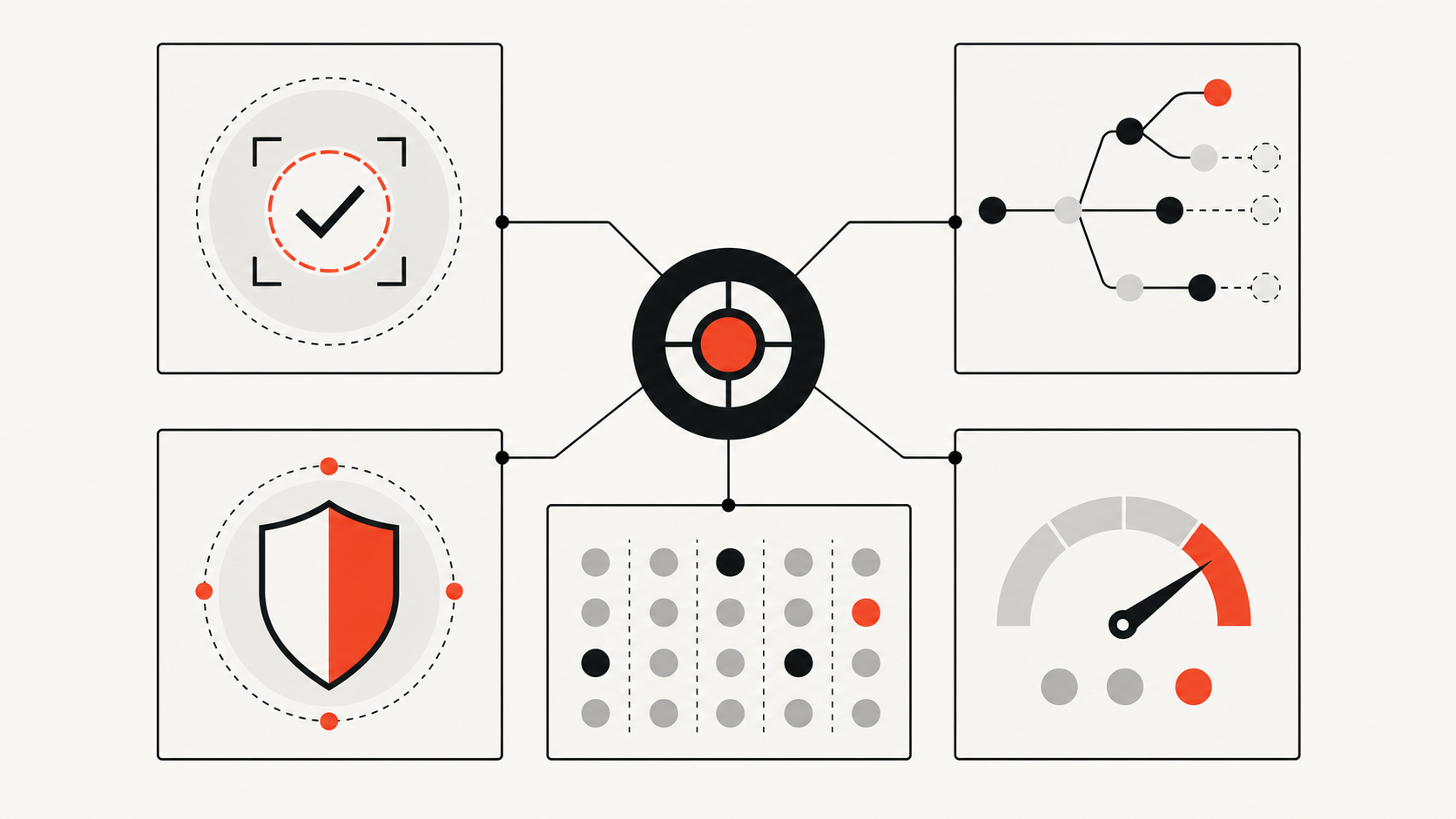
AWS's practical guidance on evaluating agentic systems similarly frames evaluation as a layered operational exercise rather than a single quality number. Keep a metric only if someone can name the decision it changes: promote, hold, investigate, change a guardrail, or narrow the task.
Define Production Scenarios Before Metrics
A useful AI agent evaluation framework starts with a small set of scenarios that resemble the work the team is prepared to allow. Do not begin by asking which agent evaluation tools have the longest feature checklist. First write the cases that a reviewer would recognize as meaningful.
For each scenario, record:
- Initial state. Pin the repository revision, fixture data, available credentials, and environment assumptions.
- Task contract. State the goal, allowed tools, prohibited actions, and what the agent may ask a human to approve.
- Expected end state. Prefer checks that can be independently observed: a test result, a generated artifact, a database state, or a reviewed diff.
- Critical path expectations. Identify steps that must occur or boundaries the agent must not cross. This makes trace review targeted instead of theatrical.
- Failure classification. Decide whether an unsupported claim, a timeout, a policy stop, or a wrong final state counts as a failure.
Representative does not mean “most difficult.” Begin with common work that has clear correctness signals, then add edge cases that have caused real review friction. For a coding-agent pilot, this might be a small bug with existing tests, a constrained documentation update, and a multi-file change with a known contract. It should not be an open-ended feature request with no accepted outcome.
This discipline also makes tool selection more honest. The best AI coding agents for a team are not established by a generic leaderboard alone; fit depends on the tasks, permissions, and review process the team can actually evaluate.
Measure Outcomes, Trajectories, Safety, Reliability, and Cost
Start with an outcome grader whenever a deterministic check exists. Unit tests, schema validation, exact record assertions, and validated build outputs are usually easier to audit than a model opinion. Anthropic notes that code-based graders work especially well when the environment and expected result are stable. They are not sufficient for every qualitative task, but they make a durable backbone for agent regression testing.
Then add a trace grader for the part that the final state hides. A trace review may check whether the agent read an authoritative source before editing, used only allowlisted tools, requested confirmation for a protected action, or stopped when an expected dependency was absent. Make the rule concrete. “Good reasoning” is not a reviewable criterion; “did not invoke a write-capable tool before approval” is.
Safety checks should be hard gates, not averages. If a run accesses a prohibited resource or bypasses a required human approval, it should be visible as a distinct stop condition even if the final output is otherwise useful. This is why a high success rate cannot compensate for a serious policy failure.
Reliability belongs to a fixed, versioned scenario set. Record the agent version, prompt or instruction revision, enabled tools, permissions, model configuration, environment revision, and grader revision beside each run. Without that provenance, a changed pass rate has no stable meaning. A baseline is not a promise of future quality; it is the comparison point that lets a team detect a behavioral change.
Finally, include operating cost in the decision. Count elapsed time, tool calls, model usage where available, retries, and human correction or review time. A workflow that passes a narrow suite but needs constant intervention may still be the wrong production choice. Conversely, lower latency is not a quality result unless it preserves the outcome and safety evidence.
Build an Offline-to-Online Evaluation Loop
Offline evaluation and production monitoring answer different questions. An offline suite asks whether a known set of scenarios still behaves acceptably before release. Production monitoring observes what happens after release, where inputs, integrations, and user behavior vary. Anthropic explicitly recommends using both: monitoring complements controlled evaluations; it does not retroactively prove that a release was safe.
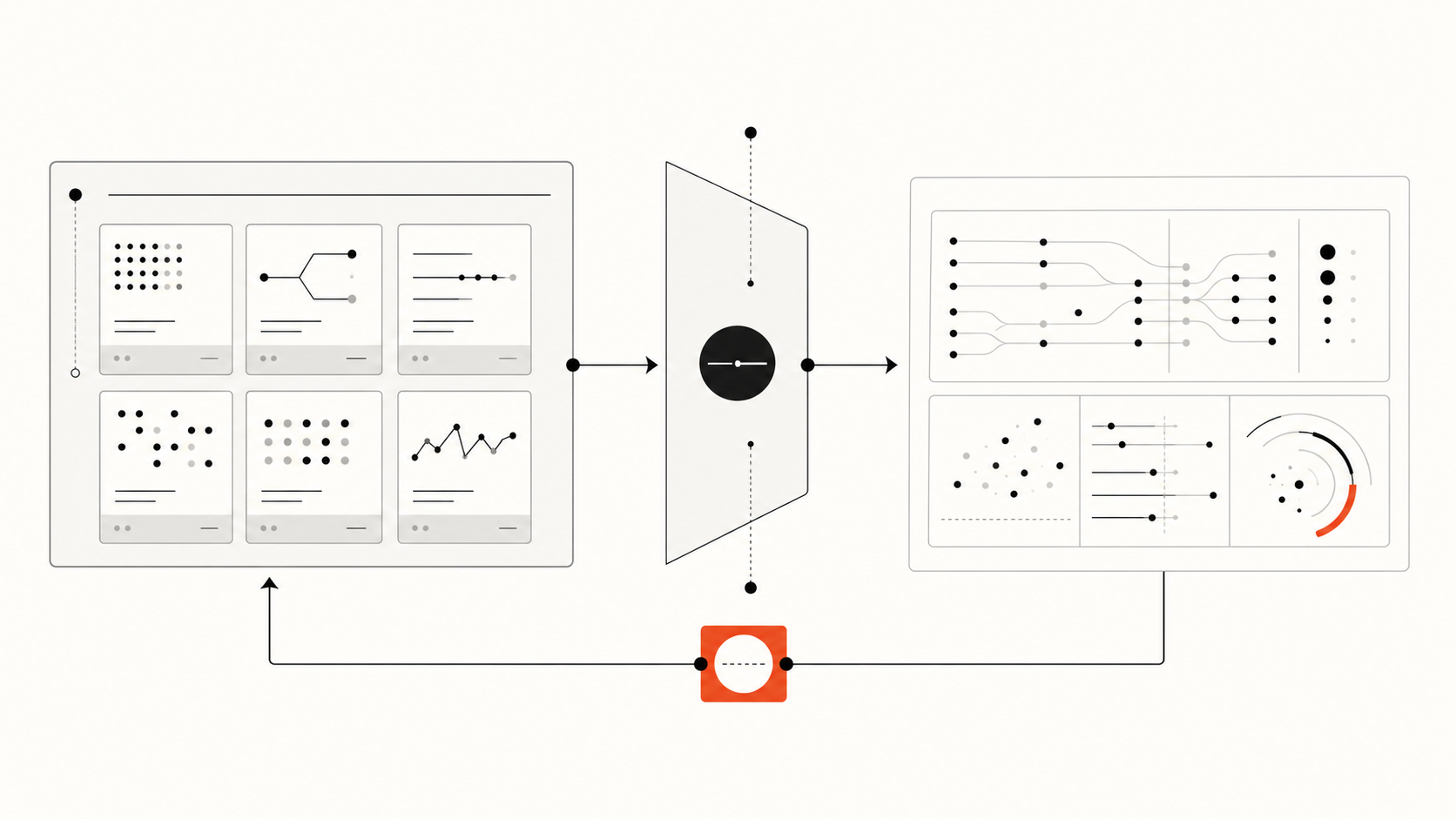
Use a simple loop:
- Build a capability set for new behavior and a regression set for behavior that must not change.
- Run both before changing a model, prompt, tool, retrieval source, or permission boundary.
- Compare results against the stored baseline, including failed traces rather than only aggregate pass rates.
- Release narrowly with monitored signals, alert thresholds, and an explicit rollback or pause owner.
- Turn recurring production failures into sanitized, versioned offline scenarios after human review.
Structured repository context can improve the evidence an agent sees before it acts, but it does not replace this loop. A code knowledge graph can help an agent locate relevant modules and tests; the source, grader, and reviewer still decide whether the change is acceptable.
Run a Pilot and Freeze a Regression Set
Keep the first pilot small enough that a technical lead can read every failure. A practical sequence is:
- Select three to ten representative scenarios with explicit end states and hard safety rules.
- Run the current workflow to create a baseline, preserving the environment and grader configuration.
- Change one meaningful variable at a time, such as the prompt, tool policy, model, or retrieval layer.
- Review failures by category: bad task definition, wrong source selection, tool-use error, policy stop, grader defect, or genuine capability gap.
- Freeze the accepted scenarios as a regression set before expanding scope.
Do not silently replace failing cases with easier ones. If a scenario is invalid, document why and replace it with a representative alternative; otherwise it belongs in the regression history. This produces a decision trail that a future reviewer can inspect instead of a claim that the agent was “tested.”
Before freezing a set, hold a short calibration review with the people who will approve releases. Read a small sample of passes and failures together. Confirm that the task contract still describes the work, the grader is checking the intended state, and each hard stop means what the team thinks it means. If reviewers disagree about a case, record the disagreement as a task-definition or grader issue rather than quietly reclassifying the run.
The regression set should remain narrow enough to explain. Keep the baseline result, failed traces, and acceptance decision beside the scenario revision. When a new task type is added, give it the same contract and review treatment before allowing its result to change the aggregate release decision. This preserves the link between a score and the concrete work it represents.
Treat every new scenario as a hypothesis about a release decision, not a tally target that a narrow prompt can merely optimize.
FAQ
Which AI agent evaluation metrics should a team track?
Track the smallest set that supports a release decision: a final-state success check, explicit safety-constraint pass or fail, targeted trajectory evidence, reliability across a versioned scenario set, and operating cost or latency. Add a metric only when its threshold changes what the team will do. There is no defensible universal composite score because a production agent's task, permissions, and harm boundaries differ.
Conclusion
Production AI agent evaluation is a release discipline: define representative scenarios, make the desired state and non-negotiable constraints observable, preserve the run evidence, and freeze accepted behavior into a regression set. Promote a change only when that evidence supports the specific operating decision in front of the team. Name the reviewer, rollback owner, and evidence record before the expanded release begins.
Leave a Reply