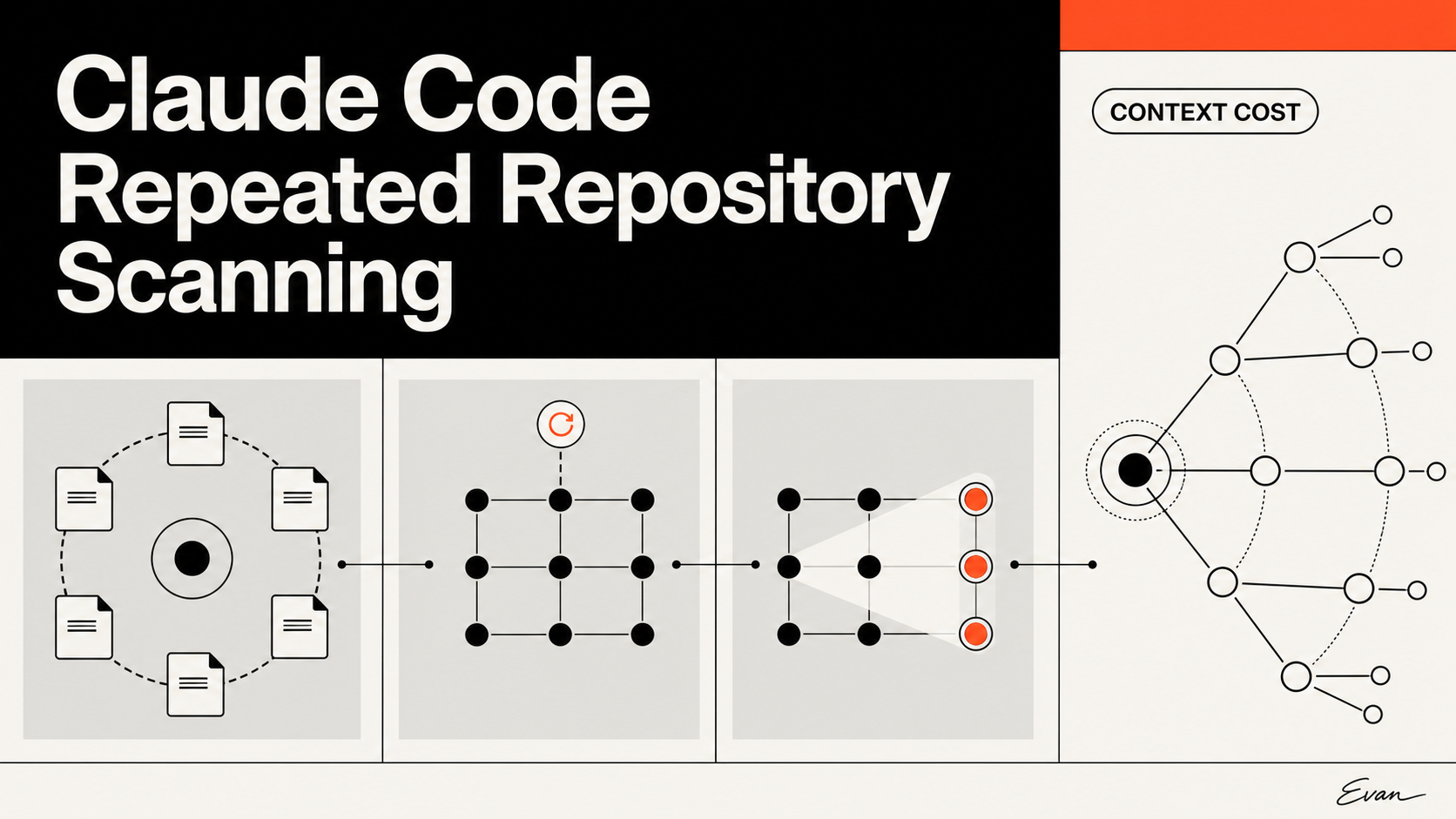
Claude Code repeated repository scanning is a retrieval problem before it is a token problem. A workflow wastes context when each run rediscovers the same module boundaries, definitions, callers, and tests without preserving a source revision or reusing a trusted project map. The remedy is not “never scan again.” It is to scope each task, persist reusable structural candidates with provenance, retrieve only relevant evidence, and force rescans when freshness conditions fail.
In this article, recipe is editorial shorthand for a repeatable workflow. Claude Code implements reusable workflows as Skills; it does not document a built-in repository-map cache.
Why Recipes Re-Read the Same Repo
Claude Code repeated repository scanning usually begins when a reusable recipe has no persisted, revision-aware map of the structure it is about to inspect.
Repeated workflows often begin with broad instructions: inspect the repository, understand the architecture, then find the relevant code. That sequence is defensible for a new codebase, but expensive when every task repeats it.
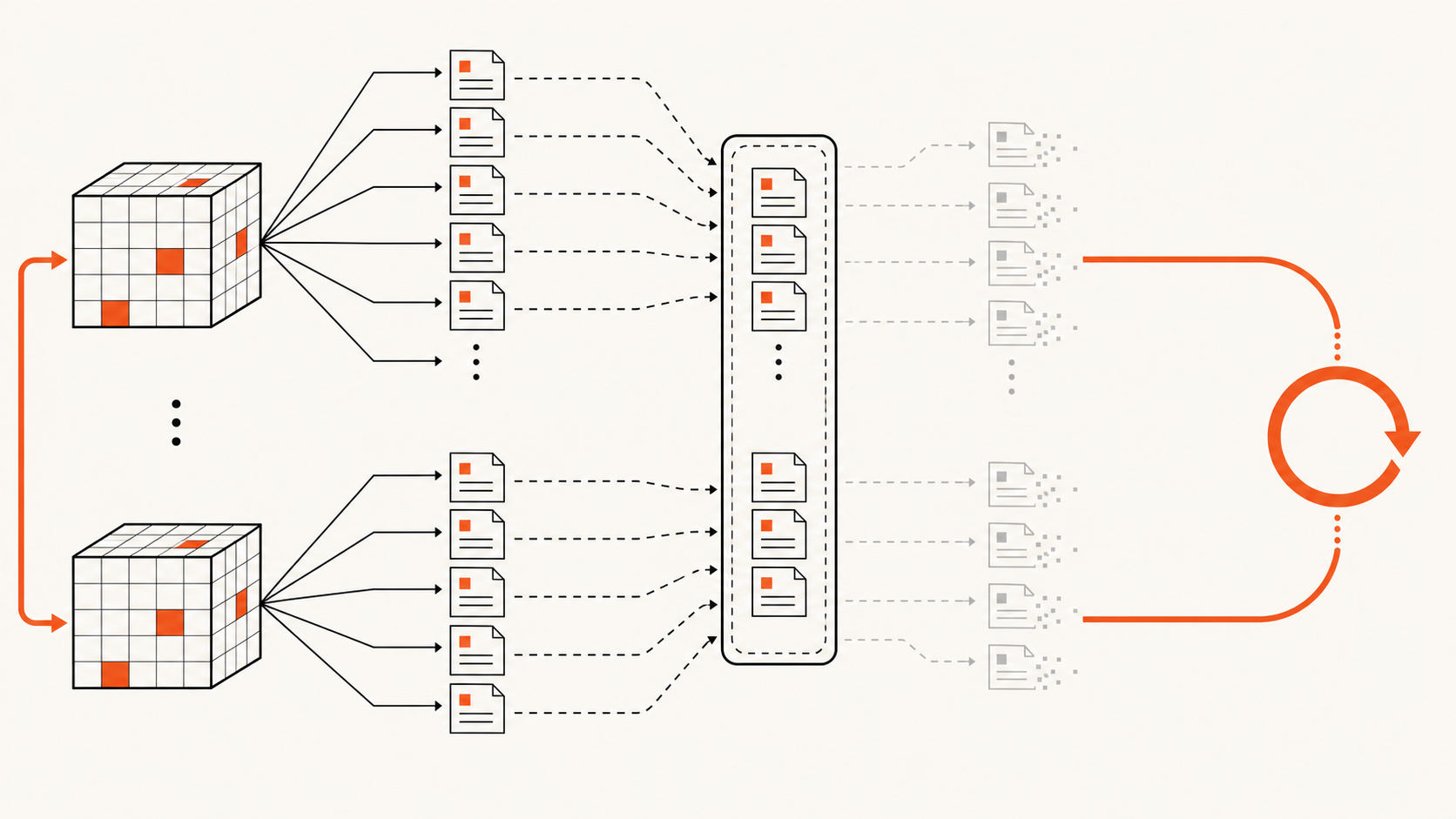
Three things cause the loop:
- the recipe has no bounded target or stop condition;
- prior findings live only in conversation text and lack a revision;
- stable guidance, procedures, and mutable code facts are mixed in one always-loaded file.
Claude Code context optimization starts by separating those layers. Put stable conventions and essential commands in scoped CLAUDE.md files. Put specialized procedures in on-demand Skills. Keep current module, dependency, and test relationships in source-backed maps or an external index, not as timeless instructions.
Anthropic's large-codebase guidance recommends starting Claude in the relevant directory, using nested instructions, excluding generated or vendor paths, and using code intelligence for definitions and references. These measures reduce unrelated file reads without claiming that previous analysis remains correct forever.
For repeatable architecture and impact workflows, see Claude Code recipes for large codebases. The key addition here is measurement: prove that retrieval became smaller while review quality did not decline.
Where Context and Token Cost Accumulates
Effective Claude Code context optimization starts by measuring every context surface, not only the source files opened during the task.
Context grows from more than source files. Instructions, conversation turns, tool inputs and outputs, file reads, search results, and Skill content all consume space. Anthropic notes that large repositories can fill context with unrelated instructions and file reads, increasing token use and degrading performance.
The cost model needs qualification. Claude Code uses prompt caching and automatic compaction. API users are charged by token consumption, while Pro and Max usage is included in the subscription plan; therefore there is no universal dollar cost for “one repository scan.” Anthropic's cost documentation points users to /usage for session usage data and recommends moving specialized procedures from always-loaded CLAUDE.md content into Skills.
Measure the retrieval pattern instead of inventing a savings percentage:
| Metric | What it reveals |
|---|---|
| file-read and search-tool count | breadth of repository inspection |
| input and cache-read tokens | context consumed or reused |
| time to first evidence-backed answer | retrieval latency |
| unsupported or omitted edges found in review | quality cost |
| age and indexed revision of reused maps | freshness exposure |
Track these values for comparable tasks at a pinned commit. Lower token use accompanied by more missed dependencies is not an optimization.
Persist Project Maps and Dependency Graphs
A persisted project map is a team artifact or external index. It is not guaranteed Claude Code memory. At minimum, record modules, entry points, relation types, tests, source locations, repository revision, generation time, and known coverage gaps.
A search such as “Claude Code Graphify” usually reflects interest in attaching a persistent structural layer to Claude's workflow. Graphify can be evaluated as one possible external code-graph layer, but it should be treated as a separately operated source of candidate relationships, not a native Claude Code feature. The broader architecture is covered in knowledge graphs for AI coding assistants.
Persist only facts that are useful across tasks. A useful map might answer “which packages consume this schema?” or “which tests exercise this entry point?” It should not store a long narrative that every run must reread.
For each stored edge, keep:
- source and target identity;
- relation type and direction;
- source file or extraction evidence;
- indexed commit or content hash;
- extraction method and time;
- coverage or uncertainty note.
An external index may be exposed to Claude Code through MCP, a CLI, or another controlled tool. Query it for a small candidate set, then verify high-impact results against the current source revision.
Retrieve Only Task-Relevant Files
Begin each task with a retrieval plan:
- Pin the revision and name the target behavior, symbol, or module.
- Query a project map for candidate entry points and one relation type.
- Open the defining source and the nearest relevant configuration.
- Use code intelligence for definitions and references where available.
- Read tests that claim to exercise the selected paths.
- Expand only when evidence conflicts or a freshness rule fires.
This sequence turns a broad scan into progressive retrieval. It also keeps code intelligence, graph queries, text search, and tests in their appropriate roles. Definitions and references can be precise for supported languages; text search catches configuration and strings; graphs support reverse and cross-module discovery; tests provide behavioral evidence.
Use scoped Skills so the full procedure loads only when needed. Use nested CLAUDE.md or path-scoped rules for local conventions rather than placing every package's guidance in the root file. After context compaction, Claude Code reinjects some context surfaces according to documented limits, so concise, well-placed instructions still matter; context-window behavior should not be mistaken for a durable code index.
Risks and Freshness Checks
Less reading increases dependence on what was retained. A stale map can be more dangerous than a fresh scan because it looks intentional.
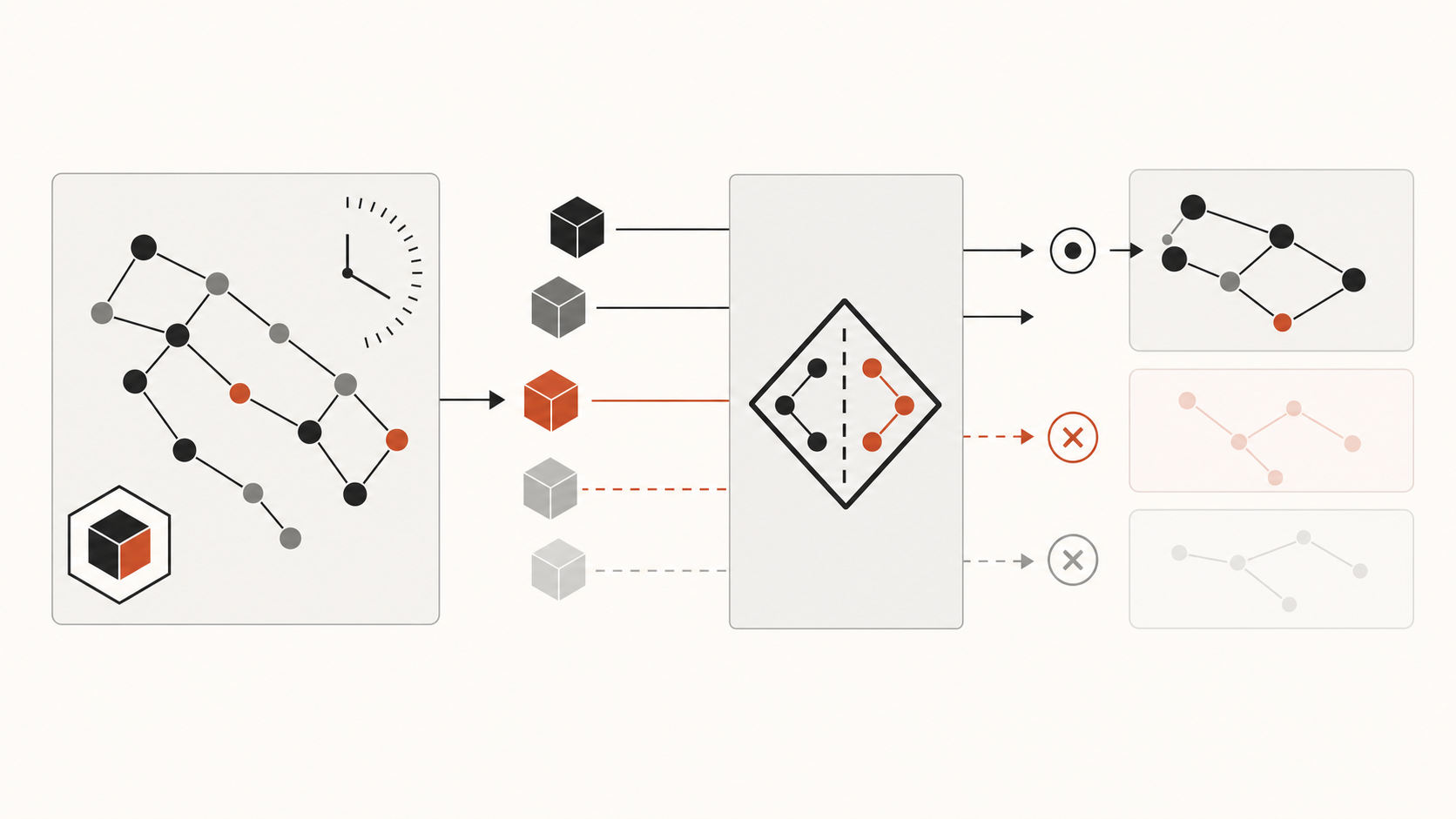
Force a refresh when dependency manifests, public schemas, routing, plugin registration, generated clients, build configuration, migrations, or ownership boundaries change. Also refresh when the stored revision is not an ancestor of the working revision, the index lacks the target language, or source verification contradicts a returned edge.
Use different expiry policies. Stable module descriptions may survive many commits with spot checks. Call edges, route registration, generated APIs, and tests around an active refactor should expire quickly. Runtime-discovered relationships need the shortest confidence window unless they are continuously observed.
Keep a rescan budget rather than a no-rescan rule. Broad scans are appropriate for an unfamiliar repository, a major architecture migration, a suspected coverage gap, or a failed freshness check. For routine changes, retrieve a small map slice and validate it against source.
Finally, audit omissions. Sample changes after merge and ask whether the retrieval plan missed a dependent module, relevant test, or operational boundary. Feed that failure into the map schema, freshness triggers, or recipe—not into an unsupported claim that more context is always better.
FAQ
When should a recipe force a rescan?
Force one when the pinned revision and stored map diverge materially, relevant manifests or schemas changed, the target uses unsupported dynamic behavior, or source contradicts the map. Also rescan after a known extraction failure or when the task crosses an unindexed repository boundary.
What maps should expire quickly?
Runtime registration, call chains around active refactors, generated interfaces, routes, feature flags, migrations, and test-to-behavior mappings should have short expiry windows. Stable ownership or high-level module-purpose records can last longer if they retain provenance and periodic review.
How should teams measure reduced reading?
Compare similar tasks at pinned revisions. Track file reads, searches, input and cache-read tokens, time to first cited evidence, map age, and omissions found in review. Use a baseline and report distributions, not one favorable run or a universal savings percentage.
claude code plan mode
Plan mode can help keep an analysis read-only while Claude explores and proposes a plan, but it does not create a persistent repository map. Teams still need scoped retrieval, freshness checks, evidence review, and appropriate permission rules for the surrounding workflow.
Conclusion
Reduce Claude Code repeated repository scanning by reusing small, revisioned maps and retrieving evidence progressively. Measure both context reduction and missed relationships. Rescan when freshness fails, and never let a persisted map outrank current source, configuration, tests, or responsible human review.
Leave a Reply