Claude Code recipes for large codebases should be repeatable analysis workflows, not collections of clever prompts. In this article, recipe is editorial shorthand. Anthropic's current product surface is a Skill; legacy custom commands still work but have been merged into Skills. A useful recipe tells Claude what scope to inspect, what evidence to return, what uncertainty to preserve, and how a reviewer can verify the result.
The three recipes below cover architecture orientation, module and call-chain analysis, and impact plus test mapping. None assumes that Claude Code has a built-in repository graph. They work with source reads and code intelligence, and can optionally query an external, source-attributed index.
Before Using Recipes on a Large Codebase
Claude Code recipes for large codebases should begin by reducing the search surface. Anthropic's large-codebase guidance recommends starting Claude in the directory relevant to the task, using nested CLAUDE.md files for local conventions, excluding generated or vendor directories, and adding code-intelligence plugins where supported. That setup matters more than making a repository analysis prompt longer.
Define four fields before running any recipe:
- Scope: repository commit, workspace or package boundaries, and directories that are out of scope.
- Question: one architecture, call-chain, or impact question, stated so a reviewer can tell when it has been answered.
- Evidence contract: file paths, symbols, line-level references where practical, relevant tests, and commands or tools used.
- Stop conditions: missing language support, generated indirection, runtime registration, unavailable services, or contradictory evidence.
This turns the prompt into reviewable work. It also prevents a common failure mode: Claude reads broadly, produces a plausible summary, and leaves no way to distinguish code evidence from inference.
Treat repository analysis prompts as evidence contracts rather than prose templates. The required scope, output fields, and stop conditions matter more than stylistic wording.
Stable conventions belong in CLAUDE.md; the procedure belongs in a Skill; current dependency and call relationships still need to come from code, code intelligence, or an external knowledge graph for AI coding assistants. If your team wants to package the procedure, see the Claude Code repository analysis Skill.
Recipe for Architecture Overview
Architecture-focused repository analysis prompts should build a bounded orientation map, not summarize every directory. Give Claude the commit and scope, then ask it to identify:
A search for “Claude Code recipes for large codebases Reddit” may provide examples, but the architecture recipe still needs repository-specific evidence and review criteria.
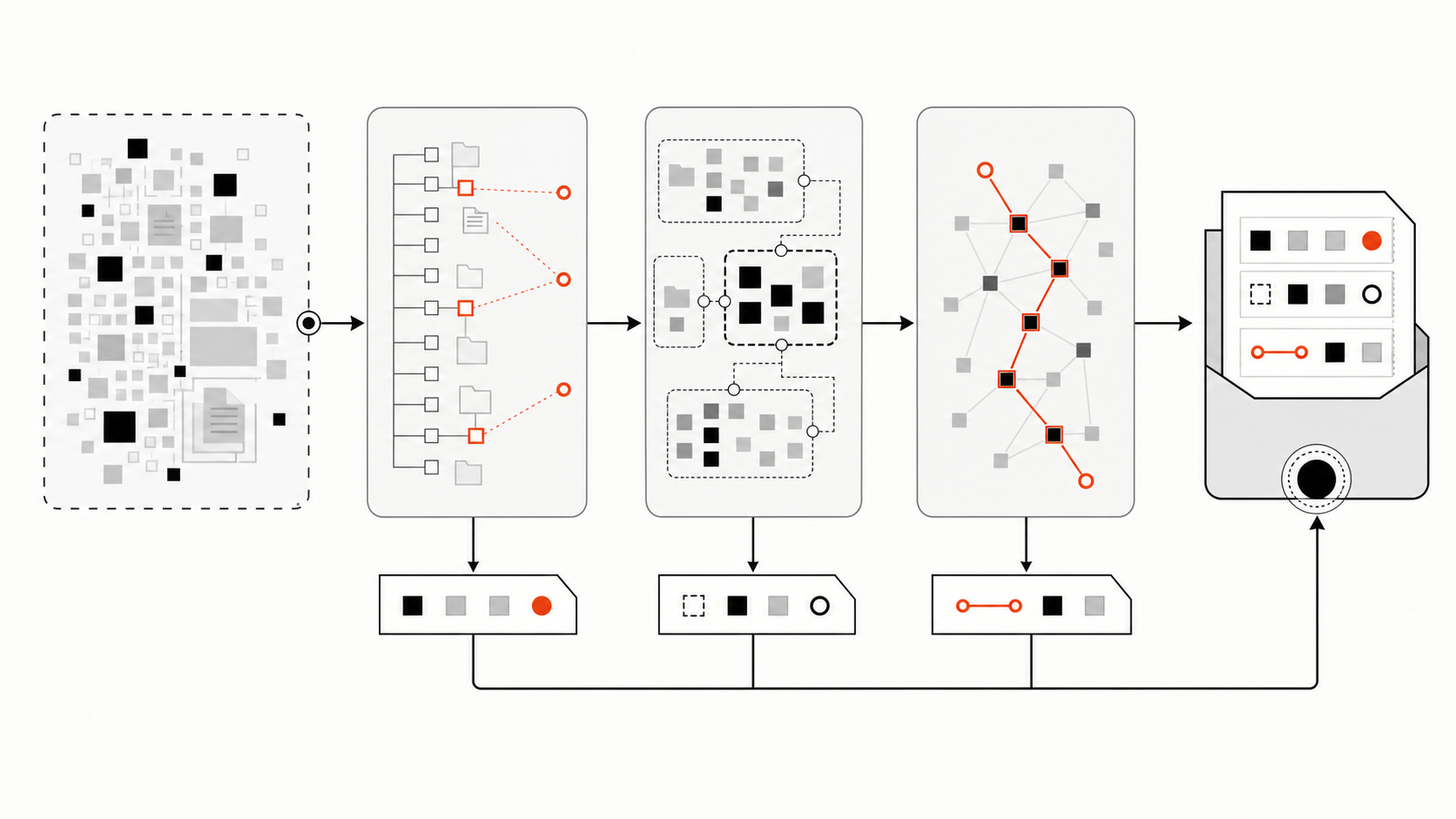
- user-facing or machine-facing entry points;
- top-level modules and the responsibility of each;
- dependency direction between those modules;
- shared infrastructure and cross-cutting concerns;
- configuration, build, and deployment boundaries relevant to the target area;
- unresolved areas that would require runtime evidence or an owner interview.
Require a compact output table with component, responsibility, entry evidence, outbound dependency, and confidence. The confidence column is not a probability score. It should use explicit labels such as direct source evidence, supported inference, or unknown.
A practical instruction is:
Start from documented and executable entry points. Trace only enough imports, registrations, and configuration to explain the target system boundary. Cite a file and symbol for every component. Mark runtime-discovered relationships as unknown unless a test, configuration file, or code-intelligence result supports them. End with three verification checks a maintainer can run.
Do not ask for “the complete architecture.” In a monorepo, that request encourages breadth without proof. Ask for the smallest map that answers the task, then expand one uncertain boundary at a time. The deliverable should let a new reviewer challenge individual edges instead of accepting one polished narrative.
Recipe for Module and Call-Chain Analysis
A search such as “Claude Code recipes for large codebases Reddit” often reflects a reasonable need for reusable examples. The useful pattern, however, is not a copied prompt. It is a call-chain contract that separates direct evidence from possible runtime behavior.
Start with one symbol, endpoint, event, job, or configuration key. Ask Claude to return:
- its definition and public entry points;
- direct callers or references found through code intelligence;
- adapters, registrations, dependency-injection bindings, and generated layers;
- outbound calls and observable side effects;
- branches that are indirect, dynamic, or not statically resolvable;
- the files and tests a reviewer should open next.
Code intelligence can provide precise definition and reference lookups for supported languages. Text search remains useful for strings, configuration, templates, and languages without a configured server. Neither technique alone proves a complete runtime call graph.
Use an edge table rather than prose:
| From | Relation | To | Evidence | Status |
|---|---|---|---|---|
| symbol or entry point | calls, registers, publishes, reads | target | file, symbol, lookup | direct, inferred, unknown |
Then require a reverse check: choose one claimed downstream effect and trace back to the original entry point independently. If the two paths disagree, the recipe should report the disagreement rather than smooth it over.
Recipe for Impact and Test Mapping
Impact analysis begins with a proposed change, not with the whole repository. State the symbol, schema, API, configuration, or behavior that may change. Ask Claude to map four surfaces: direct dependents, compatibility boundaries, stateful or operational effects, and tests.
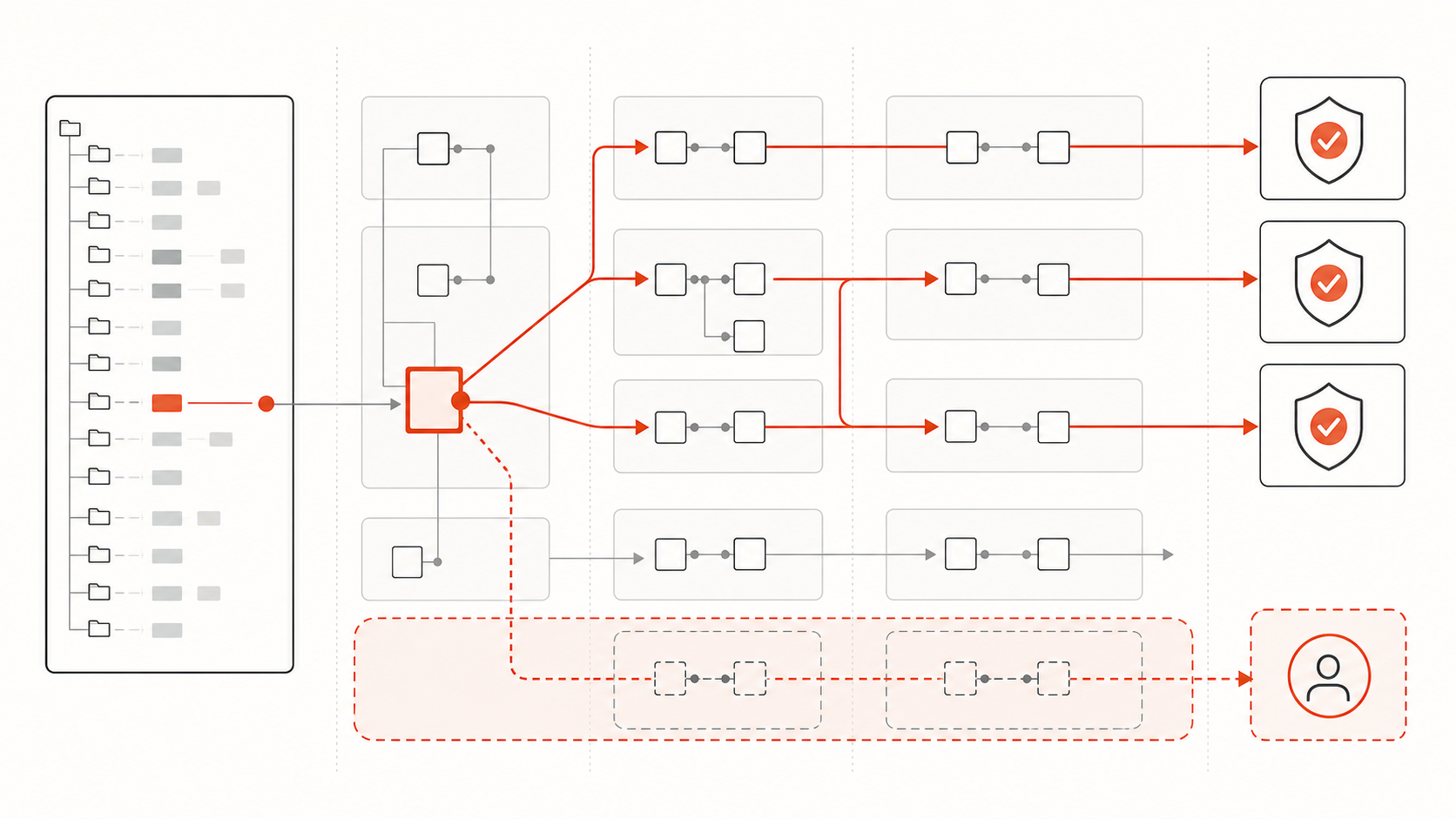
The output should distinguish:
- compile-time impact: imports, types, interfaces, generated clients, and build targets;
- runtime impact: registrations, queues, routes, feature flags, migrations, and external integrations;
- behavioral impact: assumptions encoded in callers, validation, error handling, and fallback paths;
- verification coverage: unit, integration, contract, end-to-end, and operational checks.
A test file is not automatically evidence that a behavior is covered. Require Claude to cite the specific test name and explain which edge or behavior it exercises. Also ask for negative cases: tests that appear related by filename but do not reach the changed path, and important paths for which no test was found.
Finish with a review matrix: risk, affected evidence, existing check, missing check, owner. The owner can be a team or CODEOWNERS path; do not invent a person. For a high-risk boundary, the recipe should recommend a human verification step or a targeted test, not a larger speculative scan.
If an external code graph is available, query it for candidate dependents, then confirm the important edges against the pinned source revision. Anthropic documents exposing an existing search or RAG index through MCP; that is an integration option, not a native Claude Code index.
Limits, Drift, and Review Notes
A recipe controls procedure. It does not make stale instructions, incomplete language-server results, or an outdated graph correct. Treat every stored project map as a snapshot with a source commit and generation time. Force revalidation when dependency manifests, routing, schemas, build configuration, or generated interfaces change.
Review output at three levels:
- Evidence validity: do cited paths and symbols exist at the stated revision?
- Edge validity: does the source support the claimed direction and relation?
- Coverage: did the recipe search the relevant static, configuration, generated, and runtime-registration surfaces?
Keep unknowns visible. Dynamic dispatch, reflection, generated code, macro expansion, and runtime configuration can defeat static inspection. A mature result may contain more qualified uncertainty than an early result; that is often an improvement.
Finally, keep the recipe short enough to maintain. Put stable repository facts in scoped CLAUDE.md files, reusable procedures in Skills, and current structural claims in source-backed evidence. When any of those layers changes, review its owner and revision independently.
FAQ
Who should maintain repository recipes?
The team that owns the affected architecture boundary should maintain the recipe, with one named role responsible for review. Platform teams can own the shared evidence schema, but module owners should approve scope, special cases, and verification rules. Store the recipe with the repository so changes are reviewed beside code.
When should a recipe call a graph query?
Call an external graph when the question spans many modules, requires reverse dependency lookup, or repeats often enough that broad source scanning is wasteful. Use it to generate candidate relationships, not final truth. Check high-impact edges against source at the graph's indexed commit.
How should teams audit recipe output?
Sample cited files and symbols, reproduce at least one lookup, reverse-trace one important edge, and inspect every “unknown.” Compare the result with a small fixture or a change whose impact is already understood. Record false edges, omissions, and stale sources so the recipe or context layer can be corrected.
what is claude code
Claude Code is Anthropic's coding agent for terminal, IDE, desktop, and web workflows. It can read repositories, use tools, follow CLAUDE.md instructions, and load Skills. Those features support analysis workflows, but they do not turn every repository into an automatically maintained code graph.
Conclusion
The best Claude Code recipes for large codebases are narrow, evidence-producing, and comfortable reporting uncertainty. Start with one bounded question, require files and symbols for every important claim, and end with a human-verifiable check. Save repeated procedures as Skills, and treat code intelligence or an external graph as evidence sources whose coverage and freshness still need review.
Leave a Reply