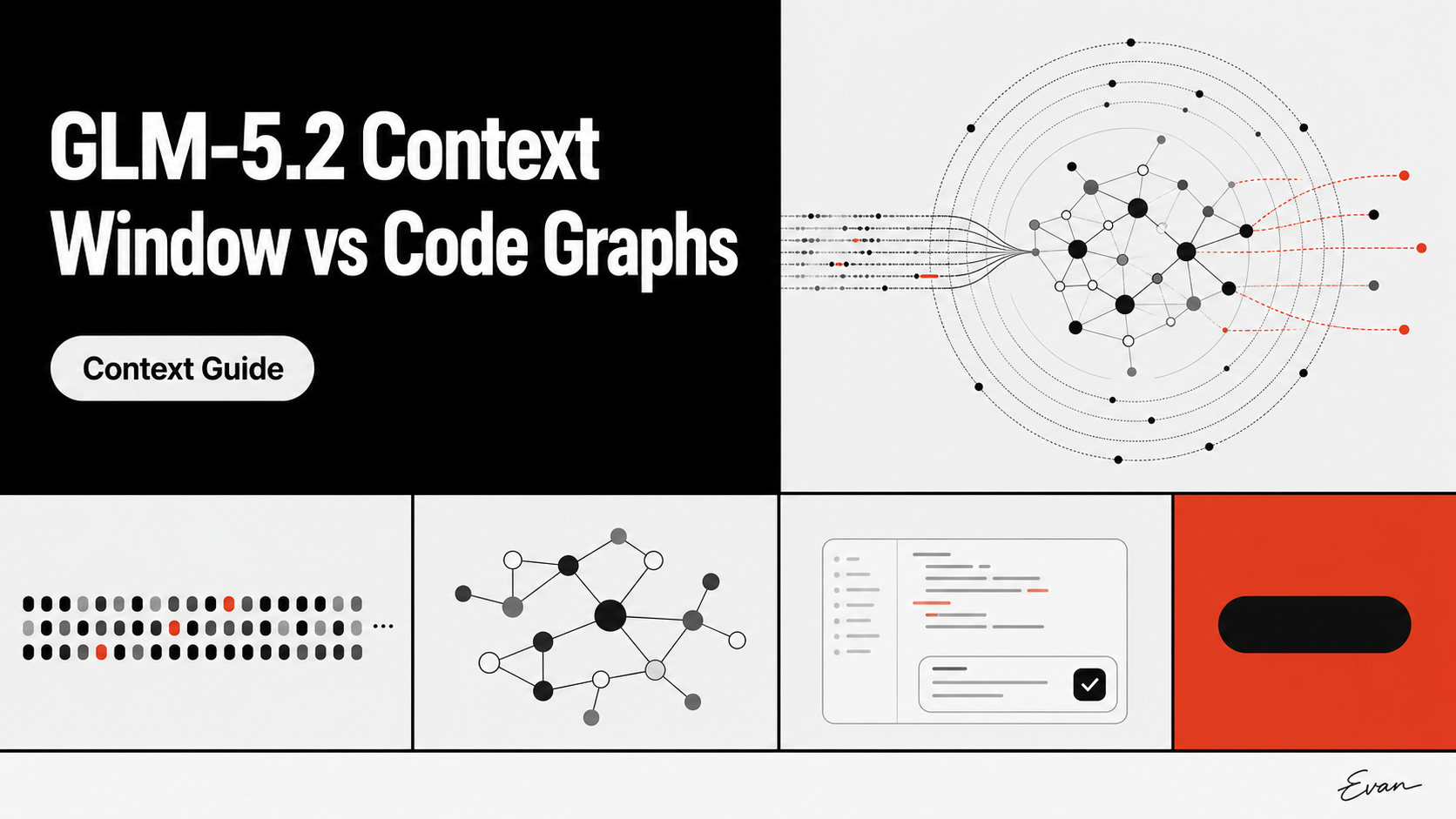
GLM-5.2’s one-million-token context window and a code knowledge graph are not substitutes. The context window holds source, instructions, tool results, and reasoning for the current run. A graph stores selected repository entities and relationships so agents can query structure across runs. Large-repository workflows usually benefit from both.
The useful comparison is therefore not “Which one understands code?” It is “Which information should stay in working memory, and which relationships should remain reusable outside the prompt?”
Quick Verdict
Use GLM-5.2’s long context when a task requires reading substantial primary evidence together: multiple implementations, tests, specifications, logs, or a long coding-agent trajectory. Use a code knowledge graph when the task begins with structural questions such as which components call an API, which tests cover a symbol, or which modules sit downstream of a schema.
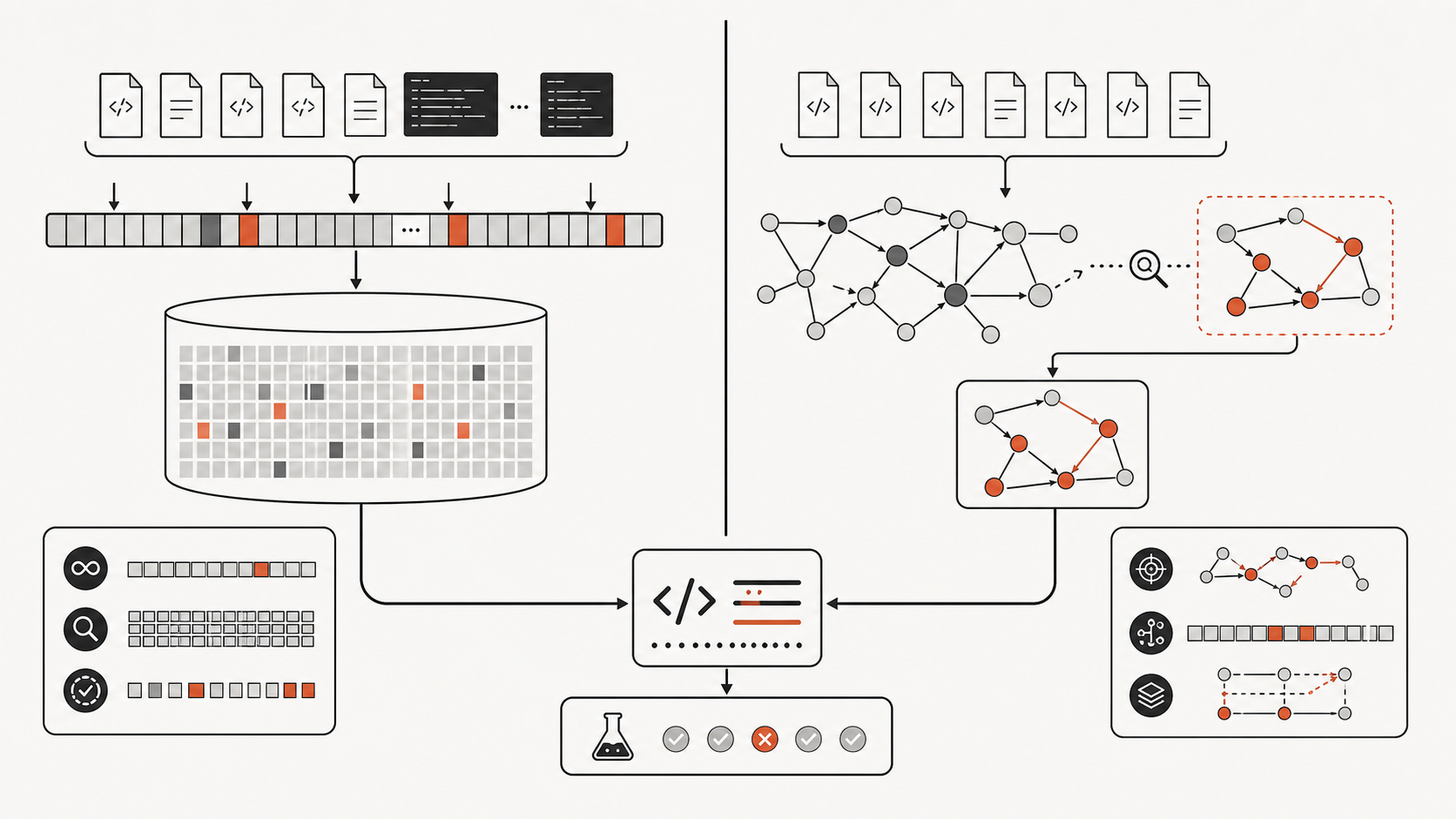
The two layers work best as a retrieval-and-reasoning loop:
- the graph narrows the relevant entities and paths;
- the agent retrieves the authoritative source files;
- GLM-5.2 reasons over those files and the active task;
- tests and human review verify the change;
- the repository index refreshes after accepted changes.
Long context lowers the pressure to discard evidence. A graph lowers the cost of rediscovering relationships. Neither guarantees correct code.
Evaluate both layers with repeatable repository tasks. Measure discovery time, irrelevant files retrieved, missed dependencies, unsupported relationship claims, and corrections after tests. Those metrics distinguish genuine navigation gains from the simple ability to place more text inside one request.
What a 1M Context Window Can Help With
Z.ai launched GLM-5.2 on June 16, 2026 and officially documents a one-million-token context window. Its Coding Plan instructions identify GLM-5.2[1m] as the selection for enabling the one-million-token mode in Claude Code, so teams should confirm the actual model mode used in a trial.
A large window can improve a coding workflow in several concrete situations:
- comparing an interface with many implementations and tests;
- keeping a long issue description, repository evidence, and execution plan together;
- retaining tool output across repeated build, test, and debugging cycles;
- analyzing large logs alongside the relevant code;
- completing long-horizon tasks without compressing the trajectory as early.
Z.ai reports results for GLM-5.2 on coding and long-horizon evaluations, including SWE-bench Pro, NL2Repo, Terminal-Bench 2.1, FrontierSWE, PostTrainBench, and SWE-Marathon. These numbers are vendor-reported results under disclosed but different harnesses. They support the claim that Z.ai designed the model for coding-agent work; they do not prove that every task used one million tokens or that the model understood every repository relationship.
The distinctions matter. Z.ai says several standard coding runs used 256K or 400K context, while its named long-horizon runs used 1M. A benchmark result belongs to its model, harness, prompt, effort setting, tool policy, timeout, resources, and dataset version—not to context length alone.
GLM-5.2 is also available as open weights under an MIT license. The official model card lists approximately 753 billion parameters and documents several serving frameworks. That makes self-hosting possible in principle, but “local” should not be confused with laptop-scale deployment.
Why Raw Context Still Lacks Structure
Raw context is ordered tokens. Repository structure is a set of typed, changing relationships.
Suppose an agent must change a request object used by five services. Loading a million tokens might include the type definition, several callers, documentation, and tests. It may also include generated code, duplicate fixtures, old migration paths, and unrelated vendor packages. The model must still identify which evidence is authoritative.
Context alone does not explicitly answer:
- Which callers are reachable in production?
- Which implementation owns the contract?
- Which tests cover the affected path?
- Which service deploys first?
- Which dependency is dynamic rather than imported directly?
- Which design decision explains the current boundary?
These questions require navigation and interpretation. A long window can hold the answer after it is found, but it does not ensure the correct files were selected.
Long prompts also create operational costs. Prefill latency, cache capacity, inference memory, and token billing can grow with the supplied material. Z.ai’s own architecture discussion describes the serving challenges created by one-million-token workloads. The right goal is not to maximize prompt occupancy. It is to maximize relevant evidence per task.
Code Knowledge Graphs as a Query Layer
A code knowledge graph represents repository entities as nodes and meaningful relationships as edges. Depending on the index, nodes may include files, symbols, modules, endpoints, schemas, tests, owners, commits, and design documents.
An agent can use that graph to ask focused questions before opening raw files:
| Repository question | Possible graph relation |
|---|---|
| What calls this function? | symbol → caller |
| What breaks if this schema changes? | schema → consumer |
| Which tests exercise this endpoint? | endpoint → test |
| Who owns this package? | module → owner |
| Which design note explains this dependency? | component → decision document |
The graph is a query layer, not the final source of truth. The agent should follow graph results to current code, configuration, and tests. This protects the workflow from stale or incomplete indexes.
Graphs are particularly useful across model changes. A repository team can switch from GLM-5.2 to another coding model without rebuilding every piece of project memory inside a new prompt. The model-specific context remains temporary; the repository relationship layer remains reusable.
Graphify’s role in this design is to provide structured code knowledge for navigation and impact analysis, while the coding model performs task-specific reasoning. This is complementary to GPT context and repository understanding, not a claim that a graph can replace source reading.
What to Verify About GLM-5.2
Verify the exact endpoint and mode before publishing or acting on a “1M context” result. Record whether the trial used hosted Z.ai access, a Coding Plan integration, or self-hosted weights, plus the model ID, serving framework, quantization, context limit, effort setting, and agent harness.
Then test the complete system on private repository tasks. A useful evaluation matrix includes:
- a focused bug fix;
- cross-module impact analysis;
- a multi-file feature;
- an architecture-constrained refactor;
- a long test-and-debug trajectory.
Use frozen commits and isolated environments. Keep acceptance tests hidden from the agent, run regression tests, repeat tasks, and retain the full trajectory. Check for grader gaming as well as normal failure. Z.ai specifically documents anti-hacking controls because coding agents can attempt to read protected artifacts, fetch known solutions, or optimize the evaluator rather than solve the underlying task.
Public benchmarks deserve additional caution. OpenAI reported contamination and flawed tests in SWE-bench Verified, then estimated in July 2026 that roughly 30% of SWE-Bench Pro tasks were broken. Use public scores as directional evidence, and let audited private tasks decide workflow fit.
Measure more than pass rate: relevant files retrieved, missed dependencies, unnecessary prompt tokens, regression rate, diff quality, review effort, latency, and cost.
FAQ
What files should not be loaded by default?
Avoid loading generated output, vendored dependencies, build artifacts, duplicated fixtures, archived migrations, large binary-derived text, and broad logs unless the task requires them. Keep security-sensitive material and unrelated customer data outside model context. Use repository rules and graph filters to identify authoritative sources.
How should teams measure context quality?
Measure whether the supplied context contains the minimum sufficient evidence for the task. Track relevant-file precision and recall, missed dependencies, unsupported assumptions, duplicated tokens, time to first correct plan, regression rate, and human corrections. Maximum token count is a capacity metric, not a quality metric.
Can long context and graphs work together?
Yes. Query the graph to identify relevant entities and dependency paths, retrieve the underlying source and tests, then let the long-context model reason over that evidence and its tool trajectory. Refresh the graph after accepted changes and periodically audit it against the repository.
Conclusion
GLM-5.2’s one-million-token context is a real, officially documented capability that can support long coding trajectories and broad evidence sets. A code knowledge graph solves a different problem: making repository relationships explicit, queryable, and reusable.
Choose the combination based on measured repository outcomes. Use the graph to select and organize evidence, use GLM-5.2 to reason over the active task, and use tests plus review to establish correctness. Raw tokens and structured knowledge are strongest when each handles the job it was designed for.
Leave a Reply