pxpipe makes an important point about AI coding cost: the same bulky context can sometimes be carried more cheaply as images than as text. That can help long agent sessions, but it does not tell the agent which repository facts matter or how modules depend on one another. Context efficiency and repository understanding are related operational problems, not the same capability.
The practical goal is not to maximize the amount of code placed in a context window. It is to supply the smallest trustworthy evidence set that supports the task, preserve exact details, and verify the resulting change.
Why pxpipe Became Interesting
The independent teamchong/pxpipe project intercepts supported model requests and renders selected large text blocks as dense PNG images. Its current documentation focuses on Claude Code, where Anthropic officially allows requests to be routed through a proxy using ANTHROPIC_BASE_URL.
The idea is attractive because model input is not priced only by human-visible information. Text and images use different tokenization paths. A dense tool result or old conversation history may occupy fewer visual tokens after rendering, provided the target model can read the page well enough.
pxpipe defaults to Claude Fable 5. Anthropic confirms that Fable 5 supports vision and is available in Claude Code. The pxpipe project reports that Fable reads its dense render profile more reliably than other models it tested. This is project evidence, not an Anthropic endorsement of pxpipe.
The project also publishes measurements instead of presenting compression as free. Its own SWE-bench Lite pilot reports 10 of 10 tasks completed in both arms and 65% smaller measured requests with compression. Its larger Pro sample reports 14 of 19 resolved with pxpipe and 15 of 19 without it. Those small, maintainer-run results support a pilot hypothesis: request size can fall without an obvious collapse in task completion. They do not establish universal parity or better coding performance.
pxpipe also documents the uncomfortable part. Image context is lossy. Dense prose and broad state may survive while a hexadecimal value, identifier, or name is silently reconstructed incorrectly. That honesty makes the project useful as a case study in context engineering, even for teams that never deploy it.
The Cost Problem in Code Context
Coding agents consume context through more than source files. System instructions, tool schemas, repository rules, file reads, command output, test failures, diffs, plans, and old conversation turns all occupy the working request.
Long tasks create several kinds of waste:
- the client resends stable instructions and tool definitions;
- the agent reopens files it inspected earlier;
- command output contains repeated or irrelevant lines;
- old history stays available after its exact wording stops mattering;
- broad repository reads include generated, vendored, or unrelated code;
- failed trajectories remain in the transcript.
Compression can reduce the footprint of some of this material. It cannot decide whether the material should have been loaded in the first place.
That distinction affects cost measurement. A project can report fewer transmitted tokens while the agent takes more turns, rereads exact data, or requires more human review. Prompt caching can also change the economics. Anthropic’s token-count documentation says counts are estimates and that Fable 5 uses a newer tokenizer than older Claude generations. Teams should measure the same current workload under the exact model and client instead of applying a headline percentage.
The cost unit that matters is accepted work, not a compressed request. A useful trial tracks total provider cost, latency, successful tests, review time, corrections, re-fetches, and recovery from failures.
Why Cheap Context Is Not the Same as Understanding
Repository understanding requires selection and relationships. A model needs to know not only that a file contains a matching string, but also whether that file owns the behavior, which callers depend on it, which tests represent the contract, and which design rule constrains the change.
Consider a shared type used by an API, a queue consumer, generated clients, and analytics. A compressed dump of all matching files may be cheaper than raw text. It still does not label the authoritative schema, identify runtime consumers, or explain why one field cannot change.
More context can even make reasoning harder. Generated code, fixtures, duplicated implementations, stale documents, and vendor directories compete with the relevant interface. A one-million-token window is capacity, not prioritization.
The same boundary applies to memory. Fable 5 supports compaction and a memory tool in supported harnesses, but those features do not automatically create a durable model of a repository. A conversation summary is not a dependency graph. An old tool result rendered as an image is not a maintained architecture record.
For exact work, cheap but lossy context can create hidden cost. The pxpipe project reports that dense identifiers can be misread without an error signal. A plausible wrong path or hash is more dangerous than an explicit “not found” because the agent may act on it. Keep code to be edited, commands, IDs, versions, numerical limits, and acceptance criteria in text or re-read them from the source.
Where Code Knowledge Graphs Help
A code knowledge graph addresses selection by modeling entities and relationships before the model consumes task-specific evidence. Graphify can provide a reusable map across source code and project documents.
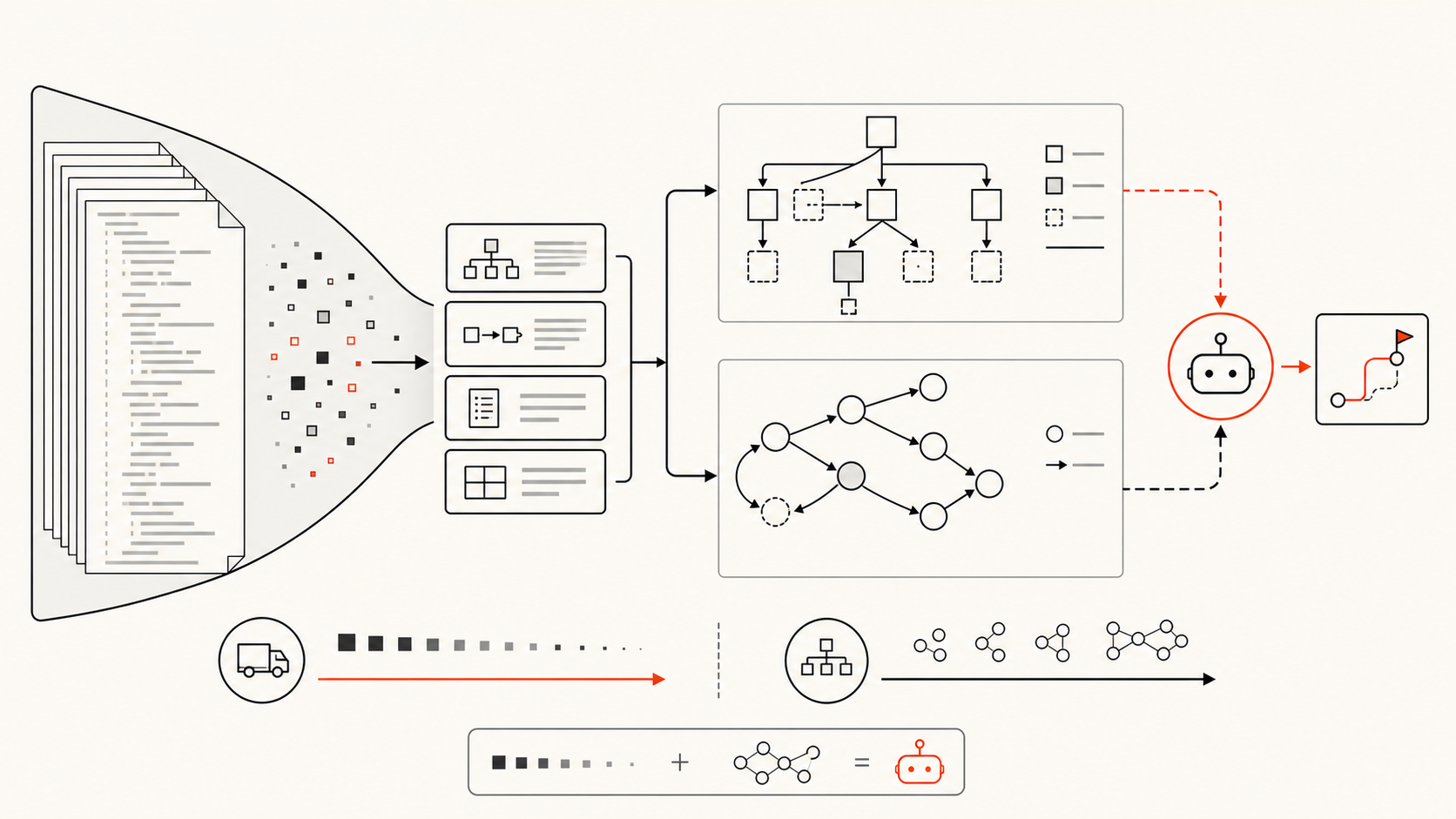
The graph can answer questions that compression does not:
- Which modules import or call this symbol?
- Which tests and documents connect to this subsystem?
- What path links the requested feature to storage?
- Which entities belong to the same architectural community?
- Which relationships were extracted directly and which were inferred?
That map lets the agent open a smaller set of authoritative files. Compression may then be unnecessary for short tasks or useful only later, after test logs and history accumulate.
Graphs are not perfect understanding either. Static analysis can miss reflection, runtime wiring, feature flags, external repositories, and generated behavior. Documents can be stale. Inferred edges can be wrong. Graph results should include provenance and point back to source evidence.
The durable workflow is layered:
- Query project structure.
- Open the authoritative source and current documentation.
- Keep exact constraints as text.
- Compress only older or bulky gist-level material.
- Verify the patch with tests, diff review, and architecture ownership.
The Graphify knowledge-graph guide explains the structural layer. The broader pxpipe vs Graphify comparison owns the product-selection decision once that page is live.
Practical Limits to Verify
Start with lifecycle. pxpipe’s npm package and default branch were still changing in mid-July 2026, but its maintainer said they could not promise responses or reviews for all issues and pull requests. Pin the tested version and keep a bypass path.
Then test model compatibility. pxpipe’s built-in default is Fable 5; other models are opt-in because the project reports weaker dense-image results. A model update can change image reading, token accounting, safeguards, or request behavior.
Review privacy and trust boundaries. A local proxy still forwards requests upstream. The project has open reports concerning failed-request body logging, relocated system material, safeguard refusals, and inherited proxy environment variables affecting child processes. Treat these as issues to reproduce against the installed version, not as proof that every deployment fails.
Finally, separate measured and inferred value. Record:
- original versus transformed request tokens;
- cached and uncached input;
- total session cost and turns;
- exact-string mistakes;
- re-read and rehydration calls;
- tests passed and hidden regressions;
- human review minutes;
- proxy errors and safeguard refusals;
- repository files loaded before and after structured retrieval.
This evidence shows whether compression reduces total work and whether a graph reduces unnecessary discovery.
FAQ
What context should be compressed first?
Start with large, repeated, token-dense material whose exact wording no longer matters: old narrative history, verbose logs, completed tool output, or repeated documentation. Do not start with source code about to be edited, commands, secrets, hashes, paths, versions, numerical constraints, or acceptance tests.
When does compression hide useful structure?
Compression hides structure when files and relationships are flattened into pages without labels for ownership, calls, imports, tests, or provenance. It also creates risk when visually similar characters matter. Use search or a code graph to select evidence, and preserve exact source links for verification.
How should teams compare cost savings?
Run repeated tasks from the same repository commit with the same model, client, permissions, prompt, and tests. Compare total cost per accepted task, not one request. Include latency, turns, re-fetches, failures, review time, and regressions. Label project-published benchmark numbers as project evidence.
Conclusion
pxpipe is interesting because it turns context cost into a measurable engineering problem. Its project evidence suggests that Fable 5 can read enough dense imaged context to reduce request size on some Claude Code workloads, while the documented exact-string failures prevent treating the representation as lossless.
The larger lesson is that cheap context is not repository understanding. Use structured project knowledge to identify what matters, native text for exact evidence, compression for suitable bulk, and tests plus human review for acceptance. Optimize the whole task, not only the number printed beside one request.
Leave a Reply