AI can now shorten the distance between a mood board and a playable-looking 3D scene. It does not remove the hard parts; it changes where they appear. Instead of spending all your time creating every texture, mesh and keyframe by hand, you spend more time checking topology, retargeting motion, controlling draw calls and deciding which generated assets are safe to ship.
A July 2026 WeChat article by AI for Frontend offers a compact example: generate spell graphics, create a character mesh, extract motion from video, assemble the scene with Blender MCP and Claude, then present it in a Three.js browser experience. The source says a usable demonstration was produced in a day. That is a useful prototype claim, not a production benchmark—the article does not publish its prompts, project files, hardware profile or frame-time measurements.
The more durable lesson is the shape of the pipeline. Each tool should own a narrow, inspectable artifact, and every handoff should have an acceptance test.
The pipeline at a glance
| Stage | Candidate tool | Artifact to keep | Acceptance test |
|---|---|---|---|
| Visual direction | GPT Image 2 | reference images and transparent effect sheets | consistent silhouette, palette and alpha edges |
| Geometry and materials | TRELLIS.2, Rodin, Blender | cleaned mesh, UVs and PBR textures | usable topology, scale, normals and material channels |
| Agentic editing | Blender MCP with Fable 5 or another Claude model | Blender scene plus an operation log | every change is visible, reversible and saved |
| Character motion | Mixamo or Video2MotionCapture | skeleton, source motion and retargeted clip | stable feet, joint limits and correct root motion |
| Browser runtime | Three.js | GLB/GLTF assets, code and compressed textures | target-device frame time, memory and loading budget |
That artifact-first framing matters. A model can appear to “build the game,” but the actual system is a chain of lossy transformations. Diagnose the artifact at the boundary, not the model’s explanation of what it thinks it did.
1. Build a visual grammar before building a character
OpenAI describes GPT Image 2 as an image generation and editing model that accepts text and image input. In this workflow, its best role is not “make all the art.” It is to establish a controlled visual grammar: a limited palette, repeated motifs, front/side references and effect textures designed for compositing.

The source’s first generated sheet contains sixteen purple ability emblems on transparency. For a real game, separate the cells, trim transparent margins and pack them into an atlas.

A single high-contrast magic-circle texture can drive a decal, emissive plane or particle system. Keep the source image, the processed texture and its color-space setting together.

A second colorway can communicate a different ability state without requiring new geometry.
Transparent images still need cleanup. Inspect premultiplied alpha, edge halos and empty pixels. For the browser build, resize to the maximum on-screen size, use texture atlases where appropriate, and test GPU-friendly compression. A beautiful 1024-pixel effect that occupies 120 pixels on screen is wasted bandwidth and memory.
2. Let Blender MCP operate the scene, but keep Blender authoritative
Blender MCP connects an MCP client to a Blender add-on. Its documented capabilities include inspecting a scene, manipulating objects and materials, executing Blender Python, retrieving external assets and making a Three.js sketch. This makes it a useful control plane, not a replacement for the .blend file.
Claude Fable 5 is a plausible model for the long tool-using portion of this job. Anthropic says Fable 5 is available in Claude Code, while the source says Claude Sonnet 5 handled later code fixes. The model label is less important than operational discipline:
- Save a version before each structural operation.
- Ask for one observable change at a time.
- Require a viewport render or object summary after the change.
- Keep generated Blender Python in version control when possible.
- Never assume an agent’s “done” message proves scene correctness.

The Japanese-localized Blender screenshot shows a magic-circle effect being reviewed after agent-driven changes. The useful pattern is the visual verification loop, not the specific prompt.
Blender MCP can execute arbitrary Python inside Blender. That power deserves the same caution as any local automation: review unfamiliar scripts, restrict credentials, use trusted asset sources and keep backups. Fast iteration is valuable only when rollback is cheap.
3. Treat image-to-3D output as a draft asset
The source uses a ComfyUI wrapper around TRELLIS.2 for base geometry. The TRELLIS.2 project describes a 4-billion-parameter image-to-3D model capable of PBR attributes such as base color, roughness, metallic and opacity. Its headline timing figures were measured on an NVIDIA H100, so they should not be read as consumer-hardware expectations.

The source compares an in-scene armored character with mesh and rendered references. Visual similarity does not establish animation-ready topology.
Before rigging, inspect the mesh for disconnected parts, self-intersections, thin surfaces, non-manifold areas, inconsistent normals and an impractical polygon count. Then normalize scale and orientation, decide which materials genuinely need separate draw calls, and rebuild UVs if the generated layout is inefficient. A static render can hide problems that become obvious as soon as elbows bend or a cape moves.
Rodin is another possible asset source, and Blender MCP documents direct Hyper3D Rodin integration. Whichever generator you use, retain its license terms and provenance beside the asset. “Generated” does not automatically mean unrestricted, and motion or body-model dependencies may impose separate conditions.
4. Motion is a retargeting problem, not a file-import problem
For standard humanoids, Mixamo remains a convenient baseline. Adobe’s Mixamo FAQ says its auto-rigger and animation library support bipedal humanoids only, and it lists failure cases such as extra limbs, wings, large props, disconnected parts and non-neutral poses. Ornate armor and oversized cloth can therefore break an otherwise simple upload.
The source’s more experimental route uses ComfyUI-Video2MotionCapture. Its repository labels the project “WIP” and describes a pipeline from video to SMPL motion, rigged FBX export and retargeting to Mixamo-compatible or custom characters. It also calls for roughly 3.5 GB of model downloads and notes separate licensing for underlying SMPL and GVHMR assets.

The motion-capture workflow maps a human performance to a 3D body and then to the armored character. The screenshot demonstrates the concept, not retargeting quality.

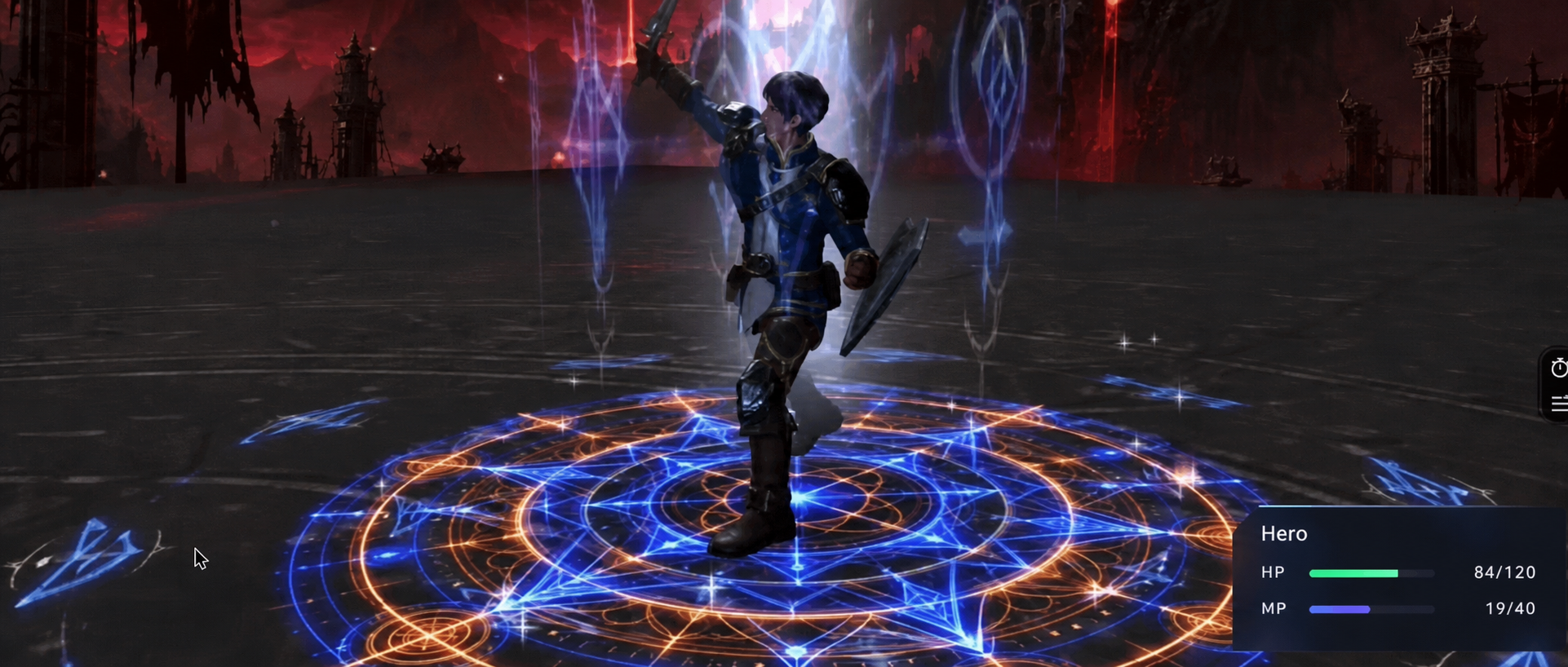
This preserved poster frame came from the source’s embedded video. It shows a different pose in the same capture-to-retarget sequence.
Review retargeted clips at half speed. Look for foot sliding, knee inversion, shoulder collapse, hand intersections, scale mismatch and root-motion drift. Fight animation also needs gameplay edits: anticipation, contact, recovery, cancel windows and hit timing. A captured dance can provide movement vocabulary, but it does not automatically become a readable attack.
5. Optimize the handoff to Three.js
Export a GLB/GLTF test asset early, before the Blender scene becomes elaborate. The official Three.js GLTFLoader documentation is the stable reference for loading these assets. Keep a small automated scene that loads every current export and reports missing textures, animation names and bounding dimensions.
The browser build needs budgets that the source article does not provide. At minimum, measure:
- compressed download size and first-interaction time;
- triangles, materials, draw calls and texture memory;
- CPU animation cost and GPU frame time on the weakest target device;
- the cost of transparent particles and overlapping emissive effects;
- fallback behavior when WebGL capability or memory is limited.
The source links a live effect-verification demo, which was reachable during review. Its existence shows the pipeline can produce a browser artifact; it does not by itself prove maintainability, asset rights or stable performance across devices.

The source’s final embedded-video poster shows the prototype’s combat HUD and spell effect. Japanese text at the bottom reports the character using a thunderbolt ability.
What a one-day prototype can—and cannot—prove
A day is enough to answer a narrow question: can these assets, this motion and this effect language coexist in a browser scene? It is not enough to establish a production pipeline. The next milestone should be a vertical slice with one character, one enemy, one attack and one target device, all passing explicit budgets.
That slice should preserve provenance, reproduce exports from saved inputs, survive a clean checkout, and hold frame time under stress. If it does, the AI-assisted workflow has become more than a demo. It has become an engineering system that can be improved.
Sources
- Original WeChat article: AI for Frontend, July 10, 2026
- Blender MCP repository
- Anthropic: Claude Fable 5 availability
- Anthropic: Claude Sonnet 5
- OpenAI: GPT Image 2 model documentation
- Microsoft Research and collaborators: TRELLIS.2 project
- ComfyUI-Video2MotionCapture repository
- Adobe: Mixamo FAQ
- Three.js: GLTFLoader documentation