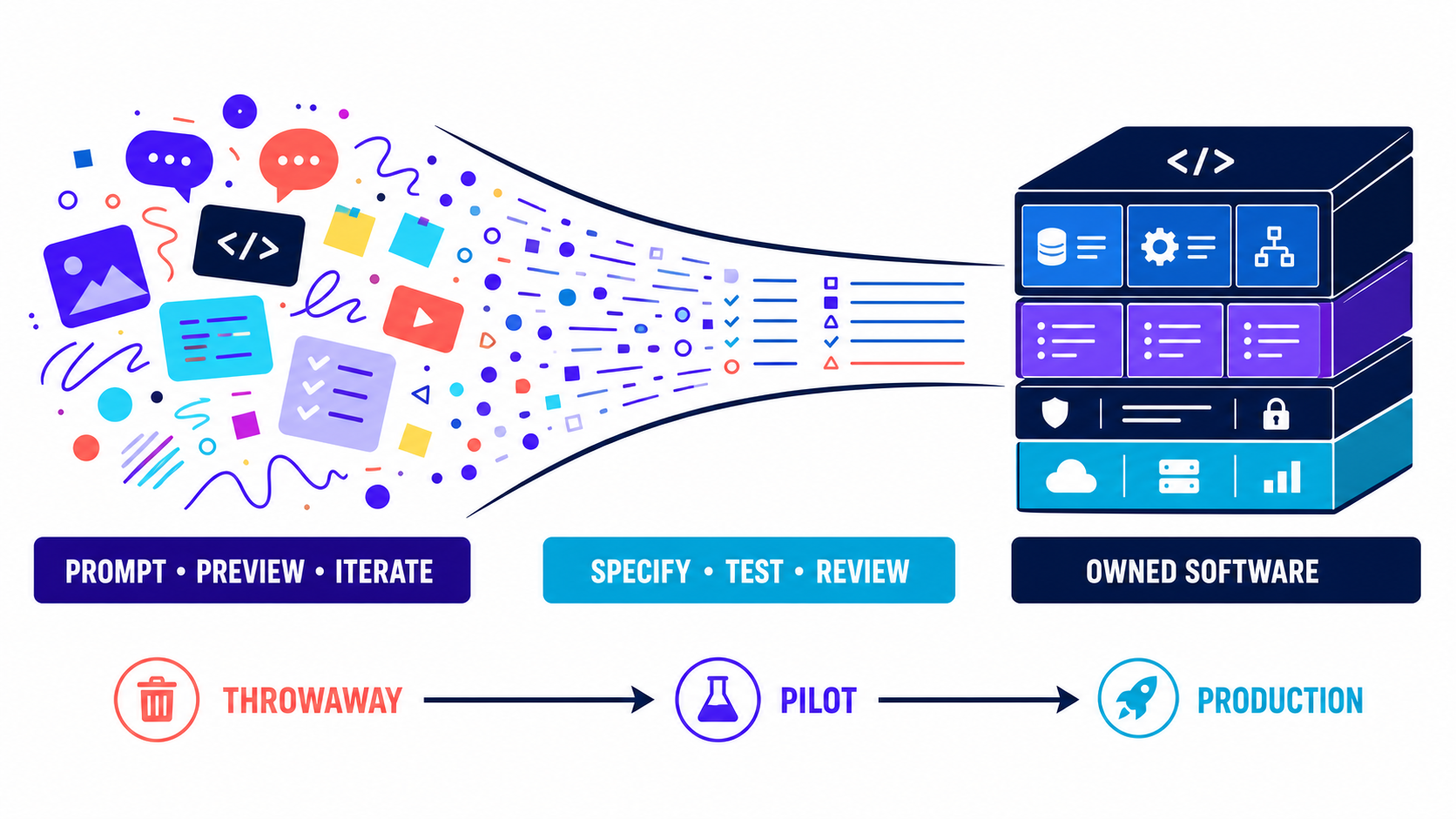
Vibe coding means directing an AI to build software through natural-language prompts, running what it produces, and steering by visible results while paying little attention to the generated code. Andrej Karpathy coined the term in a February 2025 post about accepting changes, pasting errors back, and letting the code grow beyond immediate comprehension. That original meaning is narrower—and more reckless—than simply using AI well.
In 2026, people also use “vibe coding” loosely for prompt-driven app builders and coding agents. Keep the distinction: a disposable prototype can be vibe-coded; production software becomes engineering when someone specifies behavior, inspects risk, verifies the change, and owns the result.
What Vibe Coding Means
The strict workflow is a conversational feedback loop:
- Describe a behavior or visual result.
- Let an AI model generate or modify the implementation.
- Run or preview the result.
- Report what looks wrong, or paste the error back.
- Repeat until the output feels acceptable.
The developer optimizes for observed behavior, not line-by-line authorship. Voice input, automatic edits, terminal agents and instant previews make the loop feel closer to directing than programming. That can lower the cost of exploring an idea, especially for a designer, founder or domain expert who can state the desired outcome but cannot implement the full stack alone.
It is not synonymous with AI-assisted software development. A developer who uses an agent to draft a patch, reads the diff, runs tests and rejects unsafe choices is exercising engineering judgment. The model wrote code, but the human still controls the specification and acceptance boundary.
Why Vibe Coding Became Popular
Three frictions fell at once. Models became better at coordinated multi-file edits. Tools gained access to terminals, browsers and project context. Hosted builders connected prompting to preview, databases and deployment. The time from “I wonder if this works” to an interactive artifact shrank from days to minutes for some tasks.
That speed changes who can participate. Product managers can test a workflow instead of writing a memo. Developers can create one-off migrations or internal utilities. Teams can put a rough interface in front of users before committing to an architecture.
But fast generation is not the same as faster professional work. METR’s early-2025 randomized study found experienced open-source developers took 19% longer on the measured tasks with then-current AI tools, despite expecting a speedup. The result is a historical snapshot, not a universal 2026 verdict. It does show why perceived momentum, generated lines and time-to-first-preview are weak productivity measures. Measure accepted, maintainable outcomes instead.
Where Vibe Coding Fits in Real Work
Use pure vibe coding when failure is cheap and recovery is obvious: throwaway demos, personal scripts without sensitive data, interface explorations, learning exercises and prototypes meant to answer one question. Delete the artifact when the question is answered unless it passes a deliberate promotion review.
Use a supervised prompt-driven workflow for internal tools and pilots. Freeze scope, work on a branch, use synthetic or sanitized data, add acceptance tests, keep a rollback point and assign a technical owner. The owner must be able to diagnose the system after the conversation context disappears. A maintained AI coding boilerplate can supply useful structure, but it does not transfer ownership away from the team.
Do not “accept all” for authentication, authorization, payments, secrets, destructive migrations, safety-critical behavior, regulated data or public infrastructure. These areas require explicit design, threat modeling and accountable review. The boundary depends on consequence, not whether the generated screen looks polished.
A practical promotion rule is: prototype by behavior; promote by evidence. Before a prototype becomes a product, inventory its dependencies, replace placeholder security, test failure paths, review data handling and document how to operate and reverse it.
Tools Commonly Used for Vibe Coding
No tool automatically makes a workflow safe or reckless. An AI app builder shortens the prompt-to-preview loop; it does not remove the need for review. The interaction mode and review discipline matter more than the label.
- Prompt-to-app builders: Replit Agent, Lovable, Bolt and v0 can turn descriptions into working interfaces or applications with short preview loops. Confirm current export, hosting, data and billing terms before choosing a platform.
- AI-native editors: Cursor and similar editors combine repository context, generated edits and diff review. They suit developers who want prompting without abandoning the codebase.
- Terminal coding agents: Claude Code, Codex CLI and other AI coding CLIs can inspect a repository, execute commands and propose broad changes. Terminal access increases both capability and blast radius.
- General model interfaces: chat tools can draft functions, explain errors and generate small artifacts, but manual copy-paste weakens provenance and makes it easier to miss related files.
Select a tool by the control loop you need: visible diff, command approval, sandboxing, checkpoints, test execution, repository export, audit logs and model/data policy. A one-click deployment is a convenience, not a security review.
When a task needs repository-wide planning or autonomous command execution, compare the broader operating model in Graphify's AI coding agent guide. Graphify maps tool, model and workflow relationships so a product label does not substitute for a risk decision.
Risks, Guardrails, and Code Review
The central vibe coding risk is an ownership gap: the artifact can work while nobody understands its trust boundaries, dependencies or failure modes. The OWASP Secure Coding Practices for AI-Generated Code warns about insecure output, hallucinated packages, hardcoded secrets, missing validation, excessive permissions and prompt-injection paths. Generated code belongs in the same—or stricter—review system as an external contribution.
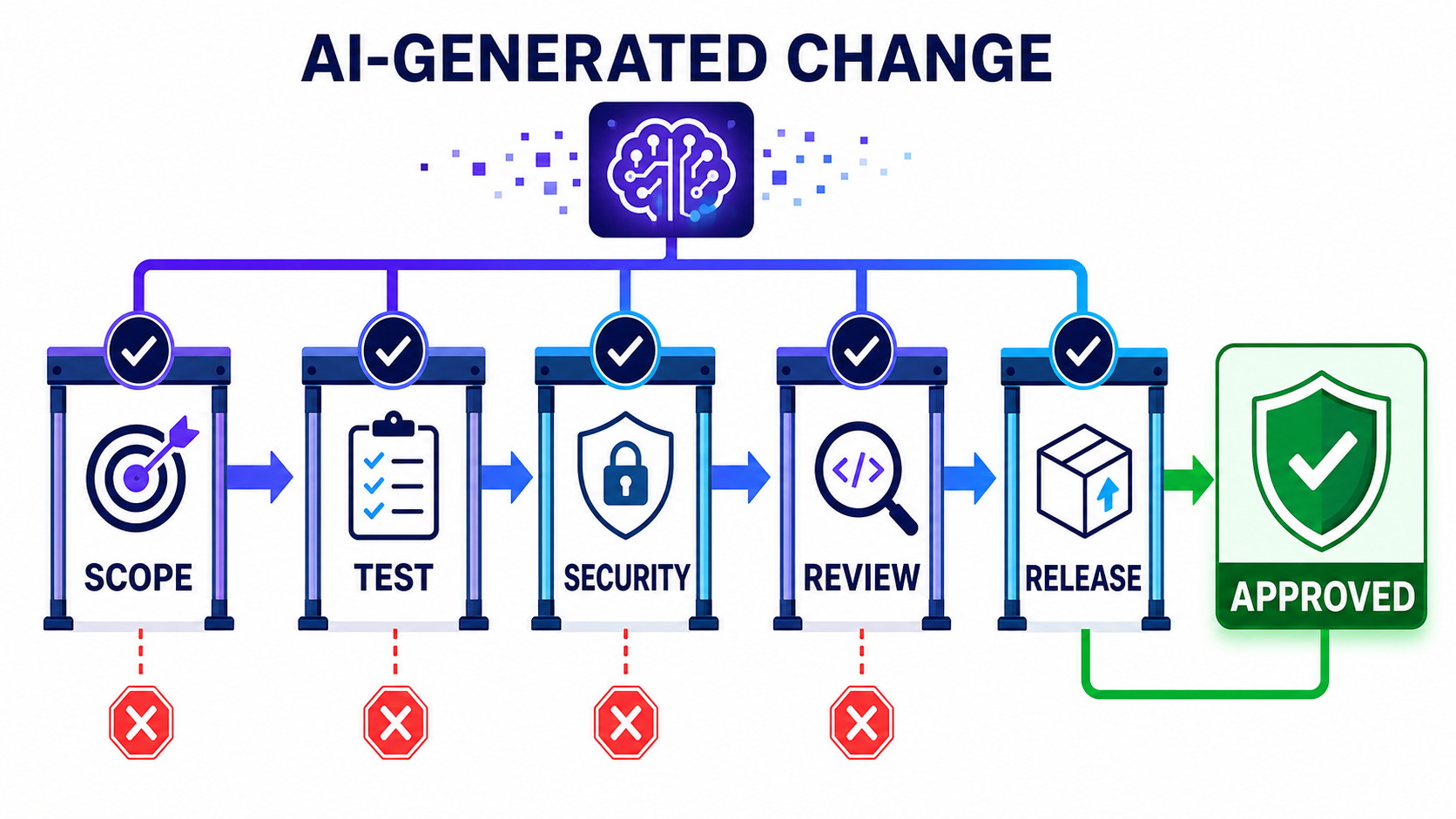
Use five release gates:
- Scope: require a small change, named files or boundaries, acceptance criteria and an explicit out-of-scope list.
- Test: run formatting, types, unit and integration tests; add a failing test that proves the requested behavior was missing.
- Security: scan dependencies and secrets, validate inputs, review permissions, and test authentication and authorization failures.
- Review: inspect the complete diff and generated configuration. A second human or independent model can assist, but the accountable reviewer must understand critical paths.
- Release: deploy gradually, watch errors and business invariants, retain a rollback, and record the prompt, model/tool version, commit and approvals needed to reconstruct the decision.
Checkpoints help iteration, but they are not equivalent to Git history, database backups or a tested rollback. Replit’s documentation, for example, notes that ordinary rollback does not restore a production database automatically. Treat application code, schema, data and deployment state as separate recovery surfaces.
For teams, define a promotion policy before experimentation starts. State which data may enter the tool, which repositories it may access, who can approve external commands, what evidence a pull request must include and which components prohibit autonomous changes. The policy turns an ambiguous “use AI carefully” instruction into a testable operating boundary.
FAQ
Who should review vibe-coded production changes?
The engineer who owns the affected system should review ordinary changes. Security, data, infrastructure or compliance owners should approve changes in their domains. A nontechnical builder can own product acceptance, but production approval needs someone capable of understanding the diff, validating failure modes and operating the result.
What tests should a team require before deployment?
Require the repository’s normal checks plus tests for the requested behavior, authorization boundaries, invalid input, dependency or network failure, data migration and rollback. For user-facing flows, exercise the critical path in a production-like environment. Test evidence should be attached to the change, not left only in an AI conversation.
How should teams document AI-generated code?
Keep the same durable records used for human changes: issue or specification, commit and pull request, architecture decisions, test results, dependency changes and approvals. Add the tool and model version, relevant project instructions and any material generated commands. Do not paste sensitive prompts or secrets into logs.
Conclusion
Vibe coding is a fast way to discover software by steering an AI through outcomes, often without reading the implementation. It fits disposable experiments and can open building to more people. It is not a production quality system. As consequence rises, narrow the scope, preserve checkpoints, inspect the diff, test behavior and failure, review security, assign ownership and retain a rollback. The useful 2026 workflow is not “vibes everywhere”; it is a controlled funnel from promptable idea to evidence-backed software.