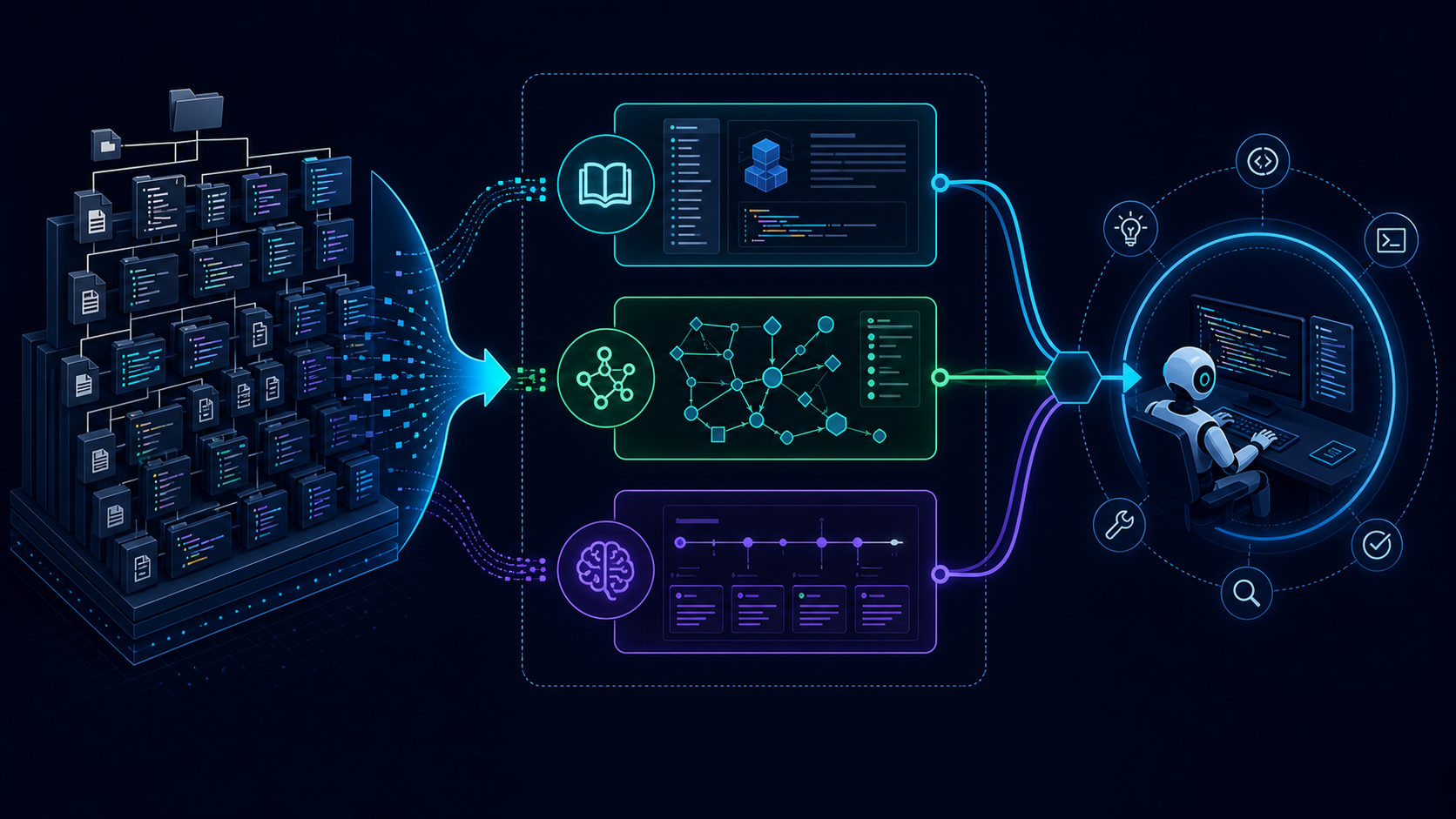
Code intelligence MCP servers give AI coding clients better evidence than a raw chat window can hold. Some retrieve current library documentation. Some package repository text. Some navigate symbols and references. Others preserve knowledge as a graph or scan code for quality and security findings.
No single server wins every task. Choose the context model that matches the question. Use Context7 for version-aware library docs, Serena for symbol-level repository work, a code index for retrieval, static-analysis servers for findings, and a knowledge graph when relationships and memory must survive across sessions.
Short answer: Documentation retrieval answers “How does this API work?” Symbol intelligence answers “Where is this behavior implemented?” Static analysis answers “Which rule is violated?” A knowledge graph answers “How are these code, document, and system entities connected?”
What Is a Code Intelligence MCP Server?
A code intelligence MCP server is an MCP implementation that exposes code or documentation operations as tools. The server may search an index, resolve a symbol, find references, retrieve versioned docs, package files, query a knowledge graph, or return scanner findings.
The key entity relationship is simple: an MCP client invokes a tool; the tool queries an evidence system; the server returns structured context; the model uses that context to plan or edit. Quality depends on what the evidence system represents and how fresh, scoped, and attributable its results are.
Which Code Intelligence MCP Server Should You Use?
Select by the question your agent must answer.
| Primary question | Context approach | Good starting points | Limitation |
|---|---|---|---|
| “What does the current library API require?” | Documentation retrieval | Context7 | Does not model your full codebase architecture |
| “What files should enter the prompt?” | Repository packaging | Repomix | A snapshot loses live symbol semantics |
| “Where is this symbol defined and referenced?” | Symbol/LSP intelligence | Serena, Sourcegraph, code index | Requires indexing or language support |
| “What does this repository do?” | Repository documentation | DeepWiki-style systems | Generated docs can lag the source |
| “What relationships persist across sessions?” | Graph memory | Graphiti, Cognee, Graphify | Ingestion and update policy matter |
| “Which defect or vulnerability is present?” | Static analysis | SonarQube, Semgrep, Snyk | Findings still need triage and context |
The best stack often combines two layers. Fresh external docs plus symbol-aware local code navigation is more reliable than either alone.
How Does Context7 MCP Improve Documentation Retrieval?
Context7 MCP retrieves current, version-relevant library documentation and examples. Its official repository describes two core MCP tools: one resolves a library name to a Context7 library ID, and another queries documentation for that ID. Supplying an exact library ID or version reduces ambiguity.
The existing Context7 MCP profile remains canonical for context7 mcp, context7-mcp, mcp context7, context7 mcp server, and configuration details. The profile also owns queries such as context7 mcp documentation, context7 mcp official docs, and context7 mcp server documentation.
Use Context7 when the failure mode is stale training knowledge: removed methods, changed configuration keys, or version-specific APIs. Cite the retrieved library and version in the final answer. Do not treat community-contributed documentation as infallible; verify security-sensitive behavior against the library owner's docs.
When Is Serena MCP Better Than Text Search?
Serena MCP exposes semantic code retrieval, editing, refactoring, and debugging operations at the symbol level. Its official repository explains that it can use Language Server Protocol backends or a JetBrains plugin to understand symbols and relationships.
Use the existing Serena MCP profile for the canonical serena mcp, serena mcp server, and mcp serena installation details.
Serena is strong when a task requires:
- Finding a symbol without reading the whole file.
- Listing references before a change.
- Understanding type or implementation relationships.
- Editing a symbol body rather than applying brittle line-based replacement.
- Preserving project memory across a longer coding workflow.
Text search remains faster for an exact literal or tiny repository. Symbol intelligence pays off when the codebase is large, names are overloaded, or a refactor crosses files.
What Do Code Index MCP and Sourcegraph MCP Provide?
A code index MCP exposes an indexed representation of a repository. The exact tools vary, but useful servers support file discovery, lexical or semantic search, symbol lookup, reference traversal, and incremental refresh. Search variants code index mcp and code-index-mcp should resolve to one canonical comparison section, not two pages.
Before adopting an implementation, test five properties:
- Freshness: how quickly do commits enter the index?
- Scope: can it isolate repository, branch, and tenant?
- Semantics: does it understand symbols or only chunks?
- Evidence: does every result include file, range, revision, and retrieval method?
- Operations: can you rebuild, inspect, and delete the index?
Sourcegraph MCP belongs to the same broad category but may connect to a larger code search and intelligence platform. Validate current MCP availability and supported operations in Sourcegraph's official documentation before planning a rollout; product integration details can change faster than the general selection framework.
Where Do DeepWiki and Repomix Fit?
deepwiki mcp and deepwiki mcp server represent repository-explanation intent. A DeepWiki-style system turns a repository into navigable documentation and answers. It is useful for orientation, but any generated explanation should link back to the exact revision and source files.
repomix mcp represents repository-packaging intent. Repomix-style tools collect selected files into an AI-friendly artifact. Packaging is simple and portable, but a packed snapshot has three limits: it can exceed the context budget, become stale, and flatten relationships that a symbol graph preserves.
Use packaging for bounded review or handoff. Use an index for repeated retrieval. Use symbol intelligence for navigation and refactoring.
How Do Graphiti, Cognee, and Knowledge-Graph MCP Differ?
graphiti mcp and graphiti mcp server target temporal or evolving graph memory. Graphiti's official repository describes a system that builds and queries knowledge graphs for AI agents, with relationships that can change over time.
cognee mcp server targets persistent AI memory constructed from ingested data. Cognee's official repository exposes memory-oriented operations and an MCP server path within its broader data and graph stack.
The generic queries knowledge graph mcp, mcp knowledge graph, knowledge graph memory, and knowledge graph memory mcp describe a pattern, not one product. A useful knowledge-graph MCP implementation should expose:
- Entity and relationship provenance.
- Time or revision boundaries.
- Upsert, deletion, and conflict rules.
- Tenant and dataset isolation.
- A way to explain which source supports each edge.
Graph memory does not replace repository truth. It accelerates reasoning by preserving relationships; the agent should still verify a proposed code change against the current branch.
Where Does Greptile MCP Fit?
greptile mcp represents hosted repository intelligence and code-review context. Treat Greptile as a product-specific option whose current tool surface, repository permissions, and retention policy must be verified in official documentation. The comparison questions remain stable: what gets indexed, which revisions are searchable, how evidence is cited, and whether the service can delete stored code.
For private repositories, include data residency, model-provider access, retention, and organization-level authorization in the review—not only search quality.
How Do SonarQube, Semgrep, and Snyk MCP Servers Differ?
Static-analysis MCP servers expose findings, rules, locations, and sometimes remediation actions. They should complement, not replace, their underlying scanners.
| Server category | Evidence | Best use | Guardrail |
|---|---|---|---|
| SonarQube MCP | Quality and security findings from analyzed projects | Explain issues, inspect quality gates | Pin project and branch |
| Semgrep MCP | Pattern and data-flow findings | Search rules, triage findings, explain matches | Keep rule and engine version |
| Snyk MCP | Vulnerability and code-security findings | Prioritize and remediate security issues | Preserve severity, dependency, and path evidence |
Keyword variants such as sonarqube mcp, sonarqube-mcp-server, sonarqube mcp server, and mcp sonarqube belong to one entity cluster. The same is true for semgrep mcp and semgrep mcp server, and for snyk mcp and snyk mcp server.
Require the server to return the scanner source, rule ID, file and range, revision, severity, and a stable finding identifier. A model-generated explanation without those fields is advice, not a verified finding.
How Should You Combine Documentation, Code, and Memory?
Use a layered retrieval plan. Each layer answers a different kind of question and supplies a different evidence type.
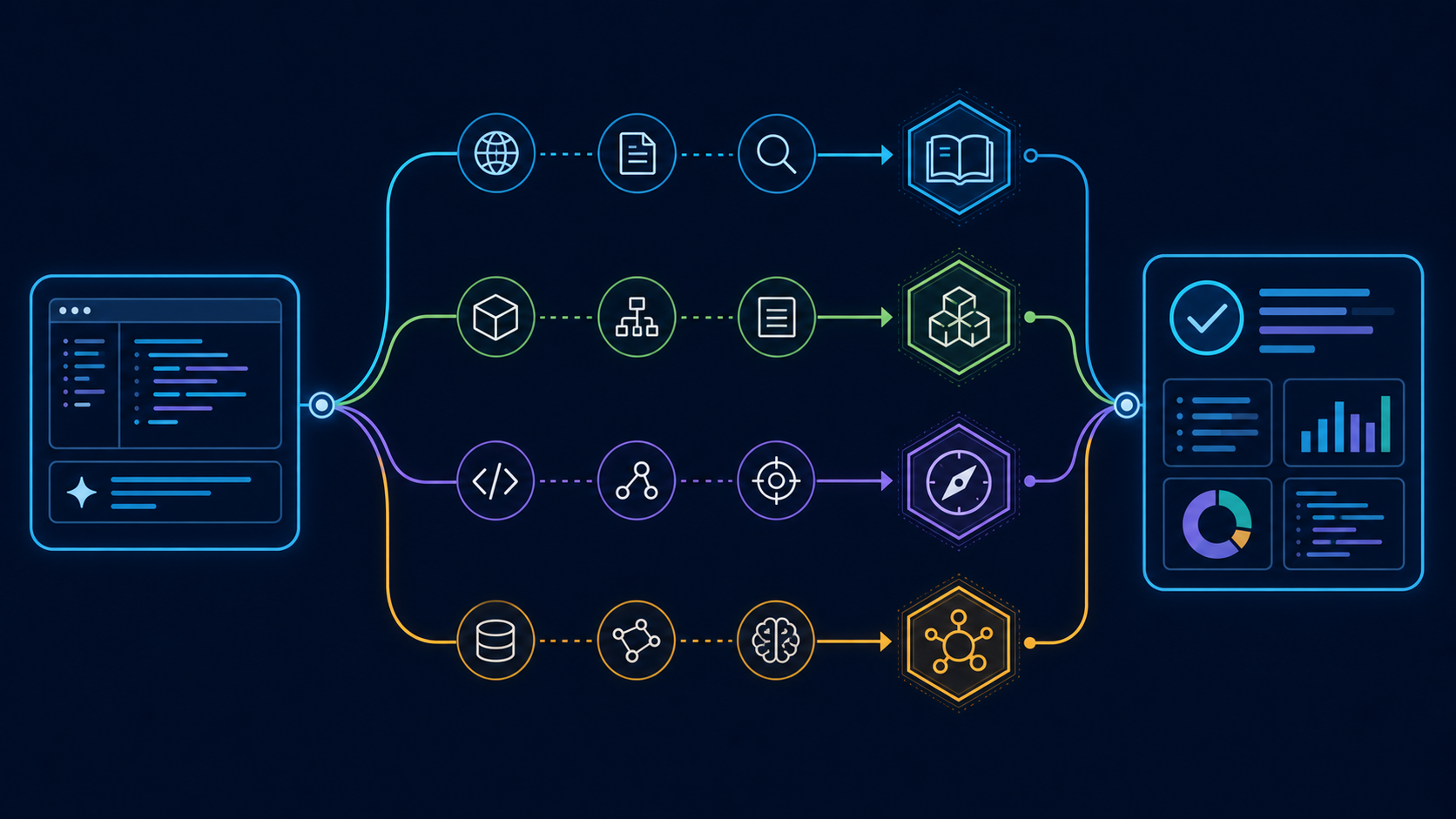
- Clarify the task. Identify target repository, branch, library version, and expected output.
- Retrieve external contracts. Use current official or Context7 documentation for APIs and frameworks.
- Inspect local structure. Use symbol or index tools to find definitions, references, tests, and configuration.
- Consult memory. Use graph memory for prior decisions, architecture relationships, and cross-artifact context.
- Verify with scanners and tests. Static analysis and tests check the proposed change.
- Cite evidence. The answer names the revision, files, symbols, docs, and findings it used.
This sequence reduces a common error: applying a correct current API example to the wrong part of the local architecture.
How Can You Evaluate Code Intelligence MCP Servers?
Create a benchmark from real repository tasks and keep the expected evidence set hidden from the tool under test.
| Task | Success criterion |
|---|---|
| Locate implementation | Finds the correct symbol and revision |
| Trace impact | Finds callers, tests, and configuration |
| Answer versioned API question | Cites the right library version |
| Explain architecture | Links claims to code and documents |
| Detect stale index | Reports revision mismatch instead of guessing |
| Triage a finding | Preserves scanner rule and location |
| Reject cross-tenant request | Returns no unauthorized evidence |
Measure precision, recall, citation completeness, context tokens, latency, freshness delay, and authorization failures. Also run a no-tool baseline. The server earns its place only if it improves task outcomes enough to justify its context and operational cost.
Where Does Graphify Add Unique Value?
Graphify is a knowledge-graph layer for AI coding assistants. It connects code, documents, and design artifacts into queryable structures so an agent can reason about a complex system instead of treating the repository as unrelated chunks.
That makes Graphify complementary to the tools in this guide:
- Context7 supplies fresh external library facts.
- Serena supplies precise symbol operations.
- Static analyzers supply verified findings.
- Graphify supplies cross-artifact structure and relationships.
For a large codebase, the strongest workflow combines these evidence types and keeps provenance attached. The model can then explain not only what to change, but why the change belongs in that subsystem and what it may affect.
Frequently Asked Questions
Is code index MCP the same as a knowledge graph MCP?
No. A code index optimizes retrieval over code artifacts. A knowledge graph stores explicit entities and relationships, often across code, documents, and decisions. Some products combine both, but the data models and query guarantees differ.
Is Context7 MCP enough to understand my repository?
No. Context7 is strongest for external library documentation. Pair it with repository search, symbol intelligence, or a code knowledge graph for local architecture and implementation evidence.
Is Serena MCP a code index?
Serena can retrieve code semantically through language-aware tooling, but its value is broader than a generic text index: it exposes symbol relationships and structured editing/refactoring capabilities.
Can graph memory become stale?
Yes. Every stored entity and relationship needs source provenance and a revision or time boundary. Re-index changed artifacts and delete invalid edges instead of allowing memory to silently diverge from the repository.
Should a scanner MCP server be allowed to edit code automatically?
Default to read and propose. Let the agent prepare a patch, then run tests and the underlying scanner before approval. An MCP explanation is not proof that a remediation is safe.
Final Recommendation
Choose by evidence model. Use documentation retrieval for external contracts, symbol intelligence for local code, static analysis for verified findings, and a knowledge graph for system relationships and durable memory. Then evaluate the combined stack on real tasks with revision-aware citations. More context is useful only when it is current, scoped, attributable, and connected to the decision.