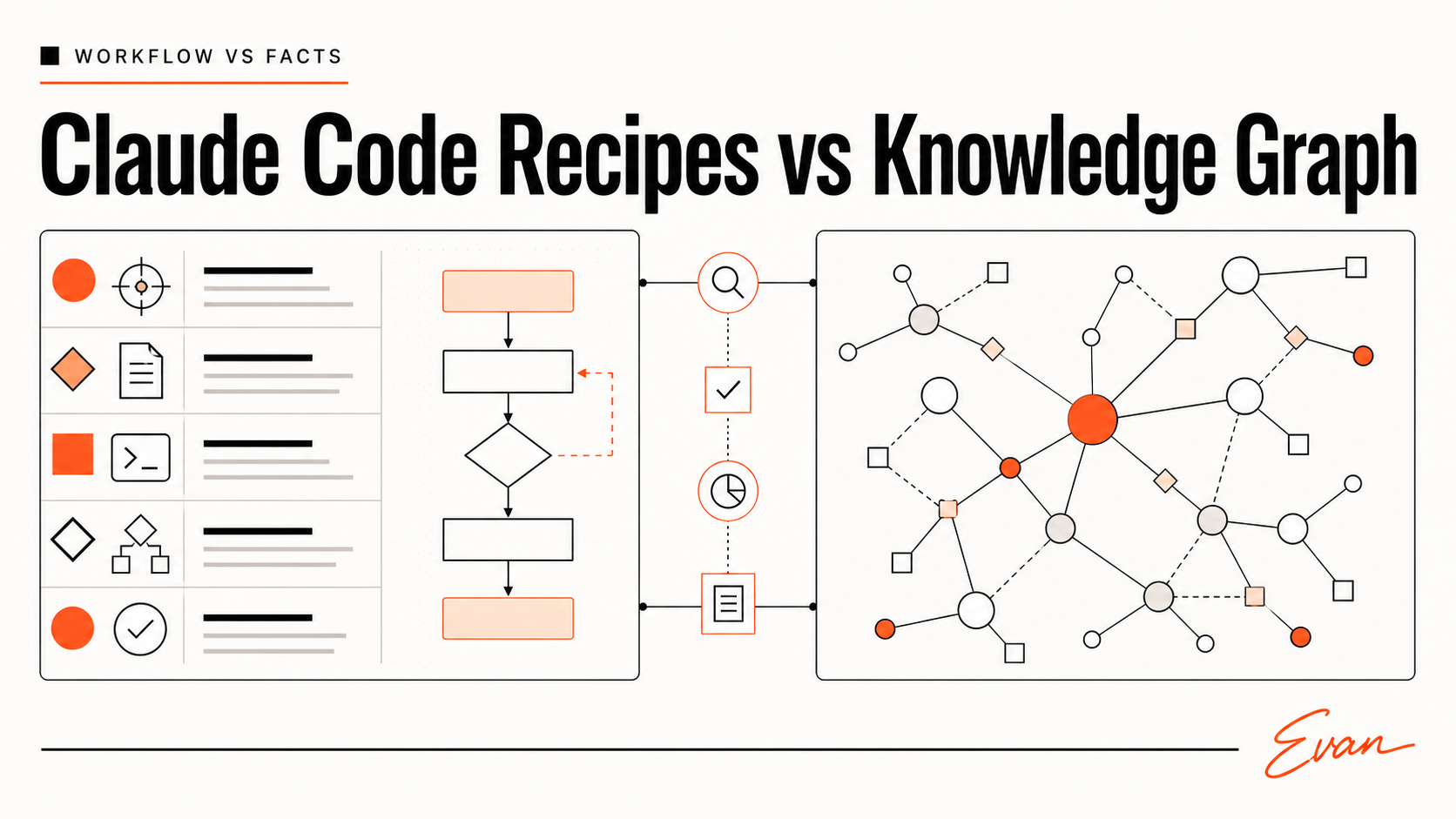
Claude Code recipes and a knowledge graph solve different problems. A recipe controls the sequence of work and the evidence format. In current Claude Code terms, a reusable executable recipe is normally a Skill, not an official feature called “Recipes.” A code knowledge graph, if a team operates one, supplies queryable structural claims such as module, dependency, call, and test relationships. It remains external unless connected through MCP, a CLI, or another tool.
The useful design is not recipe or graph. It is a procedure that queries the smallest relevant context layer, checks provenance and freshness, and verifies consequential claims against source.
Quick Verdict
For Claude Code recipes vs knowledge graph decisions, use the smallest layer that can answer the question:
For coding agent context, this means separating stable instructions, reusable procedure, queryable structural facts, and current verification evidence.
| Layer | Primary job | Appropriate content | Failure signal |
|---|---|---|---|
| Recipe / Skill | Control procedure | steps, scope questions, evidence schema, stop conditions | repeated but unsupported answer |
CLAUDE.md / rules |
Supply stable guidance | conventions, commands, local architecture constraints | stale or over-broad instruction |
| Code knowledge graph | Supply structural facts | source-attributed entities and relationships at an indexed revision | missing, false, or stale edge |
| Source and tests | Verify current behavior | implementation, configuration, assertions, runtime fixtures | contradictory or incomplete evidence |
The recipe should decide when to inspect source, invoke code intelligence, or ask a graph for candidates. It should not embed a mutable dependency map. The graph should answer relationship questions with provenance. It should not decide the team's review sequence or risk tolerance.
This is also why neither a large prompt nor a large graph removes judgment. Procedure quality and context quality are independent variables. For a broader view of the fact layer, see knowledge graphs for AI coding assistants. For the cost of repeatedly rebuilding context, see Claude Code repeated repository scanning.
What Recipes Control
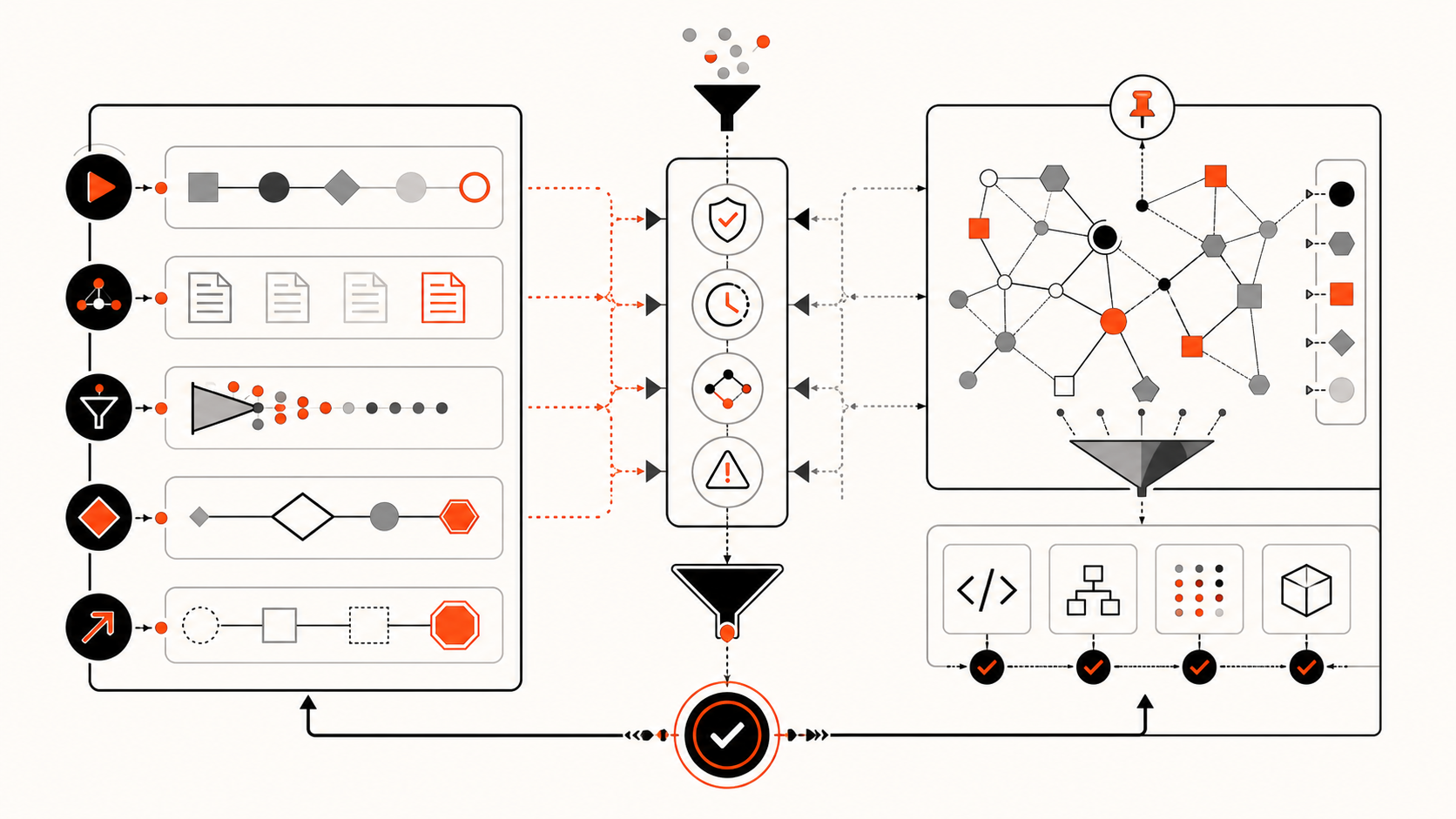
Here, “recipe” means an editorial workflow pattern for coding agent context. Anthropic documents reusable prompt-based workflows as Skills; legacy custom commands have been merged into that surface. A recipe can require Claude to:
- confirm a target, repository revision, and excluded paths;
- start from definitions or executable entry points;
- separate direct evidence, inference, and unknowns;
- return files, symbols, relationship types, and relevant tests;
- reverse-check one important edge;
- stop when dynamic behavior or unavailable tooling prevents a reliable answer.
Those requirements change agent behavior even when no graph exists. They make a source-reading run more disciplined and a graph-backed run more auditable.
Searches for “Claude Code recipes vs knowledge graph Reddit” can inspire workflow questions, but community examples do not establish current product behavior or graph accuracy.
A community comparison can treat the recipe as a better prompt. That framing is too narrow for engineering use. The important artifact is an owned contract: what question may be answered, which evidence is acceptable, and what must be escalated. Community examples may inspire wording, but they are not factual sources for current product behavior.
Recipes are especially useful for consistency. Two reviewers can compare outputs when both runs use the same fields and stop conditions. But consistency is not correctness. A recipe that tells an agent to “find all callers” without defining static, configured, generated, and runtime-dispatched relationships can produce the same category error every time.
What Knowledge Graphs Provide
Searches for “Claude Code recipes vs knowledge graph Reddit” often compare prompts with indexes; the engineering distinction is between workflow control and verifiable repository facts. A code knowledge graph models repository entities and typed relationships. Depending on the implementation, entities may include files, symbols, modules, services, schemas, tests, or owners. Edges may represent imports, calls, registration, production or consumption of an event, reads or writes, test coverage, or deployment coupling.
The operational value is not the graph label. It is the ability to ask a bounded relationship question and receive:
- the source and target entities;
- a specific relation type and direction;
- source locations or extraction evidence;
- the indexed repository revision;
- confidence or extraction method where relevant;
- explicit absence or uncertainty rather than a fabricated path.
That structure can make reverse dependency and multi-hop candidate discovery cheaper than rereading broad parts of a monorepo. It also lets different workflows query the same repository-fact layer instead of copying maps into prompts.
However, a graph represents what its ingestion and extraction can see. Dynamic registration, reflection, generated artifacts, runtime configuration, cross-repository services, and data-dependent paths may be incomplete. A graph edge can be stale or wrong. A missing edge is not proof that no relationship exists.
Graphify can be considered as one possible external code-graph layer in this architecture, not a native Claude Code capability. Evaluate any such layer by source coverage, provenance, refresh behavior, query controls, and how easily a reviewer can return from an edge to the pinned code revision.
How Recipes Query Context Layers
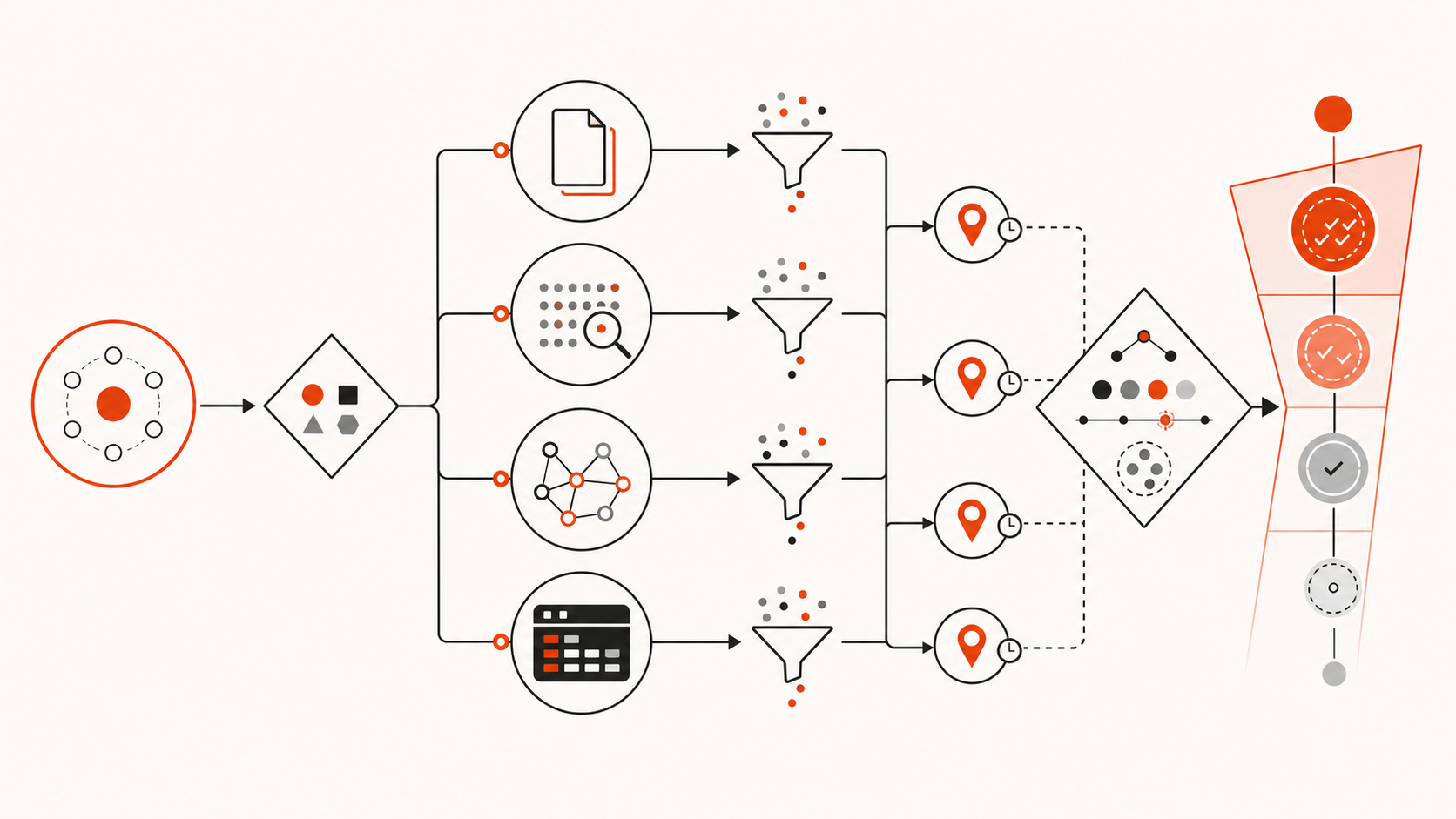
Treat retrieval as a decision tree rather than “search everything.” A useful recipe follows four stages.
1. Classify the question. Stable convention questions may be answered from scoped CLAUDE.md guidance. Definition and reference questions are good candidates for code intelligence. Reverse dependencies or repeated cross-module impact questions may justify a graph query. Runtime behavior may require tests, logs, configuration, or a human owner.
2. Request the smallest evidence set. Ask for one target and one relation type. Include repository revision and scope. A graph query for “direct consumers of schema X at commit Y” is more auditable than “explain everything affected by X.”
3. Qualify the response. The recipe should preserve relation type, source, indexed revision, and unknowns. It should not translate all results into an undifferentiated dependency list.
4. Verify by risk. Reopen the source for high-impact edges, reproduce a code-intelligence lookup, or execute an appropriate existing test. Verification effort should rise with security, data, compatibility, or deployment consequences.
Anthropic's large-repository guidance explicitly suggests exposing an existing search or RAG index through MCP when layered instructions no longer scale. That is an integration pattern. The Skill invokes the tool; the external system owns indexing and graph freshness; the repository remains the final evidence surface.
Where Each Approach Breaks Down
A recipe breaks down when its procedure is vague. “Analyze the codebase” has no scope or finish condition. “Find all callers” can hide unsupported completeness. A recipe can also become stale when paths, tool names, or output expectations change.
A recipe also breaks down when it hides missing context. Strong formatting can make weak evidence look finished. Require an unknowns section, source citations, and at least one independent check.
A graph breaks down when extraction or freshness is weak. A precise-looking edge from an old commit is still stale. An incomplete language parser or ignored generated layer can omit consequential relationships. Store and display revision, extraction time, and provenance.
The combined system breaks down at the seam. The recipe may query the wrong relation, omit the revision, or treat candidates as verified facts. The graph may answer correctly but use vocabulary the recipe collapses. Test that interface with known positive, negative, and dynamic cases.
Log the query schema and adapter version with each result. A workflow can remain textually unchanged while a graph API renames an edge, changes traversal defaults, or broadens access. Compatibility tests should fail on an unknown relation rather than silently converting it into a generic dependency.
Finally, avoid centralizing authority in either layer. Module owners should be able to challenge graph relations, workflow owners should revise procedures, and reviewers should reject conclusions that cannot be traced to current evidence.
FAQ
Can recipes hide missing context?
Yes. A rigid template can turn incomplete retrieval into a polished report. Require each result to state scope, repository revision, evidence sources, excluded paths, and unknowns. Add a stop condition when the requested completeness cannot be supported.
Who owns graph-backed recipe quality?
Ownership is shared but separable. The workflow owner maintains query choice and evidence rules. The graph owner maintains ingestion, schema, provenance, and freshness. Repository owners validate consequential relationships. One person may fill multiple roles, but the checks should remain distinct.
When should recipes be rewritten?
Rewrite them when the reader job, repository boundary, available tools, evidence schema, or recurring failure mode changes. Refresh a graph when facts change; do not rewrite a procedure merely to conceal stale graph data.
Does Claude Code see AGENTS md?
Claude Code's documented instruction file is CLAUDE.md. Anthropic's memory documentation describes a compatibility pattern in which CLAUDE.md imports @AGENTS.md. That makes the shared content available through Claude's import mechanism; it is not the same as treating AGENTS.md as the native instruction filename.
Conclusion
In Claude Code recipes vs knowledge graph, the recipe owns workflow control and the graph owns queryable structural claims. Keep both bounded and versioned. Ask the procedure to retrieve only relevant relations, preserve provenance and unknowns, and verify high-impact edges against source or tests before acting.
Leave a Reply