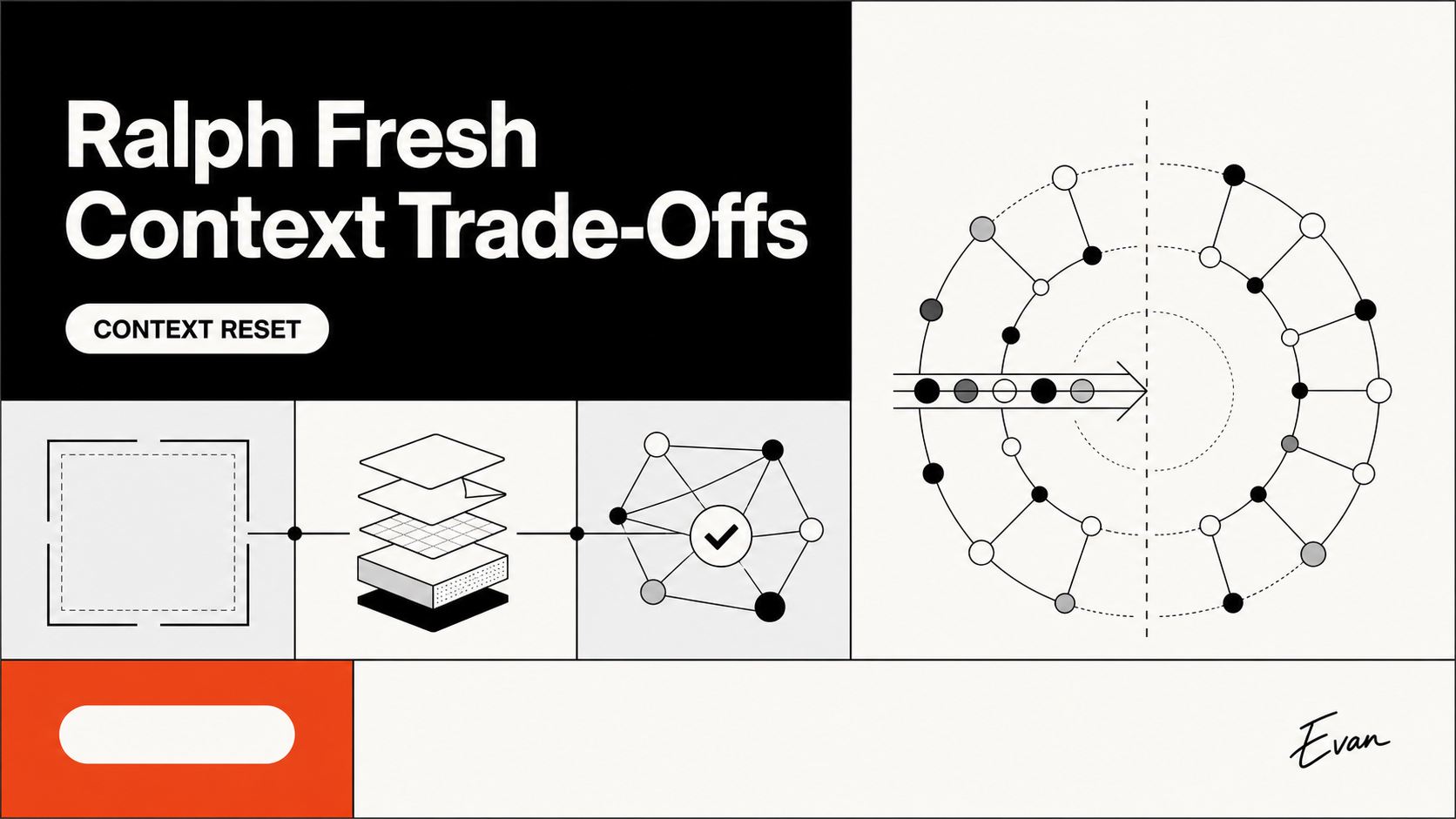
A long agent session can become an unreliable map of the repository. It contains earlier file contents, rejected hypotheses, transient failures, and instructions that may no longer match the current task. Resetting the conversation appears to solve that problem, but a clean window can also erase the reasoning that prevented a dangerous edit.
Ralph fresh context is useful only when durable project artifacts carry the right knowledge forward. The engineering question is not whether old chat is good or bad. It is which information should be re-read from current source, which should persist outside the conversation, and which should disappear at the next iteration.
What Fresh Context Solves
In a Ralph fresh context loop, a reset reduces commitment to an obsolete narrative. The next iteration can inspect the current plan, source, Git history, and test output without also weighing every abandoned approach from the previous session. In Geoffrey Huntley’s original Ralph description, each loop receives a new context window and works through a stable plan with tests, builds, or static analysis providing backpressure.
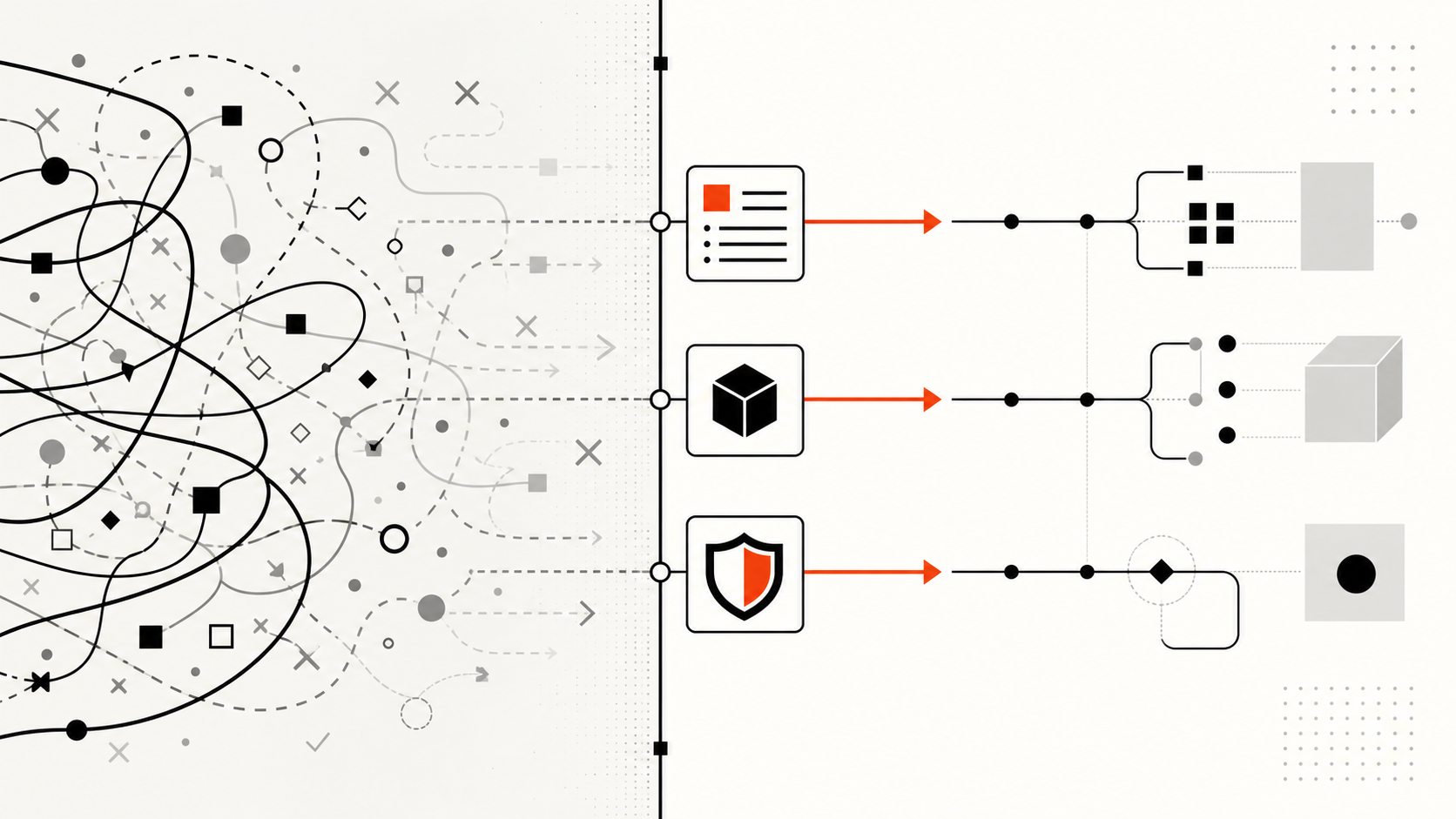
The snarktank loop creates a concrete process boundary by launching a new Amp or Claude process for each iteration. That can make failures easier to isolate and encourage the agent to rely on repository artifacts rather than an expanding chat transcript.
A coding agent context reset also creates an inspection point. Teams can define exactly what the next iteration receives: a task specification, applicable repository rules, a short progress handoff, current source, and recent validation results. If that set is too large or too vague, the problem is visible before the next prompt begins.
What It Can Lose Between Iterations
A coding agent context reset can discard useful observations that are not already in the code. An iteration may discover that a generated client must be refreshed, a flaky integration test needs a particular fixture, or a symbol with an obvious name is not the real entry point. If the observation remains only in conversation, a clean reset can force the next loop to relearn it.
The more serious loss is rationale. Source shows what exists, but not always why a constrained choice was made or why a plausible alternative failed. Git history may help, yet commit messages are rarely a complete operational handoff. A concise task note can preserve the evidence and scope of a decision without carrying the full transcript.
Fresh context can also hide an unresolved assumption. The previous iteration may have decided that a search result proved a feature was missing. If that inference is summarized as fact, the reset removes the uncertainty while preserving the conclusion. Handoffs should distinguish verified facts, hypotheses, failed attempts, and pending checks.
A Ralph fresh context review should record which observations were lost, which were promoted into durable artifacts, and which still require verification. That review makes reset quality inspectable instead of treating a clean window as success by itself.
Persistent Memory vs Conversation Carryover
Conversation carryover is easy but weakly structured. Its lifetime is tied to a session, its scope can be unclear, and later turns may treat old statements as current. Persistent memory can be smaller and more explicit: task status, reviewed repository rules, committed code, test results, and structural findings with provenance.
The distinction is implementation-specific. Anthropic’s official Ralph Loop plugin uses a Stop hook to continue inside the current Claude Code session. That is not the same reset boundary as snarktank’s new process. Teams should test their actual tool rather than infer session behavior from the Ralph name.
Persistence also needs ownership. An agent can update branch-local progress, but durable project rules should require review. Derived code relationships should be rebuilt or checked against current source. Secrets and private prompt content should not flow into a shared log merely because it is convenient.
A practical Ralph fresh context review asks three questions: what artifact will survive, what makes it authoritative, and what event makes it expire? If any persisted item lacks those answers, it is likely to become stale context in a different form.
Repository Knowledge That Should Survive
The task specification and acceptance criteria should survive unchanged unless the authorized owner revises them. Current code and commits should remain the primary implementation record. The next iteration also needs the applicable build, test, and formatting commands, plus directory-scoped rules such as those supported by the AGENTS.md specification.
Verified structural knowledge may also deserve persistence: module ownership, interface implementations, downstream consumers, test mappings, and entry points. A code graph can provide that orientation layer if each result cites the file, symbol, commit SHA, and index version. Graphify is one possible codebase graph layer; its output should be treated as candidate context and confirmed in source.
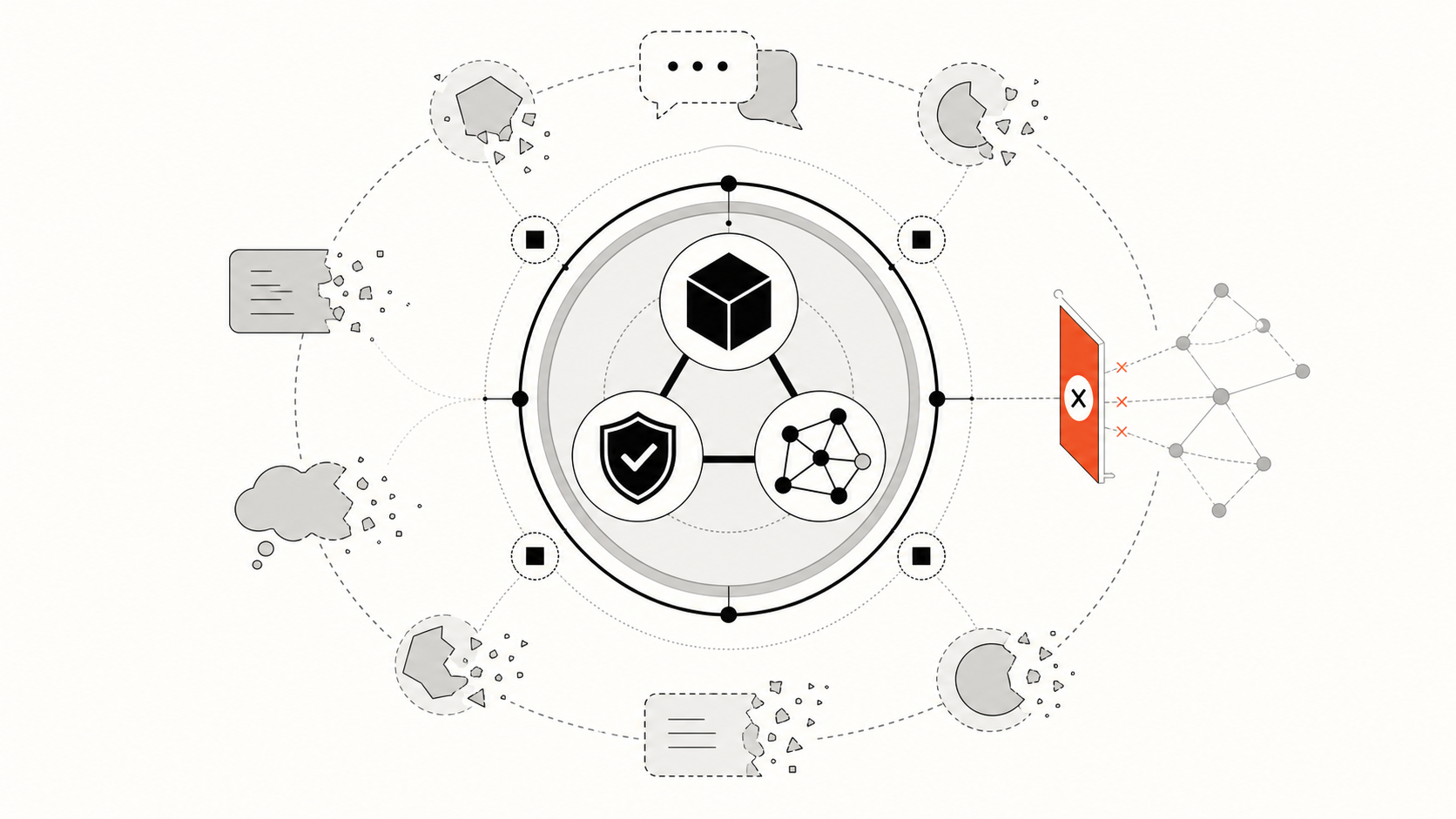
Short-lived experience can survive in an active task handoff. Record the failed command, the observed result, and the next check rather than a broad conclusion. Once a lesson is shown to recur and its scope is understood, it may be promoted into reviewed project guidance.
The full conversation usually should not survive by default. Retain it for audit when required, but feed the next iteration a curated set of durable artifacts. A smaller handoff makes contradictions easier to see.
Cost, Drift, and Review Risks
Resets are not free. Re-reading files, rerunning discovery, and reconstructing architecture consume time and context. If several iterations open the same modules before every edit, the team has probably under-specified the durable orientation layer. Measure that repetition before adding a large memory system.
Persistence creates the opposite risk: drift. A progress note can outlive its branch, a project instruction can stop matching the build, and a graph can describe an earlier commit. Tie active task state to task or branch identity, review instructions when they are contradicted, and invalidate structural results when provenance no longer matches.
Reviewers should inspect what crossed the reset boundary, not only the final diff. Ask whether each carried statement is fact, inference, or instruction; whether its source is current; and whether it grants more write scope than the task allows. This is especially important for security boundaries, migrations, and public APIs.
Finally, avoid treating passing tests as complete proof. Tests are essential backpressure, but they only cover what the suite exercises. Source inspection, scoped search, type checks, and human review remain necessary when the change affects relationships that the test suite may not encode.
FAQ
What should survive a reset?
Keep the authorized task, current repository state, applicable reviewed rules, relevant test results, and verified findings that the next iteration would otherwise have to rediscover. Include provenance and expiration for structural or operational notes. Do not preserve every hypothesis merely because it appeared in the earlier session.
How should teams inspect carried memory?
Use a small, typed handoff. Label facts, hypotheses, decisions, failures, and pending checks. For each material fact, cite current source, a commit, test output, or another authoritative artifact. Review who can write each layer and reject entries whose scope or freshness is unknown.
When is a clean reset safer?
It is safer when the current session is dominated by stale file contents, contradictory instructions, repeated failed approaches, or an unrelated prior task. Before resetting, persist only the verified state needed to continue. If critical rationale cannot be reconstructed from durable artifacts, repair the handoff first.
What is the Ralph method of AI?
Ralph is a repeated coding-agent workflow in which a stable task or plan drives successive implementation attempts and executable checks provide feedback. It is a pattern with multiple implementations, not a single required session model. Fresh-process, fresh-window, and same-session hook loops should not be conflated.
Conclusion
Ralph fresh context is a control over attention, not a substitute for memory design. It can reduce old-chat pollution and loosen attachment to a failed approach. It can also erase architecture, rationale, and unresolved uncertainty when those exist only in the conversation.
Define the reset boundary for the implementation you actually run. Preserve a small set of typed, scoped, and verifiable artifacts; let temporary hypotheses expire; and check current source before acting on carried knowledge. For the structural layer, see knowledge graphs for AI coding assistants. For a practical response to repeated discovery, see how to stop Ralph rereading the repository.
Leave a Reply