A loop can keep an agent moving without keeping it oriented. On a small repository, reopening a few files may be enough. On a large codebase, the agent must repeatedly recover module ownership, call paths, test boundaries, generated surfaces, and local conventions before it can make a safe edit. That recovery cost is easy to mistake for implementation work.
The Ralph pattern makes this tension visible because it deliberately repeats an implementation cycle. Geoffrey Huntley’s original description uses a simple outer loop, a stable plan, one task per iteration, and tests or builds as backpressure. It does not prescribe a universal repository-memory system. A practical Ralph Loop large codebase workflow therefore needs a separate answer to a narrower question: what repository context should each iteration recover, and how should it verify that context before writing?
Why Ralph Loops Repeat Repository Search
Each iteration begins with an information deficit. The task may be durable, but the agent still needs to locate the relevant implementation and understand how it fits the repository. In Huntley’s formulation, each loop receives a new context window. In the snarktank implementation, each iteration launches a new Amp or Claude process. That makes rediscovery an expected property of those implementations, not proof that the loop is broken.
In a Ralph Loop large codebase workflow, that information deficit should be treated as an orientation problem with a bounded evidence target.
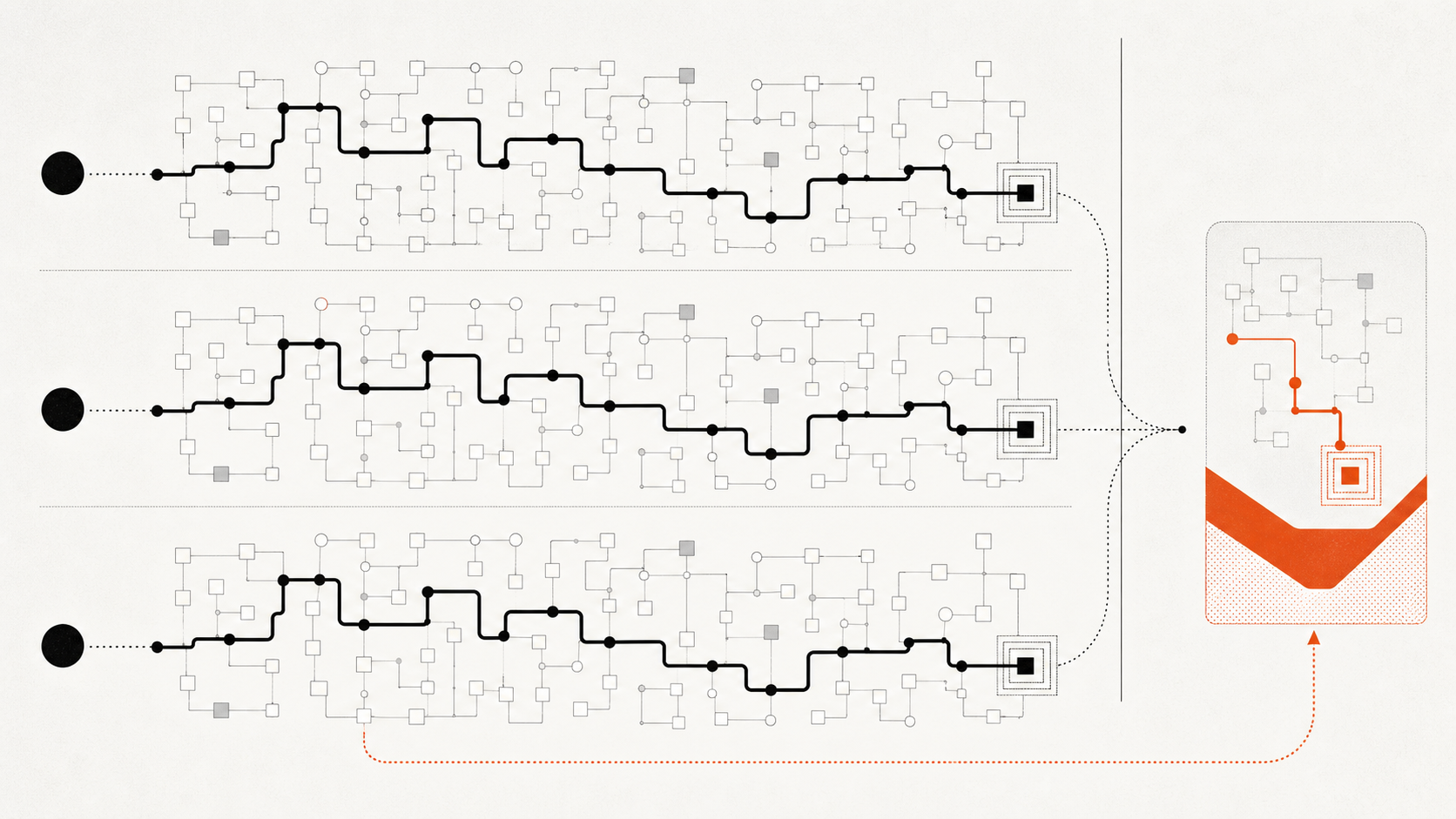
The problem becomes expensive when discovery restarts from the repository root. A broad text search can find exact names, but a task often arrives in behavioral language: “preserve the import contract,” “update every consumer,” or “find the test that protects this path.” The relevant code may use aliases, wrappers, dependency injection, generated clients, or a name that differs from the task wording. An agent can spend several iterations reconstructing the same relationships.
What Fresh Context Helps With
Fresh context can reduce attachment to a failed approach. The next iteration reads the current repository rather than relying on a long conversational narrative about what the repository used to contain. If the previous attempt changed code, tests, or the plan, the new iteration can inspect those artifacts directly. This supports Ralph’s core bias toward durable work products and executable feedback.
It also limits the amount of incidental discussion competing with the task. A concise specification, current source, and test result are usually better inputs than a transcript containing several abandoned hypotheses. For long-running work, that reset can improve attention and make the loop easier to inspect.
Useful Ralph repository context is therefore the smallest set of durable artifacts that lets the iteration verify the current task without inheriting every abandoned hypothesis.
But “fresh” is implementation-specific. The official Anthropic Ralph Loop plugin uses a Stop hook to continue inside the current Claude Code session. It does not create the same clean-process boundary as the snarktank script. Teams should document the actual reset boundary instead of assuming that the word Ralph guarantees one.
What Large Codebases Need Beyond Search
Large repositories need a compact structural orientation layer. At minimum, an iteration should be able to answer:
This is also why the phrase “Ralph loop GitHub” is ambiguous. Huntley’s pattern, snarktank’s shell scripts, Anthropic’s Claude Code plugin, and Ralph Orchestrator make different choices about process lifetime and persisted state. Treating one repository’s files as properties of every Ralph loop creates false assumptions before repository search even begins.
- Which module owns the behavior?
- Which public entry points reach it?
- Which modules depend on the symbols likely to change?
- Which tests, schemas, migrations, or generated artifacts constrain the edit?
- Which repository rules apply in this directory?
Text search remains part of the answer. ripgrep is a deterministic, line-oriented regular-expression search tool. Its default treatment of ignored, hidden, and binary files matters, and text matches alone do not encode call or dependency relationships. The safe conclusion is not that search is unreliable. It is that search has a defined retrieval model, and the task may require evidence outside that model.
Repository rules should also follow scope. An AGENTS.md file can carry instructions for a tree, with more deeply nested files taking precedence for their subdirectories, as described by the AGENTS.md specification. That is useful policy context, but it is different from code structure. Combining policy, architecture, task status, and observations into one undifferentiated note makes every layer harder to validate.
Where Code Graphs Fit the Loop
A code graph can serve as one possible repository-orientation layer. It can index modules, definitions, imports, calls, inheritance, and test relationships, then return a task-sized subgraph instead of a repository-wide dump. For example, an iteration changing an authentication interface could request the definition, direct and indirect consumers, related tests, and paths where the interface crosses a package boundary.
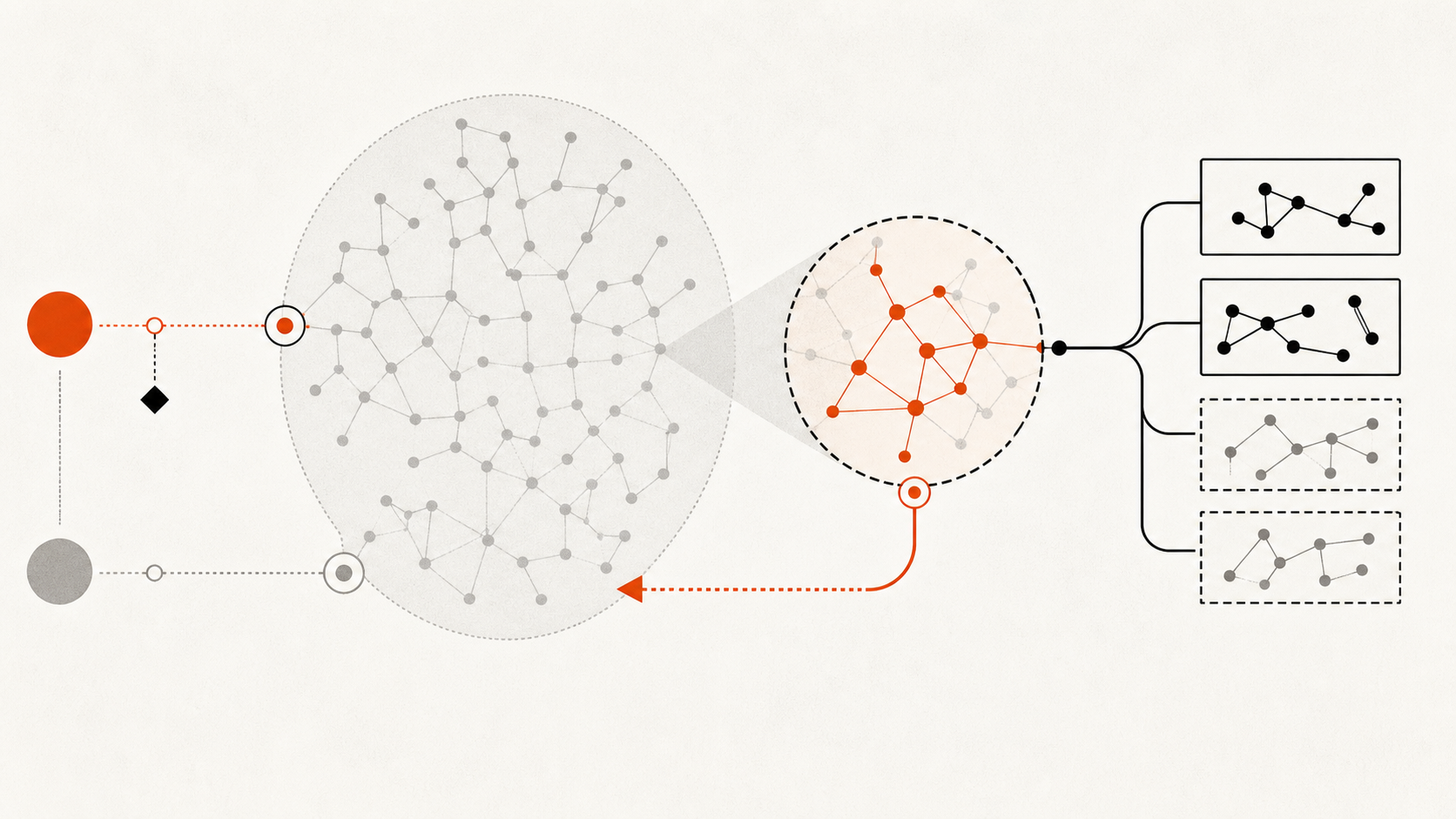
That result should be treated as candidate context, not truth. The agent still needs to open the cited files, confirm symbol resolution, and run the repository’s tests or static checks. Graph data can be stale, incomplete, or blind to dynamic behavior. It is most useful when every returned relationship includes provenance such as file path, symbol, commit SHA, and index version.
Graphify is one possible codebase graph layer for this role. The relevant product claim is modest: structure-aware retrieval may reduce repeated orientation work when a repository’s relationships are difficult to recover from isolated text matches. It does not make every repository easier, replace source inspection, or remove the need for backpressure.
This integration is an editorial extension to the Ralph pattern. Neither Huntley’s original loop nor the cited snarktank and Anthropic implementations include a native code-graph bridge. Claude Code can connect to external tools through MCP, but the existence and behavior of any graph service must be verified separately.
Limits and Verification Notes
The first limit is drift. A graph built at one commit can mislead an agent working at another. Pin retrieval to the active commit when possible, reject results with mismatched provenance, and rebuild or incrementally update the index after structural edits. If a relationship cannot be traced to current source, it should not authorize a change.
The second limit is task scope. Retrieving every caller in a monorepo can recreate the same context overload as reading the repository root. Queries should begin with the task’s expected behavior and write scope, then expand only when evidence exposes an additional dependency. The output needs ranking and boundaries, not merely more nodes.
The third limit is verification quality. Tests are backpressure, not a proof that the retrieved architecture is complete. Reviewers should ask which files were searched, which graph edges were followed, what assumptions remain, and whether generated or runtime-only relationships were inspected. A change that passes a narrow unit test can still violate an external contract.
Finally, teams should measure the orientation layer against real failures. Useful signals include repeated opening of the same files, missed consumers found in review, unnecessary full-repository scans, and stale results rejected by provenance checks. Those observations are more defensible than a generic promise of faster agents.
FAQ
What should persist between loops?
Persist durable task state, accepted repository rules, committed code, test results, and verified structural findings with provenance. Keep short-lived hypotheses separate. The exact files depend on the implementation: snarktank uses prd.json, Git, and progress.txt, while Huntley describes a plan file and repository artifacts. Do not treat those names as a universal Ralph contract.
Who reviews recovered architecture assumptions?
The agent should verify them against current source and tests first. A human reviewer or designated code owner should review assumptions that affect public interfaces, security boundaries, data models, migrations, or multiple teams. The review should cite paths and symbols so disagreement can be resolved from evidence rather than summaries.
When should search results be ignored?
Do not ignore them merely because they are incomplete. Treat them as one evidence source. Reject or qualify results when they come from the wrong commit, excluded paths, generated output that is not authoritative, ambiguous symbols, or an index with unknown freshness. Then use another retrieval method and inspect the source.
What is Ralph in AI coding?
Ralph is a development pattern in which an agent repeatedly works from a stable task or plan, changes the repository, and receives feedback from tests, builds, or other checks. Implementations differ in session lifetime, memory files, stopping conditions, and concurrency, so the name describes a family of loops rather than one fixed tool.
Conclusion
The central challenge in a Ralph Loop large codebase workflow is not preserving the entire previous conversation. It is recovering the smallest trustworthy slice of repository context for the next task. Fresh iterations help when durable artifacts and executable feedback carry the work forward, but they can waste time when architecture must be rediscovered from scratch.
Start with scoped text search, repository rules, current source, and tests. Add structure-aware retrieval when repeated failures show that relationships are the missing layer. Keep every result tied to current code, and let the loop expand context only when the task requires it. For the broader retrieval model, see knowledge graphs for AI coding assistants; for the state layers between iterations, see Ralph Loop memory.
Leave a Reply