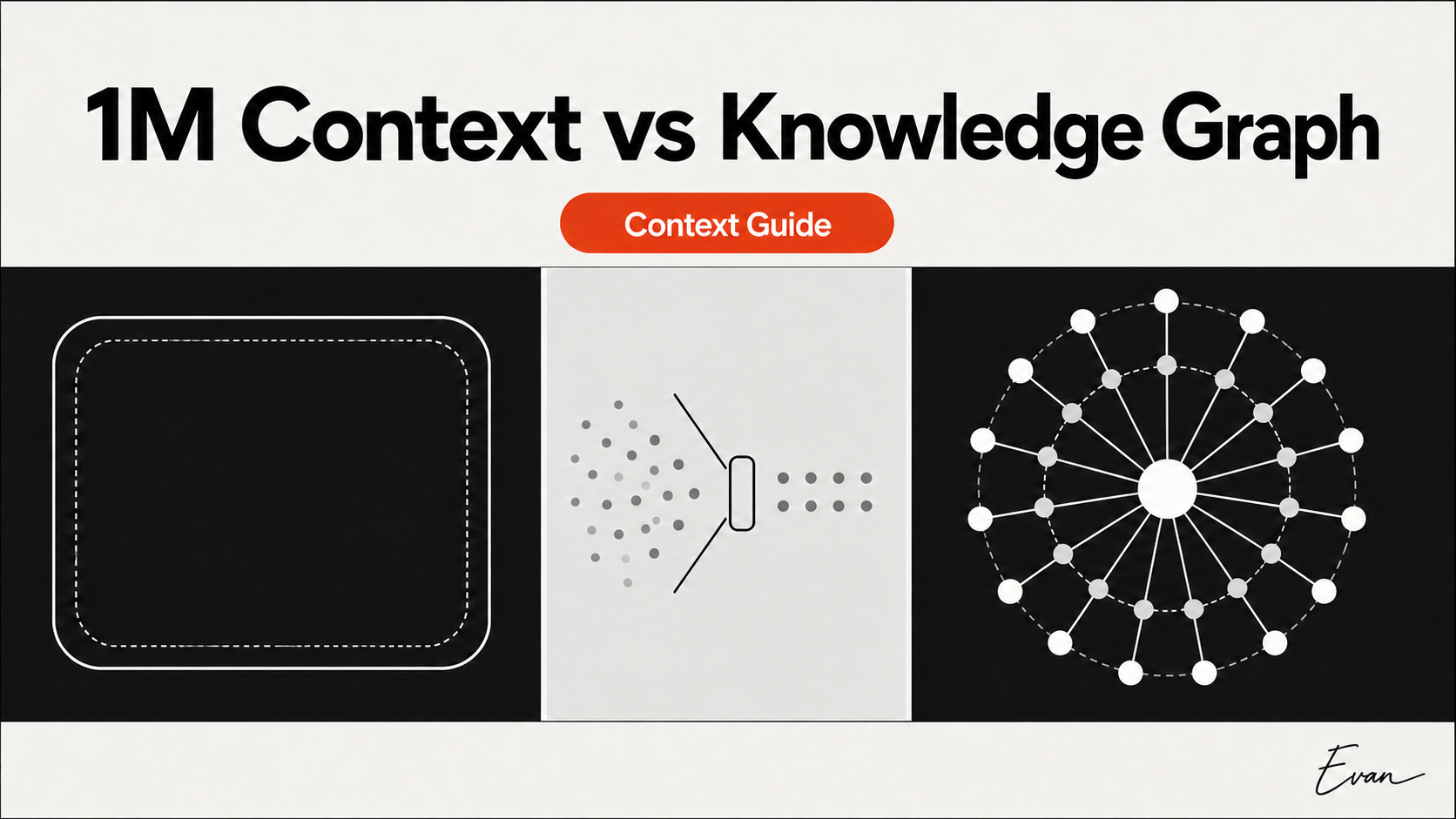
A one-million-token context window expands how much evidence a model can receive in one request; a code knowledge graph changes how repository evidence is selected and connected. Use long context for a bounded body of primary material, retrieval to select likely evidence, and a graph when the task depends on calls, imports, ownership, or other relationships. None of the three proves repository understanding on its own.
The practical question is not which technology wins. It is whether the workflow can locate current evidence, preserve the relationships that matter, and verify the answer against source and tests. That distinction prevents a large context limit from becoming an excuse to dump an entire repository into every prompt.
Quick Verdict
The safest default is a hybrid workflow: use a graph or other index to identify a bounded evidence neighborhood, then let a capable long-context model read the relevant source, tests, specifications, and task history together.
| Context method | What it changes | Strong fit | Main failure mode |
|---|---|---|---|
| 1M context | Maximum material available in one request | Dense review of a known set of files and documents | Important evidence is present but not used correctly |
| Lexical or semantic retrieval | Which chunks enter the prompt | Exact symbols, errors, concepts, and document search | The necessary chunk never enters top-K |
| Code knowledge graph | Which entities and relationships can be traversed | Impact paths, callers, imports, implementations, ownership | The graph is stale, incomplete, or contains a wrong inferred edge |
These layers answer different questions. Context capacity asks, “How much can the model receive?” Retrieval asks, “Which pieces look relevant?” A graph asks, “How are these entities connected?” AI repository understanding requires all three questions to be handled in proportion to the task.
For the adjacent distinction between human rules and generated structure, see AGENTS.md vs Knowledge Graph. The existing GLM-5.2 context-window comparison applies the same boundary to one model.
What 1M Context Helps With
A million-token window is a real current capability, but the exact number belongs to a specific model and surface. As verified on July 17, 2026, OpenAI documents 1,050,000 tokens for gpt-5.6-sol; Anthropic documents one million tokens for models including Claude Opus 4.8 and Claude Sonnet 5; Google documents a 1,048,576-token input limit for gemini-2.5-pro.
Those limits make several long context coding tasks more practical:
- comparing a specification with several implementations and their tests;
- reviewing a migration whose behavior spans code, schema, fixtures, and logs;
- keeping a long agent trajectory with tool results available for synthesis;
- reading a bounded subsystem without prematurely compressing every file;
- checking whether a patch satisfies several distributed constraints at once.
Long context is especially useful after the evidence set is known. If a team has already identified the authentication package, its callers, contract tests, relevant decision record, and deployment rule, one request can let the model reason across them without fragmenting the task into many disconnected summaries.
Capacity also reduces some retrieval pressure. A workflow can include more neighboring files and preserve more local detail instead of forcing a retriever to pick only a handful of chunks. Google’s long-context guidance nevertheless recommends omitting unnecessary tokens and notes that longer inputs generally increase time to first token. More room is useful; filling every available position is not the goal.
What Long Context Still Misses
Maximum input length is not the same as effective use of every token. A model may have the evidence and still miss its relevance, confuse two similar definitions, or fail to connect facts separated across modules.
Historical peer-reviewed evaluations explain why teams should test effective context rather than trust the limit alone:
- NoLiMa removed easy literal overlap between questions and hidden evidence. In its 2025 model set, performance degraded as context grew, showing that exact “needle” retrieval can overstate semantic long-context use.
- LongCodeU evaluated code-unit perception, within-unit understanding, cross-unit relationships, and documentation. Across its nine tested models, performance dropped sharply beyond 32K, and inter-code-unit relationships were the hardest category.
- RULER extended simple needle tests with multiple needles, multi-hop tracing, and aggregation, exposing performance gaps that a basic exact-retrieval test missed.
These results do not score the current 2026 models named above. They establish a better evaluation standard: a model’s published window is a capacity claim, while effective repository reasoning must be measured on the model version, prompt, tools, and codebase actually used.
A million token codebase dump also lacks automatic authority. Old generated files, vendored code, duplicated definitions, obsolete architecture notes, and irrelevant test fixtures can all fit beside current evidence. The model still needs revision boundaries, source priority, and a way to distinguish facts from hypotheses.
Retrieval vs Code Knowledge Graphs
Retrieval and graphs both reduce the evidence passed to the model, but they preserve different signals.
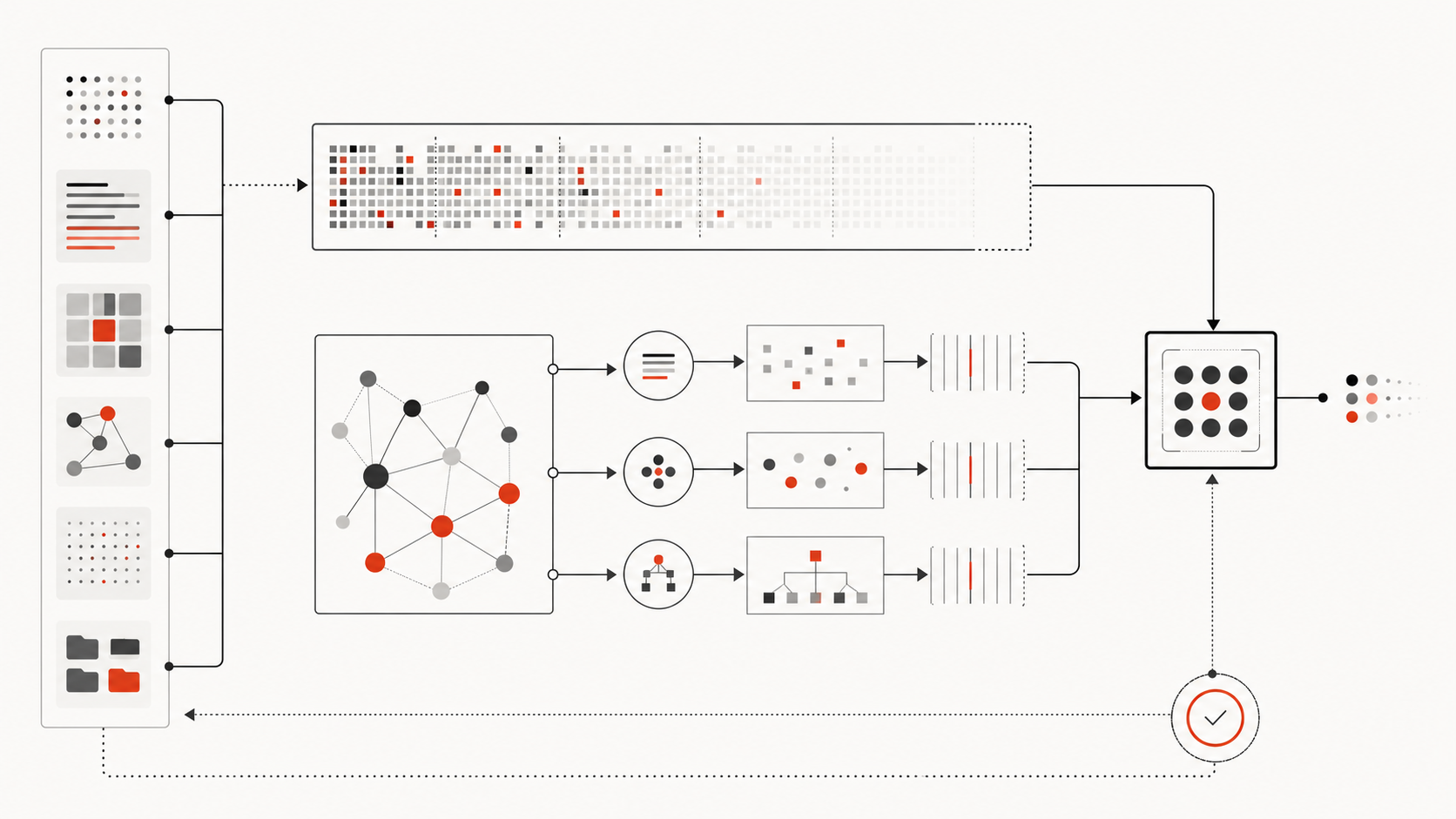
Lexical search is strong when the query contains an exact symbol, route, error code, or configuration key. Semantic retrieval can find conceptually similar text when vocabulary differs. Combining them improves coverage, but both usually return ranked chunks rather than an explicit dependency path.
Retrieval can fail before generation. Anthropic’s Contextual Retrieval report explains that ordinary chunking may remove the context needed to retrieve a passage. In its disclosed multi-domain evaluation, contextual embeddings, BM25, and reranking reduced top-20 retrieval failures, but did not remove them. Those percentages should not be transferred to a codebase or to Graphify; the durable lesson is that chunk boundaries, query wording, embedding choice, ranking, and top-K all affect recall.
A code knowledge graph instead represents entities such as files, symbols, APIs, tests, schemas, owners, and design documents, then connects them through typed edges. Peer-reviewed systems including RepoGraph and CodexGraph use repository graphs for navigation and structure-aware retrieval. Their results show that graph-guided context is a credible design pattern, not that every graph implementation wins on every repository.
Graphify documents a similar separation between deterministic and inferred evidence. Its AST pass emits structural relationships with provenance, while semantic relationships can be marked INFERRED or AMBIGUOUS. Its report and query artifacts can guide an agent toward current files, but Graphify does not replace raw-source inspection, tests, permissions, or human approval.
The useful pattern is therefore graph-selected raw context: traverse the likely impact path, open the source behind important nodes and edges, include the relevant evidence in the model window, and verify behavior.
Repository Tasks That Need Structure
Structure matters most when answering the task requires more than locating a matching string.
| Repository task | Evidence path that should be explicit |
|---|---|
| Change a shared schema | schema → generated clients → consumers → contract tests → deployment order |
| Replace an authentication method | entry points → middleware → policy checks → session storage → failure tests |
| Remove a public API | exports → callers → documentation → examples → downstream packages |
| Diagnose an intermittent job | scheduler → queue → handler → retry policy → state writes → telemetry |
| Split a package | imports → interfaces → ownership → build graph → release boundaries |
For these tasks, a flat repository dump may contain every relevant file while hiding why those files belong together. Retrieval may find the target symbol but miss a caller whose vocabulary differs. A graph can make the candidate path explicit, but dynamic registration, reflection, generated behavior, runtime configuration, and external consumers may still escape extraction.
Use a relationship-aware workflow:
- Pin the task to a commit and define the allowed repository scope.
- Query or inspect direct neighbors, multi-hop dependencies, related tests, and current owners.
- Open the raw source behind every high-impact relationship.
- Add the selected source, specifications, and test evidence to the working context.
- Mark dynamic or inferred paths as hypotheses.
- Run focused tests, broader contract checks, and owner review.
This workflow converts a graph from an attractive map into an auditable evidence selector.
Limits and Cost Trade-Offs
Every approach moves cost rather than eliminating it.
Long prompts consume input capacity, add latency, and may cost more under provider-specific rules. Repeatedly sending the same large evidence set can benefit from caching, but caching does not improve a poor selection. Retrieval adds indexing, query, and reranking work. A graph adds extraction, storage, query design, and refresh obligations.
Measure the whole workflow rather than one token number:
- answer or patch correctness on representative private tasks;
- coverage of the expected files, dependencies, and tests;
- false or unsupported relationship claims;
- uncached input, cached input, output, and reasoning tokens;
- tool calls and time to first useful result;
- index construction and refresh time;
- reviewer corrections and escaped regressions.
Graph freshness is a hard boundary. Record the repository commit or snapshot used to build the index. Refresh after symbol moves, public-contract changes, dependency rewiring, generator updates, and accepted structural patches. Verify high-impact graph edges against the current worktree.
A graph is unnecessary when the task is small, the evidence set is already known, relationships are shallow, and a direct source read plus focused tests is cheaper than maintaining an index. Conversely, a giant prompt is wasteful when repeated work begins by rediscovering the same architecture and dependency paths.
No universal break-even point exists. Run the full-context, retrieval, graph, and graph-plus-source variants on the same commit and tasks before standardizing a team workflow.
FAQ
Should teams index everything first?
No. Start with repositories or subsystems where repeated impact tracing and cross-file discovery create measurable review cost. Exclude generated, vendored, secret, or irrelevant material deliberately. Expand coverage only when missed relationships justify the additional indexing and refresh burden.
How should context costs be measured?
Record the exact model ID, date, prompt size, cache status, reasoning setting, output tokens, tool calls, latency, and index-refresh work. Pair those numbers with correctness, evidence coverage, and reviewer corrections. A cheap wrong patch or an expensive correct summary is not a useful comparison by itself.
When is a graph layer unnecessary?
Skip it for a small, stable project; a single-file task; a known evidence packet; or an occasional question answerable through exact search and tests. Add a graph when structural queries recur, relationships span many modules or artifacts, and the team can keep the index aligned with the source revision.
Conclusion
The 1M context vs knowledge graph decision is not a choice between “reading everything” and “using structure.” Long context supplies working capacity. Retrieval selects likely evidence. A code knowledge graph preserves navigable relationships. Current source and tests determine whether the resulting claim is true.
Use a long window directly when the evidence is bounded and already known. Add retrieval when the corpus is larger than the task. Add a graph when repeated work depends on multi-hop structure. For high-impact repository changes, let the graph select candidates, let the model read the underlying evidence, and let tests and responsible owners approve the result.
Leave a Reply