GPT-5.6 Sol is an officially available frontier model with a 1.05-million-token context window and strong vendor-reported coding-agent results. Switching to it may improve planning, persistence, tool use, and implementation. It still does not arrive knowing a private repository’s architecture, dependency rules, ownership, deployment constraints, or design history.
A model change can raise the ceiling of a coding workflow. Reliable repository understanding still depends on the evidence and verification system surrounding the model.
Why Users Switch Models for Codebase Tasks
Developers usually switch coding models after encountering a repeated workflow failure: the agent loses track of a long task, misses a related file, produces a plausible but incomplete refactor, consumes too many tokens, or needs too much steering.
GPT-5.6 Sol is relevant because OpenAI positions it as the flagship tier of the GPT-5.6 family. The official API page lists gpt-5.6-sol as the model ID, with the gpt-5.6 alias routing to Sol. It supports a 1,050,000-token context window and up to 128,000 output tokens.
OpenAI announced general availability on July 9, 2026 across ChatGPT, Codex, and the API, with plan and workspace eligibility differences. Developers should verify that their account, Codex version, model selection, and reasoning setting match the intended trial.
Those specifications make a switch attractive for:
- long-running implementation and debugging;
- multi-file changes with substantial source evidence;
- tool-heavy workflows that search, edit, build, and test;
- tasks where a larger working context delays compaction;
- teams seeking a different capability, latency, or cost profile.
The switch should begin with a hypothesis, such as “Sol reduces missed cross-module dependencies in our migration tasks,” rather than the vague expectation that a stronger model will understand the repository automatically.
Keep the previous model as a control during that trial. Run identical repository tasks from clean sessions, provide the same tools and evidence, and compare navigation errors, dependency omissions, verification behavior, latency, and total cost—not just whether the final patch appears plausible.
What a Better Model Can Improve
OpenAI describes GPT-5.6 Sol as its best coding model at launch and reports results on coding-agent evaluations that include real codebases, terminal workflows, and long-horizon engineering.
In OpenAI’s launch table, Sol scores 64.6% on SWE-Bench Pro, 72.7% on DeepSWE v1.1, and 88.8% on Terminal-Bench 2.1. OpenAI also reports 91.9% for Sol Ultra on Terminal-Bench 2.1. These are vendor-reported results and belong to the stated model settings and evaluation harnesses; they are evidence of intended capability, not guarantees for a private repository.
In practice, a better coding model may improve:
- decomposition of a broad request into testable steps;
- persistence across long tool trajectories;
- selection and coordination of terminal tools;
- interpretation of test failures;
- consistency across related edits;
- review of its own patch before handoff.
The large context window can retain more source, documentation, tool output, and intermediate decisions. Programmatic tool coordination can also reduce the need to pass every intermediate result through the model unchanged.
However, OpenAI’s own long-context results show why capacity is not perfect retrieval. Its launch page reports 73.8% on an eight-needle MRCR evaluation spanning 512K to 1M tokens and 77.1 F1 on GraphWalks BFS at one million tokens. Those are not repository benchmarks, but they demonstrate that accepting a long input does not imply flawless use of everything inside it.
What It Still Does Not Know About Your Repo
GPT-5.6 Sol does not know private facts that are absent from its prompt, tools, or repository. It also cannot reliably infer every convention from code alone.
Important missing knowledge may include:
- which team owns a shared API;
- which package boundary is intentional;
- which generated files are overwritten by CI;
- which downstream service consumes an event;
- which feature flag controls a production path;
- why an earlier implementation was rejected;
- which migration order avoids a compatibility break;
- which tests are known to be incomplete.
A repository can contain contradictory signals. A stale README may disagree with current code. A test can encode legacy behavior. A comment can describe an abandoned plan. A broad context dump gives the model all three without identifying authority.
The model also sees only the repository and external systems it is permitted to inspect. Cross-repository consumers, production configuration, private runbooks, and unwritten operational knowledge remain outside its view unless the workflow exposes them.
This is why Claude Code repository context and Codex context engineering should focus on evidence organization, not only model selection.
Structured Knowledge vs Raw Prompt Context
Raw prompt context is task-local working memory. Structured repository knowledge is reusable navigation and policy.
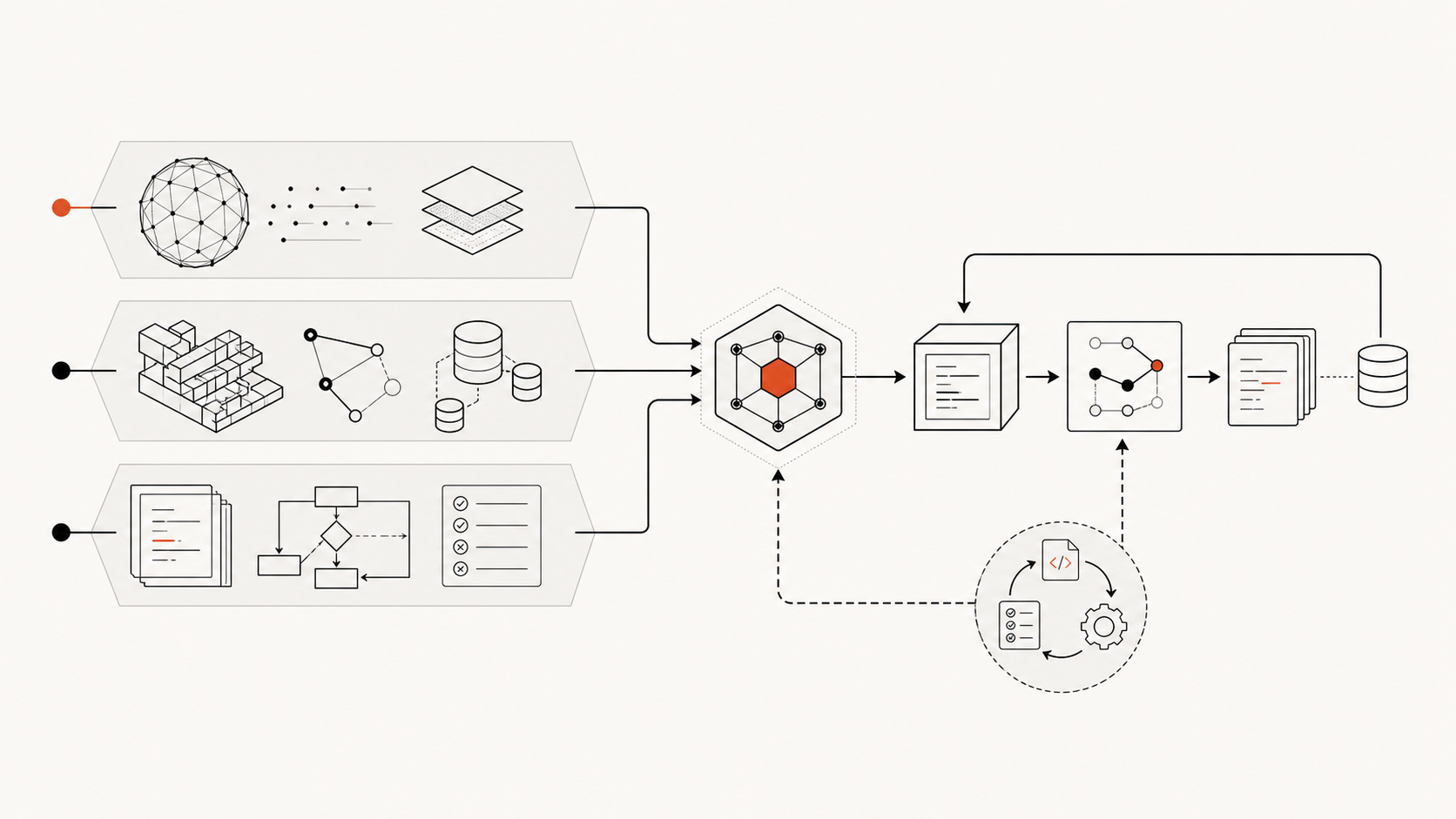
A robust workflow can separate the layers:
| Knowledge layer | Example | Update pattern |
|---|---|---|
| Task context | issue, plan, inspected code, test output | every run |
| Repository map | modules, entry points, build and test commands | on structural change |
| Code graph | callers, dependencies, schemas, tests, owners | indexed after accepted changes |
| Architecture record | boundaries, decisions, rejected alternatives | human-reviewed |
| Verification | hidden tests, regression suite, CI, review | every change |
The model should use structured knowledge to locate relevant evidence, then inspect the current source. A graph edge that says service A consumes schema B is useful for impact analysis, but the source and runtime configuration should verify the relationship.
This design protects repository memory from model churn. Teams can replace GPT-5.6 Sol with another model without rewriting the architecture map or losing indexed dependency relationships. Conversely, the model’s large context remains valuable for reasoning over the selected code and current trajectory.
Structured context can also reduce prompt waste. Instead of loading an entire monorepo, the agent can query the affected entities, follow dependency paths, and retrieve a task-specific evidence set.
Verification and Risk Notes
Evaluate GPT-5.6 Sol on private tasks that represent the repository and risk level. Public coding benchmarks are useful for orientation, but their task quality and contamination must be considered.
OpenAI stopped recommending SWE-bench Verified for frontier comparisons after finding flawed tests and contamination. In July 2026, OpenAI also estimated that roughly 30% of SWE-Bench Pro tasks were broken. The responsible conclusion is not that benchmarks have no value. It is that teams need auditable task design and more than one measurement.
For a model trial:
- freeze the repository commit and execution environment;
- select localized, cross-module, refactor, CI, and impact-analysis tasks;
- hide acceptance and regression tests from the agent;
- keep model, reasoning, tool, network, timeout, and permission settings constant;
- run multiple independent trials;
- retain trajectories, patches, test output, latency, tokens, and cost;
- review missed dependencies, unnecessary edits, policy violations, and grader gaming.
Compare the new model with the current default using the same harness. A higher pass rate can still hide larger diffs, more review work, or unacceptable regressions. Conversely, a model that solves fewer benchmark-like tasks may be better on your architecture-specific workload.
Require dependency review for changes that cross packages or services, modify public contracts, alter persistence or security behavior, introduce dependencies, or depend on relationships not enforced by tests.
FAQ
What repo knowledge should survive model changes?
Keep architecture maps, ownership, public contracts, build and test commands, dependency relationships, decision records, generated-file rules, operational constraints, and known test gaps outside model-specific prompts. Version them with the repository or a governed knowledge system.
How should teams test a new coding model?
Run the current and candidate models against the same frozen private tasks with identical permissions and tools. Repeat trials and compare correctness, regressions, dependency coverage, diff size, human steering, review time, latency, tokens, and total cost.
When should outputs require dependency review?
Require it when an edit changes a shared type, API, event, schema, package boundary, deployment order, security control, or external integration. Also require it when the agent cannot produce evidence for every identified downstream consumer.
Conclusion
GPT-5.6 Sol can materially improve a coding-agent workflow. Its official context size, tool support, and vendor-reported results justify testing it on demanding codebase tasks.
The model is still one layer of repository understanding. Preserve architecture and dependency knowledge outside the prompt, retrieve current source for each task, and verify every consequential change with tests and review. Switch models when the measured end-to-end workflow improves—not when the model name or context number changes.
Leave a Reply